

On this page
Connect a standard red LED straight to a 9-volt battery, and it will likely flash brightly for a fraction of a second before dying. A 9 V battery provides far more voltage than the LED can handle, and unlike a simple wire, the LED cannot regulate the resulting flood of current.
The reason lies in the physics of semiconductors. To understand why components fail—and how to prevent it—we have to look at the relationship between voltage and current.
Why does an LED need a resistor?
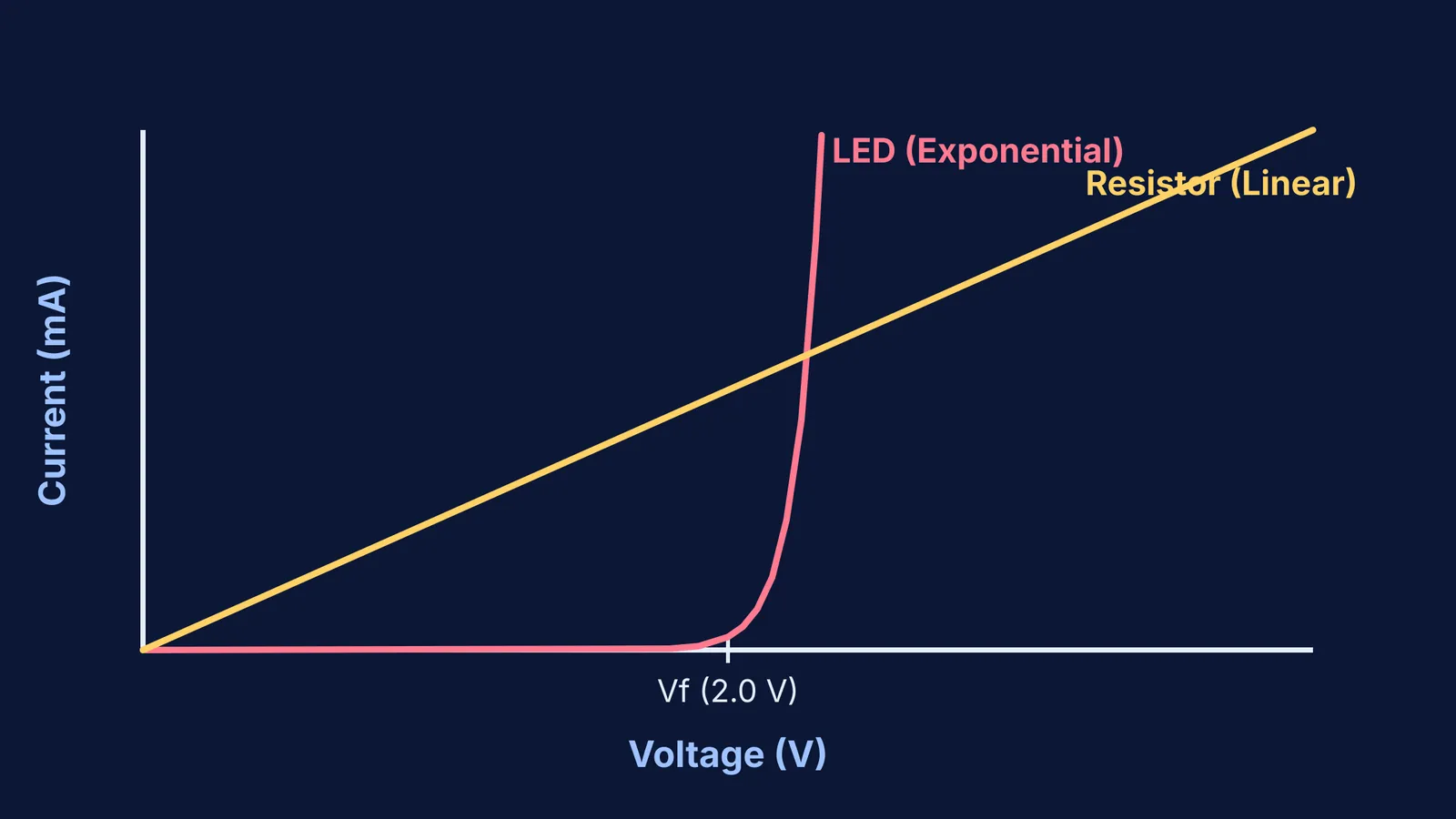
An LED (light-emitting diode) is not an ohmic device. While a standard resistor obeys Ohm's law, meaning the current rises linearly and predictably as you turn up the voltage, an LED is a p-n junction governed by the Shockley diode equation (Wikipedia). A standard resistor dissipates power safely as heat across a wide range of voltages, proportional to the square of the voltage. An LED, however, is designed to emit light, not to dissipate large amounts of thermal energy.
Once the applied voltage reaches the LED's forward voltage—about 1.8 V to 2.0 V for a red LED—the potential barrier inside the semiconductor drops. After this threshold, the current does not rise in a straight line; it shoots up exponentially. Because of this exponential relationship, a tiny increase in voltage of just 0.1 V (100 mV) can multiply the current by a factor of up to 48 (Wikipedia).
Without a series resistor to choke this flow, the LED draws too much power and overheats. Semiconductors have a negative temperature coefficient, meaning that as the LED gets hotter, the voltage drop across it actually decreases. This lower barrier draws even more current from the battery, generating more heat, until the LED destroys itself in a destructive cycle called thermal runaway.
How to calculate the series resistor?
To safely operate an LED from a 9 V battery, you must add a series resistor to absorb the excess voltage. The resistor acts as a linear ballast, keeping the circuit stable and the current in check across different conditions.
Choosing the right resistor value is a balancing act. If the resistance is too low, the LED will draw more current than it can handle, shortening its lifespan or causing immediate failure. If the resistance is too high, the current will be choked too much, and the LED will appear very dim or might not light up at all.
Here is how to calculate the exact resistance needed for a perfect balance:
Identify the supply voltage (Vs): For a standard block battery, this is 9 V.
Find the LED's forward voltage (Vf): We will use 2 V for a typical red LED.
Choose the safe current (I): Standard 5 mm LEDs typically operate safely at 15 to 20 mA, which is 0.02 A (Wikipedia).
The resistor must drop the remaining voltage in the circuit. Voltage to drop = 9 V − 2 V = 7 V. Using Ohm's law (R = V / I), the required resistance is 7 V / 0.02 A = 350 Ω. In practice, you would use the closest standard value, such as a 330 Ω or 390 Ω resistor, depending on whether you prefer a slightly brighter or slightly safer operation.
Visualising circuit limits
If you are designing circuits for a project or studying for exams, seeing how voltage and current interact can save both your components and your time. The Simulation Lab offers interactive simulations for the ideas that are easier to see than to read, allowing you to watch the current spike when a resistor is omitted.
If you are exploring Photodiode, LED and solar cell I-V curves for JEE Main or comparing Energy bands: conductors, semiconductors and insulators, Fermi's AI tutor can work out what you already know and build a plan for the session, guiding you through the physics behind the formulas.


