

On this page
In a semiconductor, an empty space can carry an electric current. For many students preparing for their exams, this is a difficult idea to accept. How can a void act as a moving particle?
To make sense of semiconductor electronics, we have to look closely at the crystal lattice and understand how a missing electron behaves just like a positively charged particle.
What is a hole in a semiconductor?
In a pure silicon crystal, every atom is bonded to its four neighbours by sharing valence electrons. At absolute zero temperature, all these electrons are locked tightly in their covalent bonds, making the crystal a perfect insulator.
However, at room temperature, thermal energy constantly shakes the lattice. Occasionally, an electron gains enough energy to break free from its bond and become a mobile conduction electron. The empty space it leaves behind in the covalent bond is called an electron hole. In the words of Wikipedia, an electron hole is a "quasiparticle denoting the lack of an electron at a position where one could exist in an atom or atomic lattice".
Because a normal silicon atom is electrically neutral, losing a negative electron leaves that local region with a net positive charge. This means the hole behaves as if it has a positive charge equal and opposite to the electron's charge.
How does a hole move?
Even though a hole is technically just an empty space, it is fully capable of moving through the crystal.
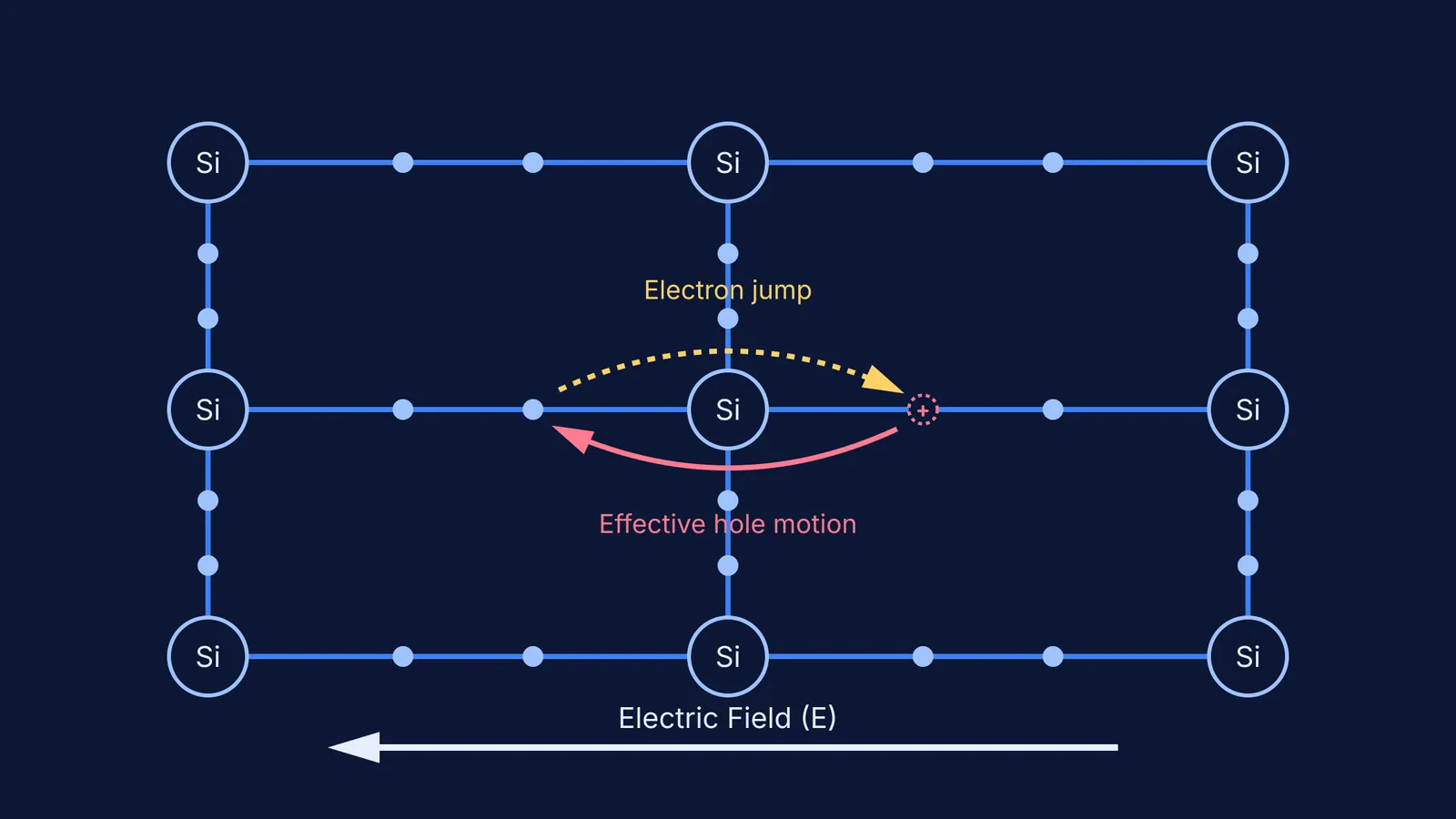
When an electric field is applied across the semiconductor, it exerts a force on all the valence electrons. An electron from a neighbouring, intact bond can easily jump over to fill the hole. As soon as it does, it leaves a new hole behind in its previous position.
While the negatively charged electron hopped in one direction, the positively charged hole effectively moved in the opposite direction. Because the hole constantly moves in the direction of the applied electric field, it acts as a mobile positive charge carrier.
Holes vs electrons in a circuit
Both free electrons (in the conduction band) and holes (in the valence band) contribute to the overall electrical conductivity of the material. Before diving into more complex devices, it helps to review how these energy bands separate materials, which you can explore in our guide on Energy bands: conductors, semiconductors and insulators compared.
When you calculate the total current flowing through a semiconductor, you must add the separate contributions of both carriers: I = I_e + I_h
Because electrons are pushed opposite to the electric field and holes are pushed along the electric field, their resulting charge flows work together in the exact same direction. However, they do not move at the same speed. A free electron moves smoothly through the empty conduction band, whereas a hole moves through a series of discrete electron hops between bonds, which is naturally a slower and more constrained process.
How do you solve semiconductor carrier questions?
When answering exam questions about charge carriers, use this step-by-step checklist to avoid common mistakes:
Identify the majority carrier: In pure (intrinsic) semiconductors, the number of electrons exactly equals the number of holes. In doped p-type materials, holes are the dominant majority carriers. You can practise finding the exact numbers with our walkthrough on n-type and p-type semiconductors: carrier concentration problems.
Assign the force direction: The force on a free electron is always opposite to the electric field E. The force on a hole is always in the direction of E.
Check the current addition: Both carrier movements create a current flowing in the direction of E. Never subtract them unless they are moving in the same physical direction, which does not happen in a simple applied field.
If you are struggling to picture this electron-hopping mechanism, the Fermi Concept Library has every concept in physics, chemistry, biology, mathematics and computing, each with its own lesson and its place in the map. It helps turn abstract definitions into clear, working knowledge so you can tackle exam numericals with confidence.


