On this page
Most of us meet Newton's prism in a Class 10 diagram: white light goes in, a band of colours comes out. The more telling experiment came next. Newton took one colour from that band, sent it through a second prism, and watched. The answer settled what colour is.
What did Newton see with his first prism?
Newton described his work in a letter published in the Royal Society's *Philosophical Transactions* in 1672 (Crossref record, vol. 6, pp. 3075-3087). He writes that at the beginning of 1666 he "procured me a Triangular glass-Prisme", darkened his room and let sunlight in through "a small hole in my window-shuts" (full text at The Newton Project).
By the accepted laws of refraction he expected a circular patch of colour, and he "became surprised to see them in an oblong form". The length was "about five times greater" than the breadth (Newton, 1672).
So either the glass was creating colours and smearing the light, or sunlight already held rays that bend by different amounts. He needed a test to tell them apart.
What was Newton's crucial experiment with two prisms?
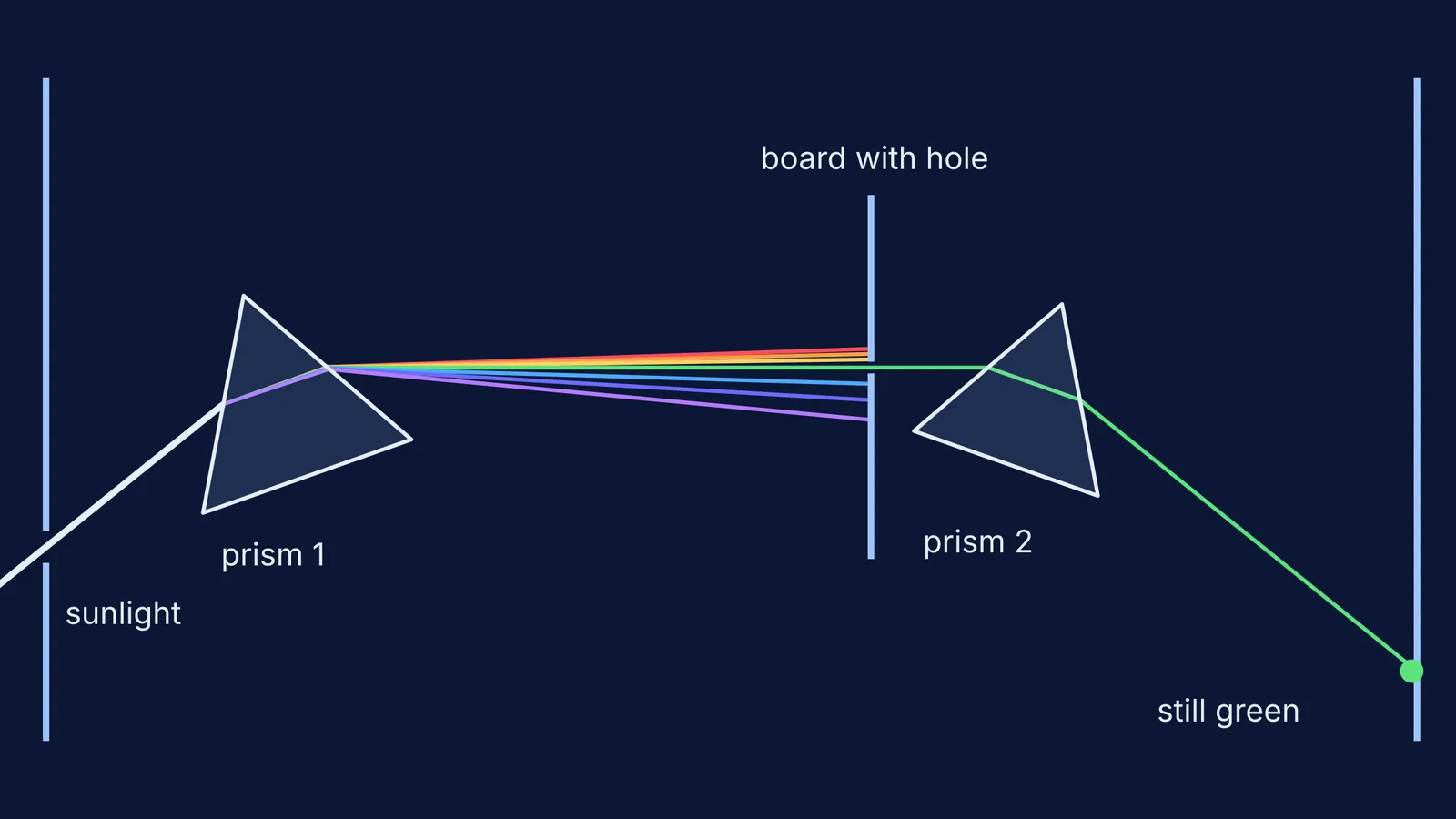
He called it the *Experimentum Crucis*, the crucial experiment: "The gradual removal of these suspitions, at length led me to the Experimentum Crucis" (Newton, 1672). The setup, in his order:
Sunlight passes through the first prism and spreads into a band of colours.
A board close behind that prism has a small hole, so only a narrow beam goes on.
A second board, "at about 12 feet distance", also has a small hole, so only one part of the band gets through.
A second prism behind that board refracts this light again before it reaches the wall.
Turning the first prism "to and fro slowly about its Axis" moved each part of the band in turn onto the hole.
The light from the end of the band that the first prism bent most, the violet end, "did in the second Prisme suffer a Refraction considerably greater then the light tending to the other end" (Newton, 1672). Each colour bent by its own fixed amount.
Nor did the colour change. Later in the same letter Newton says a separated sort of ray "obstinately retained its colour": he refracted it with prisms "and yet could never produce any new colour out of it" (Newton, 1672).
Why does this prove white light is a mixture?
Newton's conclusion: "Light consists of Rays differently refrangible" (Newton, 1672). "Refrangible" means able to be refracted. Colours, he wrote, are "Original and connate properties" of the rays, and white is "ever compounded" of all the primary colours "mixed in a due proportion".
Today we call this dispersion. NCERT's Class 10 Science chapter *The Human Eye and the Colourful World* puts it in one line: "The splitting of light into its component colours is called dispersion" (NCERT, section 10.4). The same chapter says red bends the least and violet the most, just as Newton saw.
See also why a prism disperses light but a glass slab does not.
The result also changed Newton's own work. He left off grinding telescope lenses because "Light it self is a Heterogeneous mixture of differently refrangible Rays" (Newton, 1672), and turned to mirrors instead: the road to his reflecting telescope of 1668.
Is this the same as the NCERT two-prism experiment?
No, though the two are easy to mix up. In the NCERT version, a second identical prism is placed upside down so all the colours pass through it, and white light comes out (NCERT, Fig. 10.6). That shows recombination.
The Experimentum Crucis adds a board with a hole that lets through only one part of the band. It shows a separated colour is not split further. Recombination shows white is made of colours; the crucial experiment shows each colour is basic and not made by the glass. For another way to recombine colours, see why a spinning Newton's colour disc looks white.
How do you explain it in an exam answer?
Use this four-step frame:
Setup: sunlight, first prism, a board with a hole that passes one colour, a second prism.
Observation: the single colour bends again but stays the same colour; violet bends more than red.
Conclusion: the prism does not create colour; white light is a mixture of colours that refract by different amounts.
Name it: this separation is dispersion. Add one labelled ray diagram.
Then cover your notes and explain to someone at home why the second prism gives no new colours. If you stall at "why", that is the gap to fix.
This experiment is about turning a prism and watching where each colour lands, which a printed diagram cannot show. The Fermi Simulation Lab has interactive simulations for ideas that are easier to see than to read, and the Fermi Concept Library covers every concept in physics, each with its own lesson.