

On this page
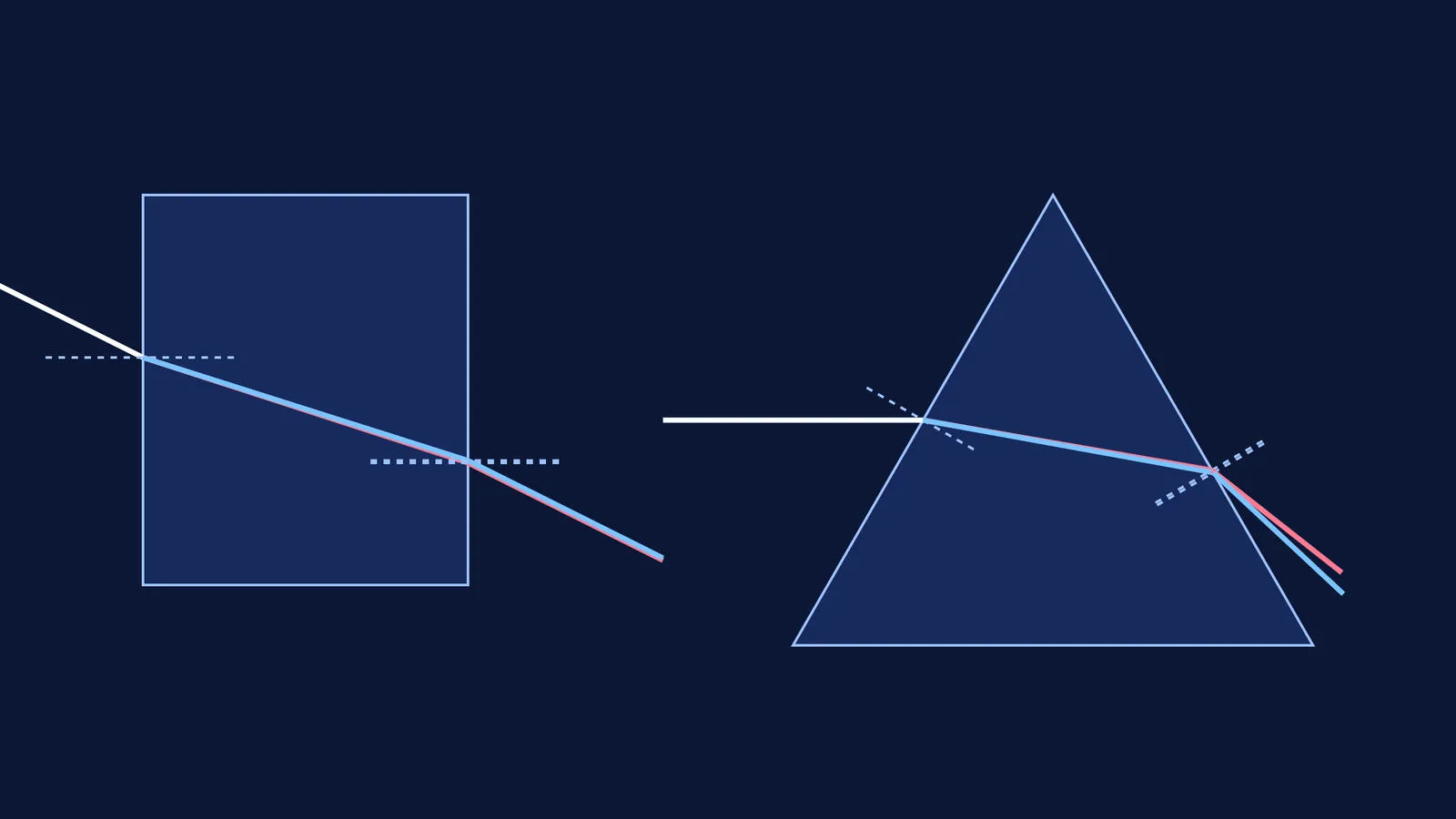
If you shine white light through a triangular glass prism, it immediately spreads into a brilliant rainbow of colours on the opposite wall. Yet, sunlight streaming through a rectangular glass window pane stays perfectly white, casting a uniform glow across the room. Since both objects are made of standard glass and rely on the exact same principles of refraction, this drastic difference in behaviour often confuses students studying geometric optics. The answer to this puzzle lies entirely in the geometry of their refracting surfaces and how sequential refractions interact with one another.
Why does a prism disperse light?
To understand dispersion, you have to look at how light behaves when it enters a new medium. Dispersion is the phenomenon where the index of refraction of a material varies with the wavelength (or colour) of light.
When white light enters a prism, the different colours travel at different speeds. Blue and violet light have a higher index of refraction and travel more slowly, which causes them to bend more sharply towards the normal. Red light travels faster and bends less. Different types of crown glass have refractive indices ranging from 1.50 to 1.62, and for any specific piece, the index changes measurably across the visible spectrum.
Because a prism is triangular, its entry and exit faces are inclined relative to each other. When the slightly separated colours hit the exit face, they are refracted a second time. This second bend increases the separation instead of cancelling it out. The rays emerge travelling in different directions (an angular separation), and they continue to spread apart as they travel, creating a visible spectrum. You can see how this geometry affects the total bending in our guide to the deviation vs incidence graph practical.
Why does a glass slab not disperse light?
The defining feature of a glass slab is that its entry and exit faces are perfectly parallel. When white light enters the first face, it does exactly what it does in a prism: it splits into its constituent colours because of the varying index of refraction.
However, the light then reaches the second, parallel face. Because the surfaces are perfectly parallel, the angle of incidence at the second face perfectly mirrors the angle of refraction at the first. When the light exits the slab, it bends back by the exact same amount, but in the opposite direction.
The second refraction perfectly undoes the angular separation of the first. As a result, all the colours emerge strictly parallel to each other and parallel to the original incident beam.
Does a glass slab produce a spectrum inside?
Yes, dispersion truly happens inside the slab. The individual colours travel on slightly different paths through the glass. When they finally emerge, the red ray and the blue ray are separated by a tiny spatial gap known as a lateral shift or lateral displacement.
For a standard laboratory glass slab, this lateral shift is very small. Because the coloured rays are strictly parallel and so tightly packed together, the human eye cannot resolve them as distinct colours. They overlap completely on the retina, and your brain simply processes the recombined light as bright white. If you want to see this setup in action, read our walkthrough on tracing a ray through a glass slab.
Concepts like internal splitting and spatial overlapping can be hard to picture from static text alone. The Fermi Concept Library holds every concept in physics, chemistry, biology, mathematics and computing, each with its own lesson and its place in the map.
How do you calculate the path through a slab?
When solving optics numericals for exams like JEE or NEET, a common mistake is forgetting that the emergent ray must be strictly parallel to the incident ray. If your final calculated angle differs from your starting angle, you know a mistake has been made in the geometry. Here is a reliable, step-by-step framework to keep your calculations on track and prevent errors:
Apply Snell's Law at the entry boundary: Use the formula n₁ sin θ₁ = n₂ sin θ₂ to find the angle of refraction inside the glass. Always measure your angles relative to the perpendicular normal line, not the surface of the glass itself.
Transfer the angle using alternate interior angles: Because the entry and exit faces of the slab are parallel, the normal line drawn at the exit face is strictly parallel to the normal line at the entry face. This means the angle of incidence at the second boundary is exactly equal to the angle of refraction you just calculated.
Apply Snell's Law at the exit boundary: Calculate the final emergent angle using the same law. Because you are transferring back into the original medium (like air), your final calculation should mathematically prove that the emergent angle equals your original incident angle θ₁.
Calculate the lateral shift: This is the perpendicular distance between the original incident path and the actual emergent path. Use trigonometric relationships based on the slab's thickness and the difference between the incident and refracted angles.
The Fermi Problem Library has worked problems with a step-by-step solver that explains the reasoning rather than printing an answer. This helps you build the habit of checking for parallel emergence before you finish the problem and move on to the next question.


