

On this page
If you have ever stared at a bright light and looked away, only to see a lingering spot in your vision, you have experienced a hint of how our eyes blend images. This phenomenon is the secret behind the Newton colour disc—a simple activity that proves white light is not empty, but rather packed with colour.
What is the Newton colour disc activity?
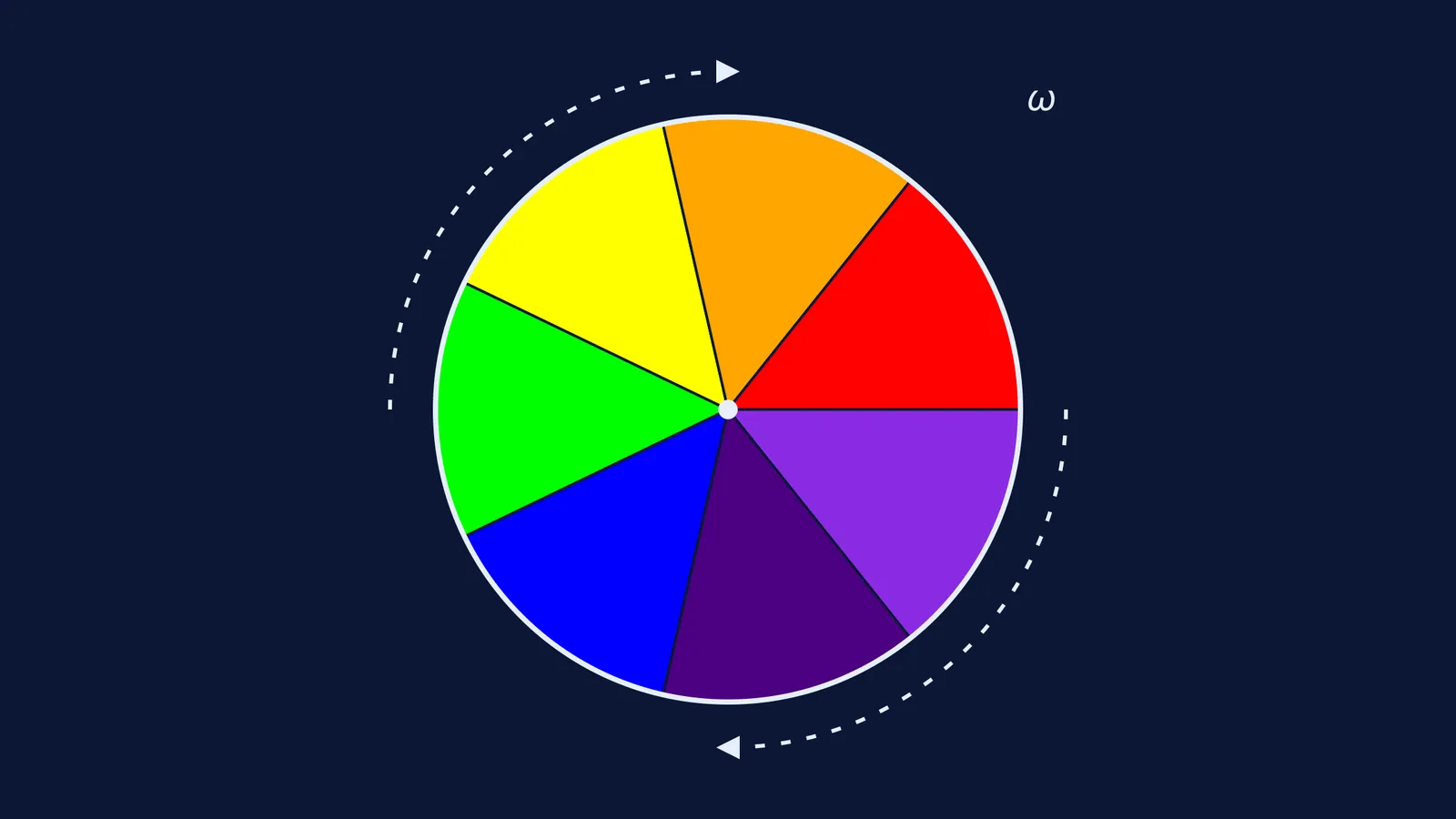
The Newton disc is a classic science experiment originally devised by Isaac Newton to demonstrate the composition of light. It consists of a cardboard circle divided into seven equal pie slices, each painted with one of the colours of the visible spectrum: red, orange, yellow, green, blue, indigo and violet (VIBGYOR).
When you spin this disc very fast on a string or a pencil, the individual colours vanish. In their place, the entire disc appears to be a uniform white or light grey. A glass prism splits a beam of white light into its seven constituent colours—a process you can read more about in our guide to the dispersion of white light by a glass prism—but the Newton disc does exactly the opposite. It takes the divided colours and recombines them before your very eyes.
Why does the disc appear white?
The optical illusion relies on a biological quirk of the human eye. When light strikes your retina, the image it forms does not disappear the exact millisecond the light source stops. Instead, the visual impression lingers on the retina for a fraction of a second—historically measured as roughly 0.13 seconds, as outlined in Wikipedia's guide to persistence of vision.
Because the disc spins so quickly, the seven painted colours sweep past your eye much faster than this persistence window. Before the impression of the red sector fades from your retina, the orange, yellow and all the subsequent colours have already arrived. Your brain cannot process them as separate, sequential flashes of colour.
Instead, your brain receives all seven colours simultaneously and performs what physicists call additive color mixing. When all the colours of the visible spectrum are added together as light, the resulting mixture is perceived by the human eye as pure white.
Additive vs subtractive mixing: why doesn't it turn black?
If you have ever mixed all your paints together on a palette, you know the result is usually a muddy brown or black, not white. This is because mixing physical paints is subtractive. Each paint absorbs (subtracts) certain wavelengths of light. Mix them all, and they absorb almost everything, leaving no light to bounce back to your eye.
The Newton disc is different. You are not mixing the pigments on the paper; you are mixing the light reflecting off them inside your eye. Because the eye adds the light from the red sector to the light from the green and blue sectors as they blur together, this is an additive process.
What does this prove about white light?
The Newton disc activity is the definitive proof that white light is a mixture. For centuries, people believed white light was fundamental and pure, and that colours were created by adding "impurities" or shadows to it. Newton's experiments, including the spinning disc, proved that white light is actually a combination of the entire visible spectrum.
If you ever find yourself struggling to visualise how these colours overlap, or if you want to explore more optical phenomena, the Concept Library holds interactive lessons on light and vision for every concept in physics, chemistry, biology, mathematics and computing. If you get stuck on a homework problem, Fermi's AI tutor can work out what you already know and build a plan for the session to help you master it.
Whether you are looking at the twinkling stars caused by atmospheric refraction or the screen of your phone (which uses additive mixing of microscopic red, green and blue pixels), the rules of light govern everything you see. Understanding the Newton disc is your first step toward mastering them.


