On this page
If you have counted electrons around a metal and landed on 36, you have used an idea from Nevil Sidgwick. Two of his tools are still in your textbook: the effective atomic number (EAN) rule for complexes, and the electron-pair picture of molecular shape.
Who was Nevil Sidgwick?
Sidgwick was born in Oxford on 8 May 1873 and died there on 15 March 1952, according to his Wikipedia biography, which draws on the Royal Society memoir by Henry Tizard (1954). He took firsts in natural science (1895) and classics (1897), a rare double.
From October 1901 he was a Fellow of Lincoln College, Oxford, for the rest of his life. He was elected a Fellow of the Royal Society in 1922 and won its Royal Medal in 1937. His book *The Electronic Theory of Valency* appeared in 1927, and *The Chemical Elements and their Compounds* in 1950.
What is Sidgwick's effective atomic number rule?
The EAN rule, also called the Sidgwick rule, says that a metal in a coordination compound tends to gain electrons from its ligands until its total electron count equals that of the nearest noble gas (Unacademy explainer).
The working formula is: EAN = atomic number of the metal − its oxidation state + 2 × the number of electron pairs donated by the ligands (same source).
Sidgwick applied the Bohr atom to complexes in a 1923 paper, Co-ordination compounds and the Bohr atom, in the Journal of the Chemical Society. The aim was to explain, with electron shells, the complexes described in Alfred Werner's coordination theory.
Irving Langmuir's 1921 paper Types of Valence counted only outer electrons, the root of the 18-electron rule. Sidgwick counted every electron, so his target was a noble gas atomic number such as 36 rather than 18.
How do you calculate the effective atomic number? A worked example
Use these four steps on any complex:
Write the metal's atomic number, Z.
Subtract its oxidation state.
Add 2 for every donor pair (each CO, NH3, CN− or Cl− gives one pair).
Compare the total with the next noble gas.
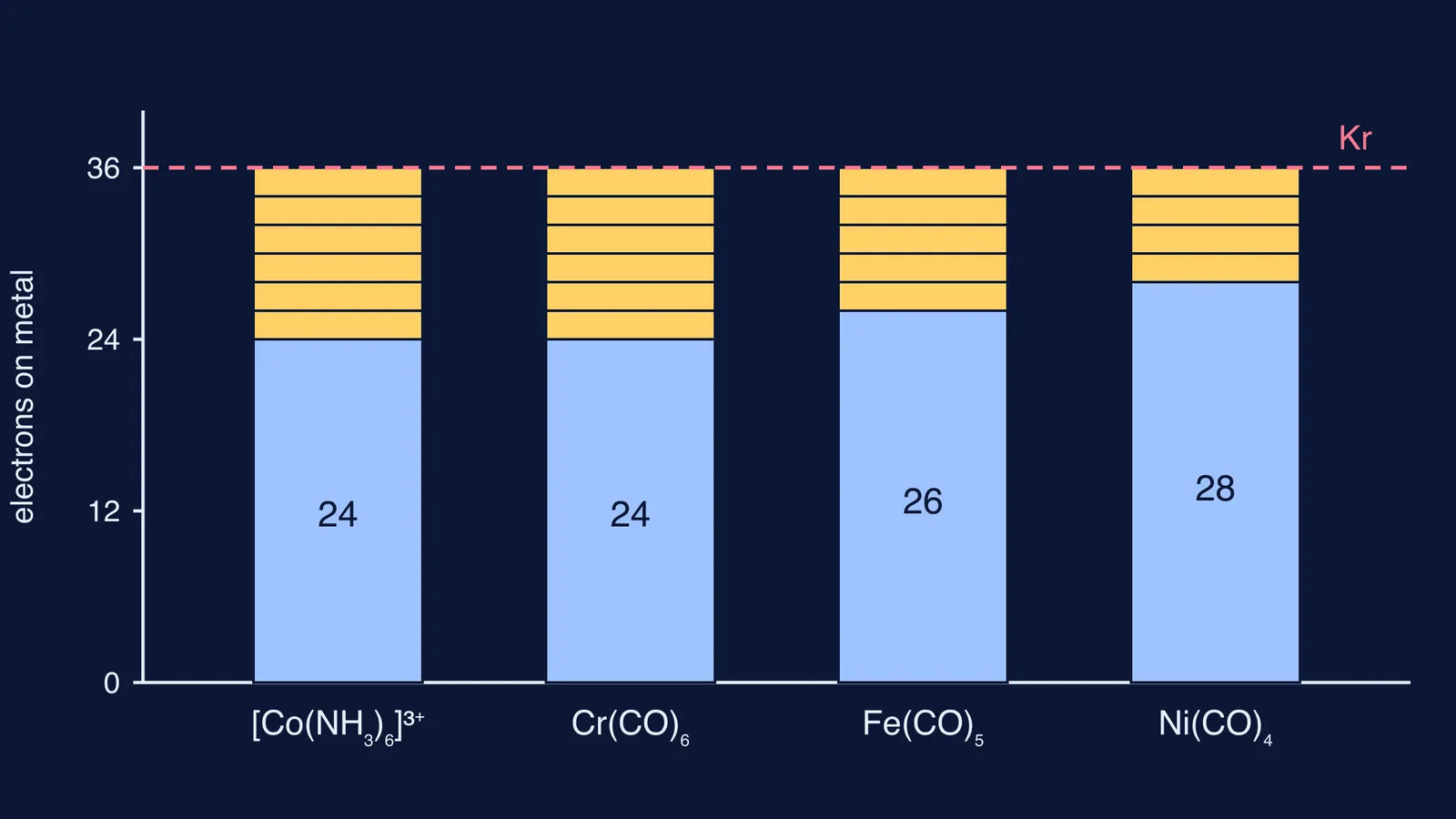
Here is the arithmetic for the four complexes in the diagram above:
[Co(NH3)6]3+: 27 − 3 + 12 = 36
Cr(CO)6: 24 − 0 + 12 = 36
Fe(CO)5: 26 − 0 + 10 = 36
Ni(CO)4: 28 − 0 + 8 = 36
You can also run it backwards. For a nickel carbonyl Ni(CO)x, set 28 + 2x = 36 and you get x = 4, the formula chemists actually find.
Now test a familiar complex that misses. The ferricyanide ion, [Fe(CN)6]3−, gives 26 − 3 + 12 = 35, one short of krypton, yet it is a common stable ion. University notes on the 18-electron rule list whole classes of complexes that break it. Treat EAN as a strong guide for carbonyls and a rough one for everything else.
For more practice problems, see our step-by-step guide on how to calculate the effective atomic number of a complex.
How did Sidgwick link electron pairs to molecular shape?
In 1940 Sidgwick and Herbert Powell gave the Royal Society's Bakerian Lecture, Stereochemical types and valency groups. They surveyed known structures and found that the arrangement of bonds around a central atom tends to fall into a limited number of types, with variations seldom exceeding 5 or 10°.
Their key move was to count electron pairs, shared or not. The abstract says the structure is linear for 4 valence electrons, flat and symmetrical for 6, tetrahedral or planar for 8, a trigonal bipyramid for 10, and an octahedron for 12. That is why water is bent and ammonia is a pyramid: both carry unshared pairs on a tetrahedral octet.
These ideas were later developed into VSEPR theory by Ronald Gillespie and Ronald Nyholm, as his biography notes; their 1957 review Inorganic stereochemistry set out the approach. Our post on Ronald Gillespie and VSEPR theory picks up the story there.
How can you study his rules the way he built them?
Sidgwick's rules came from comparing many real compounds, then looking hard at the ones that did not fit. You can practise the same habit:
Count first: write Z, charge and donor pairs before you reach for a memorised answer.
Compare: check your total against the noble gas, or the pair count against the shape.
Hunt the exception: for each rule, learn one compound that breaks it and why.
If coordination chemistry still feels like a list of facts, the Fermi Concept Library gives each chemistry concept its own lesson and shows where it sits in the map. And when your electron count keeps coming out wrong, the Fermi Problem Library has worked problems with a step-by-step solver that explains the reasoning rather than printing an answer.
Next time you write 36 beside a carbonyl, try the ferricyanide check too.