

On this page
Exam questions often give a formula like Fe(CO)5 and ask whether it is stable, or how many ligands are missing. The effective atomic number (EAN) rule answers both with one line of arithmetic.
What is the effective atomic number of a complex?
The effective atomic number is the total number of electrons the central metal appears to hold in a complex: its own electrons, minus those lost to its oxidation state, plus the pairs donated by its ligands. The idea is that a metal accepts pairs until it matches the next noble gas.
The same idea is taught under two names. A LibreTexts inorganic chemistry chapter lists the 18-electron rule alongside its older names, "The Inert Gas Rule or The Effective Atomic Number (EAN) Rule". Irving Langmuir proposed the 18-electron version in his 1921 *Science* paper "Types of Valence", and chemist William B. Jensen traces that history in "The Origin of the 18-Electron Rule" (Journal of Chemical Education, 2005). The EAN form is credited to Nevil Sidgwick in this Unacademy explainer. Sidgwick wrote The Electronic Theory of Valency (1927) and explained bonding in complexes through the dative bond.
How do you calculate EAN step by step?
The Unacademy explainer states the rule as the metal's atomic number, plus the electrons donated by the ligands, minus the positive charge on the metal. Each donor atom gives one pair, or 2 electrons, so the working formula is EAN = Z − oxidation state of the metal + 2 × number of donor atoms.
Write the atomic number Z of the metal.
Find the metal's oxidation state from the charges of the ligands and the complex.
Count donor atoms, not ligand molecules. A bidentate ligand such as ethylenediamine counts twice.
Compute Z − oxidation state + 2 × donor atoms.
Compare with 36 (Kr), 54 (Xe) or 86 (Rn).
Three worked examples:
[Co(NH3)6]3+: Z = 27, oxidation state +3, six NH3. EAN = 27 − 3 + 12 = 36.
K4[Fe(CN)6]: Z = 26, oxidation state +2, six CN−. EAN = 26 − 2 + 12 = 36.
Ni(CO)4: Z = 28, oxidation state 0, four CO. EAN = 28 − 0 + 8 = 36.
If step 3 feels shaky, our guide to ligand denticity and the chelate effect covers it.
Why is 36 the same as the 18-electron rule?
For a 3d metal, 36 electrons is an argon core of 18 plus 18 valence electrons. The 18-electron rule rests on a transition metal's nine valence orbitals (five d, one s, three p), which hold 18 electrons. EAN counts every electron; the 18-electron rule counts only the valence shell.
Carbon monoxide is a neutral two-electron donor, per the LibreTexts chapter, and the metal in a simple carbonyl is in the zero oxidation state, so carbonyls are the cleanest place to use the rule. Why CO binds so well is covered in our post on synergic bonding in metal carbonyls.
How do you predict the formula of a stable metal carbonyl?
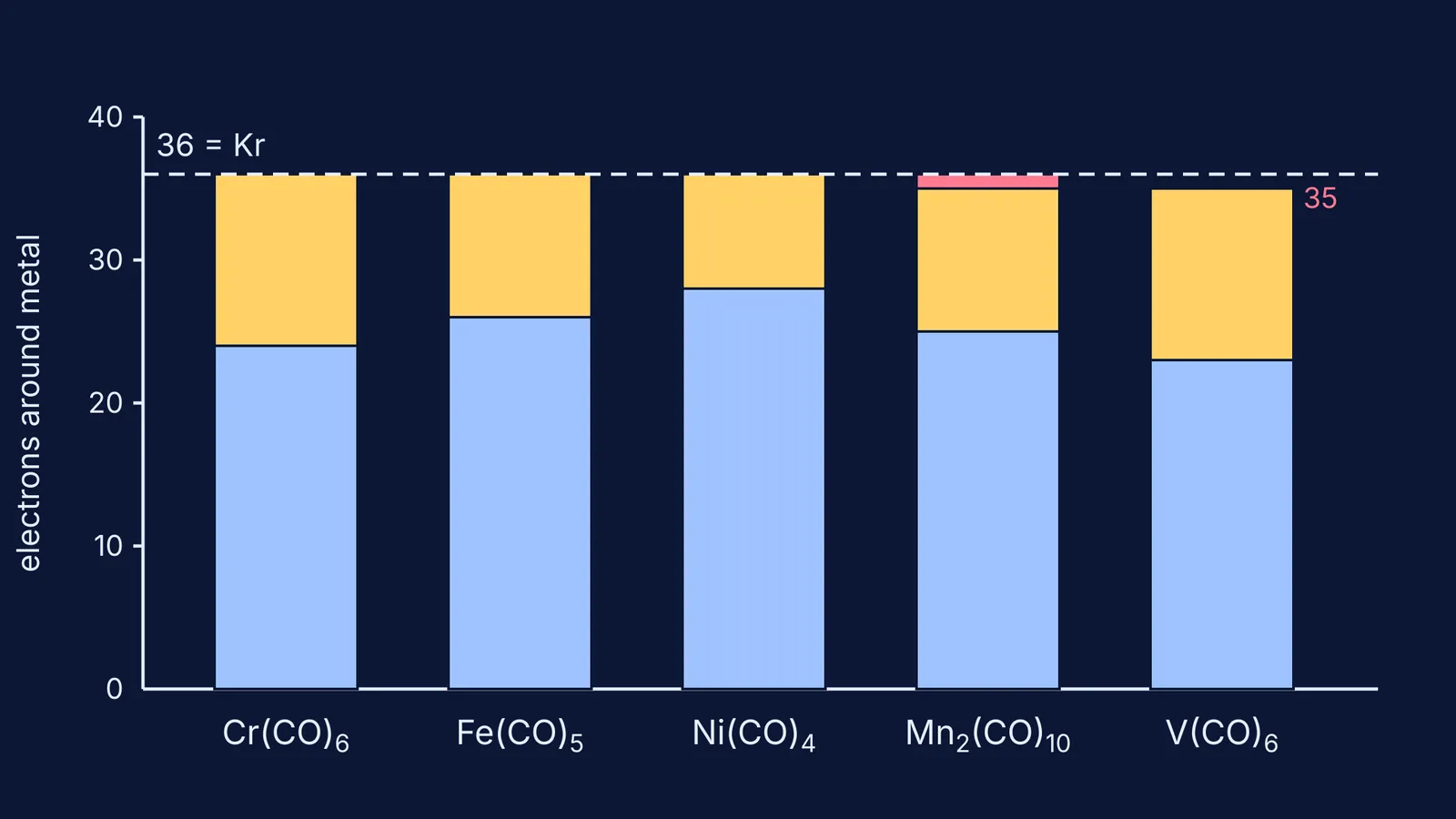
For a neutral M(CO)n, set Z + 2n = 36 and solve: n = (36 − Z) ÷ 2.
Chromium, Z = 24: n = 6, so Cr(CO)6.
Iron, Z = 26: n = 5, so Fe(CO)5.
Nickel, Z = 28: n = 4, so Ni(CO)4.
All three are real compounds listed in Wikipedia's metal carbonyl article, which notes that "the formulae of many metal carbonyls can be inferred from the 18-electron rule".
Odd Z gives a half number. Manganese (Z = 25) stops at Mn(CO)5 with 35 electrons. The fix is a metal–metal bond, which the LibreTexts chapter counts as one extra electron for each metal: 25 + 10 + 1 = 36, so the real compound is the dimer Mn2(CO)10. Cobalt (Z = 27) does the same: 27 + 8 + 1 = 36 gives Co2(CO)8. The metal carbonyl article gives both as dimers: polynuclear carbonyls form from metals with odd atomic numbers and contain a metal–metal bond.
When does the EAN rule fail?
Vanadium (Z = 23) would need 6.5 CO groups. Vanadium hexacarbonyl has 17 valence electrons, is paramagnetic, and its main reaction is reduction to [V(CO)6]−, which reaches 23 + 1 + 12 = 36.
Many ordinary complexes miss 36 too. [Cu(NH3)4]2+ gives 29 − 2 + 8 = 35, and [Ni(NH3)6]2+ gives 28 − 2 + 12 = 38, yet both exist. The 18-electron rule article lists several kinds of exception, including 16-electron square-planar d8 complexes, high-spin complexes and pi-donor ligands. Use EAN for carbonyls; for geometry and magnetism, switch to valence bond theory for complexes or crystal field theory.
A five-minute practice set
Try these: [Fe(CN)6]3−, [Cr(NH3)6]3+, Fe(CO)4 and [Mn(CO)6]+. Answers: 35, 33, 34 (so Fe(CO)4 alone is not stable) and 36.
If one goes wrong and you cannot see why, the Fermi Problem Library has worked problems with a step-by-step solver that explains the reasoning rather than printing an answer. If the gap is earlier, in oxidation states or denticity, the Fermi Concept Library gives each chemistry concept its own lesson and its place in the map.


