On this page
Ask "is the multiverse real?" and you'll find confident yeses and flat noes. The honest answer: nobody knows, because no observation has settled it. Part of the confusion: physicists use the word for at least three different ideas, each resting on a different theory.
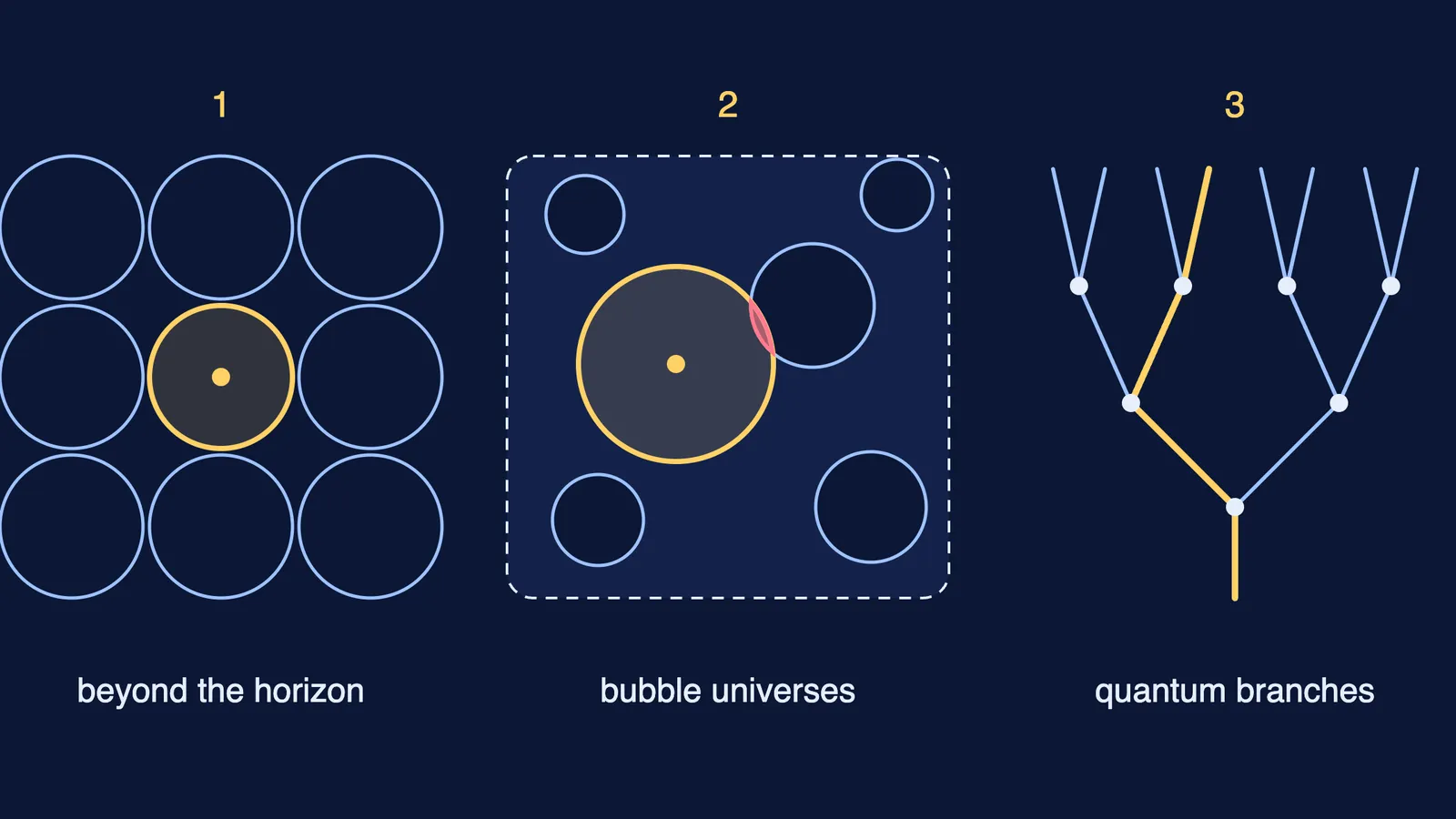
In 2003 the cosmologist Max Tegmark sorted parallel-universe theories into a four-level hierarchy. His first three levels are the three ideas below.
Is there more universe beyond our horizon?
We can only see objects whose light has had time to reach us. That region is the observable universe. If space carries on far beyond it, there are regions we will never see, with the same laws of physics as ours. Tegmark's paper calls this Level I and describes it as a generic prediction of inflation, the early burst of expansion explained in our post on Alan Guth and cosmic inflation. It is the least exotic multiverse: just more space. Tegmark even calls it uncontroversial, but those regions are still inferred from theory, not seen.
What are bubble universes?
In some versions of inflation, the expansion never stops everywhere at once. In 1986 Andrei Linde described an eternally existing, self-reproducing chaotic inflationary universe. In this picture, our observable universe sits inside a single bubble in a vast inflating multiverse, as a 2011 paper testing the idea puts it.
String theory adds a twist. In 2000 Raphael Bousso and Joseph Polchinski argued that it can allow a dense set of possible values for the cosmological constant, and Leonard Susskind later wrote that this "landscape" of possibilities is plausibly unimaginably large and diverse. Put the two together and different bubbles could have different physical constants. Tegmark calls this Level II.
What is the many-worlds interpretation?
Hugh Everett published his "relative state" formulation of quantum mechanics in 1957. In the many-worlds interpretation that grew from it, every quantum experiment with several possible outcomes produces all of them, each in a different world, even though we are only aware of the outcome we see, as the Stanford Encyclopedia of Philosophy explains. These worlds are not far away in space. They are branches of one quantum state. This is Tegmark's Level III.
Why hasn't any multiverse been confirmed?
Each idea hits a different wall.
Beyond the horizon: light from those regions has not reached us, so we can only infer them from theory.
Bubbles: a neighbouring bubble that hit ours could leave round marks on the cosmic microwave background, the oldest light we can see (here is how that light was discovered). Stephen Feeney and colleagues searched seven years of WMAP satellite data and found no reason to add bubble collisions to the standard model of cosmology (Physical Review Letters, 2011). They limited the average number of detectable collisions on the whole sky to fewer than 1.6, at 68% confidence. A null result limits the idea; it does not kill it.
Many worlds: the Stanford Encyclopedia entry notes there is no experimental evidence favouring wave-function collapse over many worlds. A decisive test would need interference between states that differ in a macroscopic number of degrees of freedom, which it calls impossible with today's technology. Collapse models, which would rule out many worlds if true, have been tested; so far the tests have ruled out some of those models, not all.
Tegmark himself wrote that a severe "measure problem" must be solved before Levels II to IV can make testable predictions. And in 2014 the cosmologists George Ellis and Joe Silk argued in Nature that exempting speculative theories of the universe from experimental checks undermines science.
How can you judge a multiverse headline?
Use three questions.
Which multiverse? Horizon, bubbles or quantum branches. If an article slides between them, slow down.
What would we see if it were true, and not see if it were false? A real test names an observation, such as a round mark in the microwave sky.
Has anyone looked, and what did they find? A theory paper is a proposal, not an observation.
Worked example. Suppose you read: "Cold spot in the sky may be a bruise from another universe."
Question 1: this is idea 2, bubble collisions.
Question 2: a collision mark is a genuine, checkable prediction. Good sign.
Question 3: check whether a team compared the spot with the bubble model across the full sky, as Feeney's group did with WMAP, or only noticed a resemblance. A resemblance is a reason to look, not a result.
Verdict: interesting, not yet evidence. Saying exactly that, out loud, is the scientific temper that Article 51A(h) of the Constitution asks of every Indian citizen, as our post on scientific temper and Article 51A(h) explains.
If superposition or the wave function is the shaky step, start there before many worlds. The Fermi Concept Library gives every concept in physics its own lesson and its place in the map, so you can see what quantum measurement rests on.
Next time someone tells you the multiverse is real, ask them: which one, and who looked?