

On this page
In September 1838, a paddle-wheel boat moved along the Neva in St Petersburg with no oars, no smoking chimney and no rattling engine. An electric motor turned its paddle wheels, fed by batteries along its sides. Its builder was Moritz Hermann Jacobi, a physicist born in Potsdam in 1801, then working in St Petersburg on driving machines with electromagnetic forces.
Who was Moritz Jacobi and what did he build in 1834?
The Karlsruhe Institute of Technology's history of Jacobi's motor says he finished it in Königsberg in May 1834 and sent a report on it to the Academy of Sciences in Paris that November. KIT calls him the first to demonstrate a usable rotating electric motor, while noting that Jacobi himself credited earlier inventions by Botto and Dal Negro.
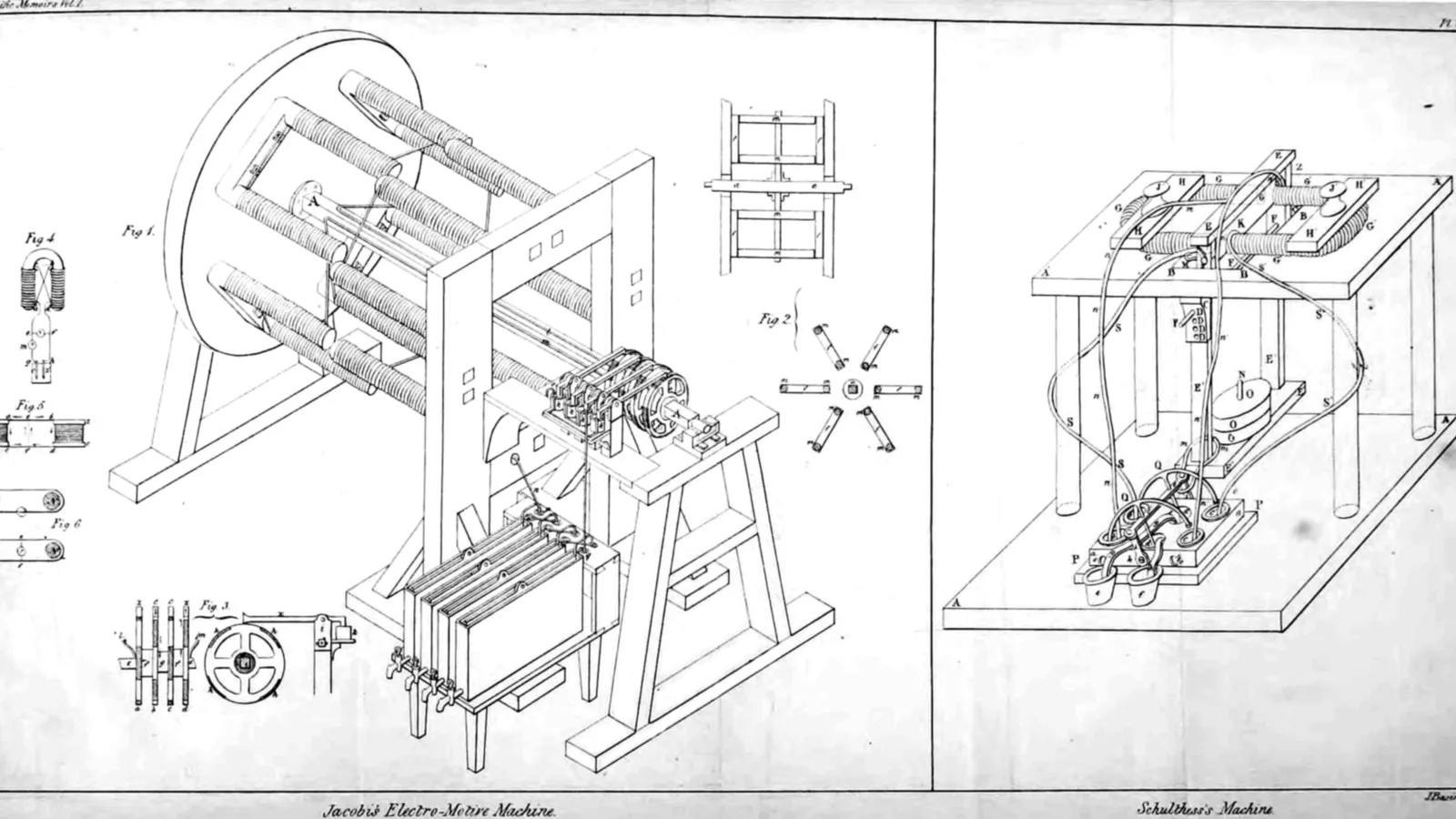
A wooden frame held four horseshoe electromagnets. A disc in front of them carried four more and could spin. A commutator, a set of discs with ebony insulating sections, reversed the current at the right moments, so each moving magnet kept being pulled onward instead of sticking. KIT gives a speed of 60 to 130 revolutions per minute, from batteries supplying 4 to 6 volts.
Jacobi's motor lifted 10 to 12 pounds at one foot per second, which KIT puts at about 15 watts on its page about the invention of the electric motor. The 1837 plate at the top of this post shows this machine on the left.
How did Jacobi's electric boat work on the Neva in 1838?
With support from Tsar Nicholas I, Jacobi scaled up. KIT's history of the electric motor gives these figures for the 13 September 1838 trial:
The boat was about 8 metres long and driven by paddle wheels.
Its zinc batteries had 320 pairs of plates and weighed 200 kg, set along the two side walls.
The motor gave between 1/5 and 1/4 horsepower.
It ran at 2.5 km/h over a 7.5 km route and could carry more than a dozen passengers.
The IEEE's Engineering and Technology History Wiki says it carried 14 passengers, and that by August 1839 an improved version reached about 4 km/h.
Why do sources give different dates and numbers?
You will find both 13 and 25 September 1838. Russia still used the Julian calendar, and in the nineteenth century the Russian calendar was 12 days behind Western Europe, so the two dates are most likely the same day written in different calendars. The Russian popular-science site Scientific Russia uses 25 September.
Other numbers differ more. Scientific Russia says the boat travelled 14 km up and down the Neva in 7 hours. ETHW puts the batteries at more than 180 kg rather than 200 kg. Wikipedia describes a 28-foot boat in 1839 moving against the current at three miles per hour. Some may describe different trials.
What can a quarter of a horsepower actually do?
You can test these numbers yourself. You need one conversion from NIST's table of conversion factors: 1 horsepower is about 745.7 W. The other figures come from KIT's history.
Check the 1834 claim. 12 pounds is 5.44 kg, weighing 5.44 x 9.8 = 53 N. Lifting it at 0.305 m/s takes 53 x 0.305 = 16 W. With 10 pounds you get about 14 W. So "about 15 W" holds up.
Convert the boat motor. 1/5 hp = 149 W and 1/4 hp = 186 W. That is roughly 10 to 12 times the 1834 motor.
Find the trip energy. 7.5 km at 2.5 km/h takes 3 hours. At 186 W, the motor delivers 186 x 3 = 558 Wh, a little over half a kilowatt-hour.
Compare with the battery. Spread over 200 kg, that is under 3 Wh of useful work per kilogram of battery carried on that trip.
That fits what ETHW says held electric boats back: batteries were too large, heavy and difficult to recharge. KIT's page also prints "(300 W)" next to the horsepower figure, but step 2 shows a quarter horsepower is nearer 186 W. Small checks like this show where sources don't agree.
If conversions like these trip you up, the Fermi Problem Library has worked problems with a step-by-step solver that explains the reasoning rather than printing an answer. And if a spinning rotor is hard to picture from text, the Fermi Simulation Lab has interactive simulations for ideas that are easier to see than to read.
What else did Jacobi leave behind?
In 1838 he also discovered electrotyping, making printing plates by electroplating, and between 1842 and 1845 he built a telegraph line with an underground cable from St Petersburg to Tsarskoe Selo, according to his Wikipedia biography.
To keep going, read how John Frederic Daniell built a steadier battery, how Faraday discovered electromagnetic induction in 1831, or build a simple homopolar motor with your teen.


