

On this page
In 1836 the London chemist John Frederic Daniell described a battery that did something earlier batteries could not: keep supplying a steady current. His trick was to give zinc and copper a solution each, so the cell no longer choked on its own hydrogen bubbles. The same zinc-copper cell still opens the electrochemistry chapter of Class 12 NCERT chemistry.
Who was John Frederic Daniell?
Daniell (1790-1845) was a London-born chemist and physicist who became the first professor of chemistry at King's College London in 1831, according to his Wikipedia biography.
He published the cell in 1836 as a letter to Michael Faraday, titled "On Voltaic Combinations", in the Philosophical Transactions of the Royal Society. In 1837 the Royal Society gave him its highest award, the Copley Medal, for the battery, as the IEEE's Engineering and Technology History Wiki records.
What was wrong with batteries before the Daniell cell?
Earlier zinc-copper cells, descended from Volta's pile, used a single acid solution. When they ran, hydrogen gas collected on the copper plate. Hydrogen does not conduct, so the bubbles raised the cell's internal resistance and the current sagged. Chemists call this polarisation.
The ETHW history of the Daniell cell says voltaic piles "lost power rapidly".
Why was the Daniell cell better?
Daniell added a second electrolyte. In his original cell, copper sat in copper sulphate solution and the zinc hung in dilute sulphuric acid inside a tube of ox gullet, a porous membrane that let ions through but kept the solutions apart. He noted a porous earthenware tube could replace the gullet, as the Daniell cell article on Wikipedia describes. Zinc sulphate around the zinc, as textbooks show, came later: the article credits it to J. F. Fuller in 1853.
Instead of hydrogen, the cell deposited copper metal, which is a conductor, so nothing built up to block the current. ETHW says the new cell "drew power more evenly during its continuous operation" and calls it "the first reliable source of electric current".
Steady current was exactly what the new electric telegraph needed. The porous-pot Daniell cell was widely used in telegraph networks until the Leclanché cell replaced it in the late 1860s, according to Wikipedia's Daniell cell article. A 2014 history of electrical units by Joel S. Jayson in the American Journal of Physics notes that telegraph-era electromotive force was mostly measured in Daniell cells.
How does the Daniell cell work in your Class 12 textbook?
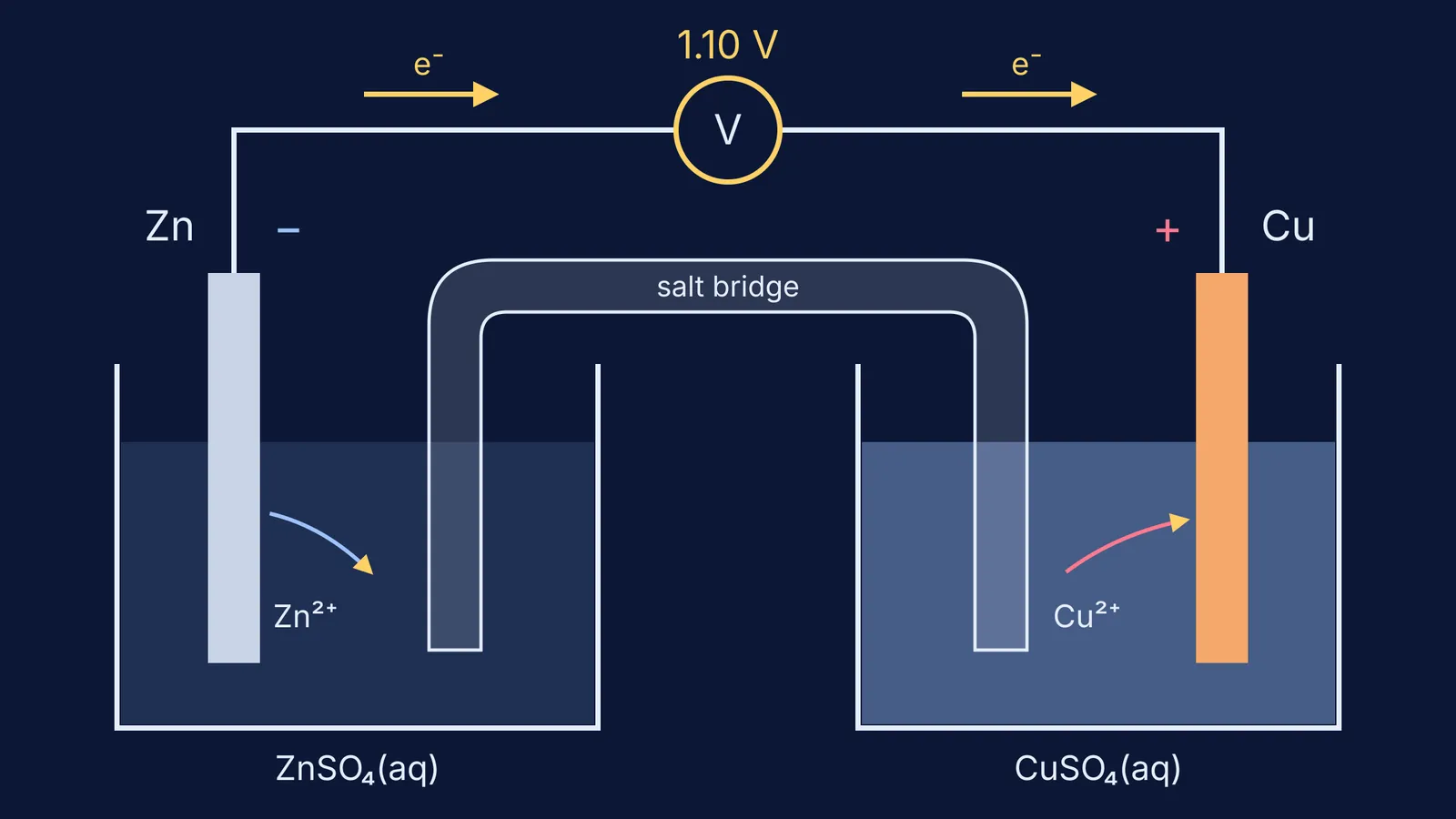
The Daniell cell is a galvanic cell in which zinc in a zinc salt solution and copper in a copper salt solution produce 1.1 V when both ions are at 1 mol per litre, as defined in NCERT's Class 12 Electrochemistry chapter. NCERT uses a salt bridge instead of a porous pot; the electrode reactions are the same as in Daniell's cell:
Anode (oxidation, negative): Zn(s) → Zn²⁺(aq) + 2e⁻
Cathode (reduction, positive): Cu²⁺(aq) + 2e⁻ → Cu(s)
Cell notation: Zn(s) | Zn²⁺(aq) || Cu²⁺(aq) | Cu(s)
Using NCERT's standard electrode potentials of +0.34 V for copper and −0.76 V for zinc, E°cell = 0.34 − (−0.76) = 1.10 V.
Worked example: what happens as the cell runs?
NCERT's chapter gives the Nernst equation for the Daniell cell at 298 K as Ecell = E°cell − (0.059/2) log([Zn²⁺]/[Cu²⁺]).
Fresh cell, [Zn²⁺] = 0.1 M and [Cu²⁺] = 1.0 M: log(0.1) = −1, so Ecell = 1.10 + 0.0295 = 1.13 V.
Tired cell, [Zn²⁺] = 1.0 M and [Cu²⁺] = 0.01 M: log(100) = 2, so Ecell = 1.10 − 0.059 = 1.04 V.
A thousand-fold shift in the ion ratio moves the voltage by under 0.1 V, because the concentrations sit inside a logarithm. You can watch it happen in our post on how concentration changes cell voltage, and see why the voltage finally reaches zero in why a galvanic cell stops working.
How do you answer any Daniell cell question?
A five-step check for board and JEE Main questions:
Find the anode: the half-cell with the lower E° (zinc, −0.76 V) is oxidised.
Mark the signs: in a galvanic cell the anode is negative and the cathode positive.
Draw electron flow through the wire from zinc to copper; conventional current flows the other way.
Salt bridge: anions drift toward the zinc beaker, cations toward the copper beaker, keeping both solutions neutral.
Compute E°cell = E°cathode − E°anode, then correct for concentration with the Nernst equation.
If a step keeps going wrong, the Fermi Problem Library has a step-by-step solver that explains the reasoning rather than printing an answer. If the salt bridge feels abstract, the Fermi Simulation Lab has interactive simulations for ideas that are easier to see than to read.
Once the Daniell cell is clear, the same logic carries over to gas and redox half-cells.


