On this page
On 3 September 1821, in a basement laboratory at the Royal Institution in London, Michael Faraday made a current-carrying wire turn continuously around a magnet: the world's first electric motor. He needed a deep basin of mercury. Your teen needs an AA cell, a strong magnet, a screw, some wire and a few minutes.
Below: the build, three safety rules, the physics in one formula and a predict-then-test plan.
What do you need for a homopolar motor?
This is the screw design used by ANU's home science activity and K&J Magnetics:
One ordinary AA cell (1.5 V)
One small neodymium disc magnet, a little wider than the screw head
One steel screw or iron nail with a pointed end
A short piece of copper wire, bare at both ends (K&J uses one about 9 inches, or 23 cm, long)
A small piece of tape as a marker, so you can see it turn
How do you build it, step by step?
Stick the magnet to the flat head of the screw, and add the tape marker.
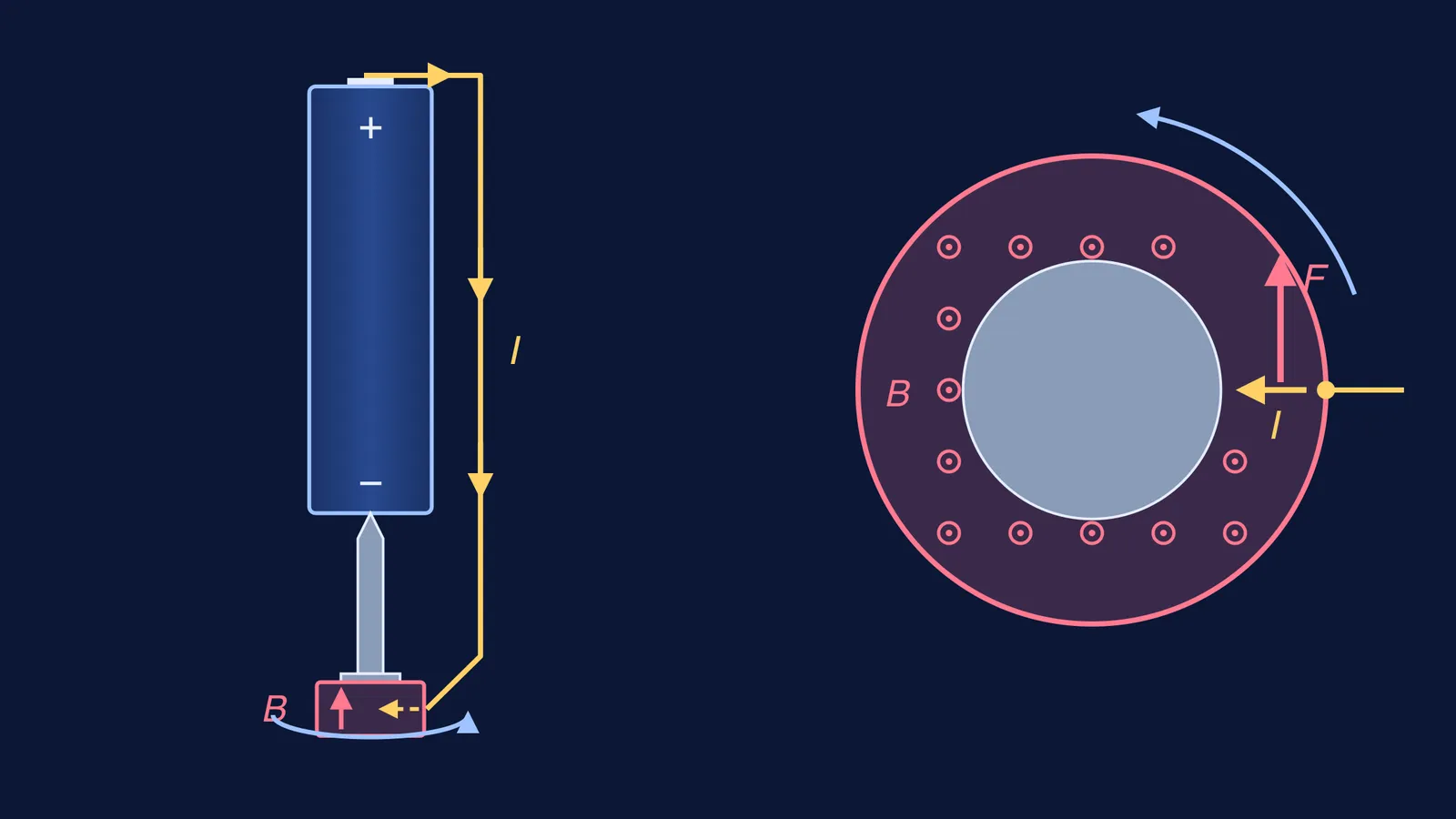
Hold the battery upright, positive end up, and touch the screw's point to the negative end at the bottom; the magnetised screw hangs there.
Press one end of the wire to the positive terminal with your thumb.
Gently touch the other end to the side of the magnet. The magnet and screw start to spin.
Count to five, lift the wire away, and let everything cool before the next run.
If nothing happens, check that the copper is bare at both ends and that the screw point sits in the centre of the terminal.
Is a homopolar motor safe for a teenager?
Yes, if you follow three rules.
Heat. The current is so large that the battery is used up within a minute or two, and K&J Magnetics warns that the wire and battery can become dangerously hot. Our explainers on why a short-circuited battery gets warm and why fuses blow in a short circuit show where that heat comes from. Use one ordinary AA cell, never a stack of cells, and never leave the wire connected.
Swallowed magnets. Swallowed high-powered magnets can attract each other through internal body tissue and cause perforations, twisting or blockage of the intestines, infection, blood poisoning and death, says the US Consumer Product Safety Commission. It estimates that 26,600 magnet ingestions were treated in US hospital emergency rooms from 2010 through 2021, and notes that teens use magnets to mimic mouth piercings and swallow them by accident. Store the magnet in a labelled box away from younger siblings. If anyone may have swallowed one, treat it as an emergency and get medical help straight away.
Magnet heat. For a standard N42 disc magnet, K&J Magnetics puts the maximum operating temperature at 80 °C. Above that, the magnet starts to lose strength permanently.
Why does the motor spin?
A current-carrying wire in a magnetic field feels a force F = IlB sin θ, where I is the current, l is the length of wire in the field, B is the field and θ is the angle between current and field (OpenStax College Physics).
In your motor, current enters the magnet at its rim and flows inward to the screw. The magnet's field runs along its axis, at right angles to that path. So sin θ = 1 and the push is as large as it can be. The force is perpendicular to both the current and the field, so it points along the rim. A sideways push at the edge is a turning effect, and the magnet spins.
In a homopolar motor, the polarity of the current and the magnetic field never changes, so no commutator is needed. The push keeps the same direction and the spin keeps going.
What should you ask your teen while it spins?
Get a prediction before every run. Point your thumb along the current and your fingers along the field; the force points straight out of your palm. That is the right-hand rule from the same OpenStax section.
Run 1: build it as above. Ask: "Looking down from the top, which way will it turn?"
Run 2: flip the magnet over. Ask: "B has reversed. What happens to F?" It should spin the other way.
Run 3: flip the magnet back and turn the battery upside down. Ask the same question about I.
Run 4: flip both. Ask: "Two reversals. Now what?" It should turn the original way, because reversing both I and B leaves the force unchanged.
A wrong prediction is the most useful moment. Ask your teen to redo the hand rule before anyone touches the motor.
If the field is hard to picture, the Fermi Simulation Lab has interactive simulations for ideas that are easier to see than to read. For younger children, try these five magnet experiments, which use fridge magnets and no battery.
This weekend: build it, run the four predictions, then ask your teen to explain the spin back to you in their own words.