On this page
Every organic chemistry textbook has a small drawing that looks like a Y laid over a circle. It is the Newman projection, named after the chemist who suggested it. Here is who he was, what the drawing solved, and how to use it in your answers.
Who invented the Newman projection?
Melvin S. Newman (10 March 1908 to 30 May 1993) invented the Newman projection, according to the National Academy of Sciences biographical memoir by Leo Paquette and Milton Orchin. The memoir describes the technique "as originally suggested by Newman in 1952". That first version appeared in Record of Chemical Progress in 1952 (volume 13, page 111), as cited in the Wikipedia article on the Newman projection. Newman later described the notation in "A notation for the study of certain stereochemical problems", Journal of Chemical Education, July 1955.
The same memoir records that Newman was born in New York City, spent much of his childhood in New Orleans and earned his PhD at Yale in 1932. He joined Ohio State as an instructor in the fall of 1936, became a full professor in 1944 and stayed for his whole career. He was elected to the National Academy of Sciences in 1956, and Ohio State's research office lists his 1961 American Chemical Society Award for Creative Work in Synthetic Organic Chemistry.
What problem was Newman solving?
The usual drawing of ethane was the sawhorse: the C–C bond at a slant, each carbon's hydrogens shown as a Y. Drawn flat on paper, a side-on view does not always make clear which carbon is in front. Fischer projections, the other common tool, cannot show conformations properly at all, the Wikipedia article notes.
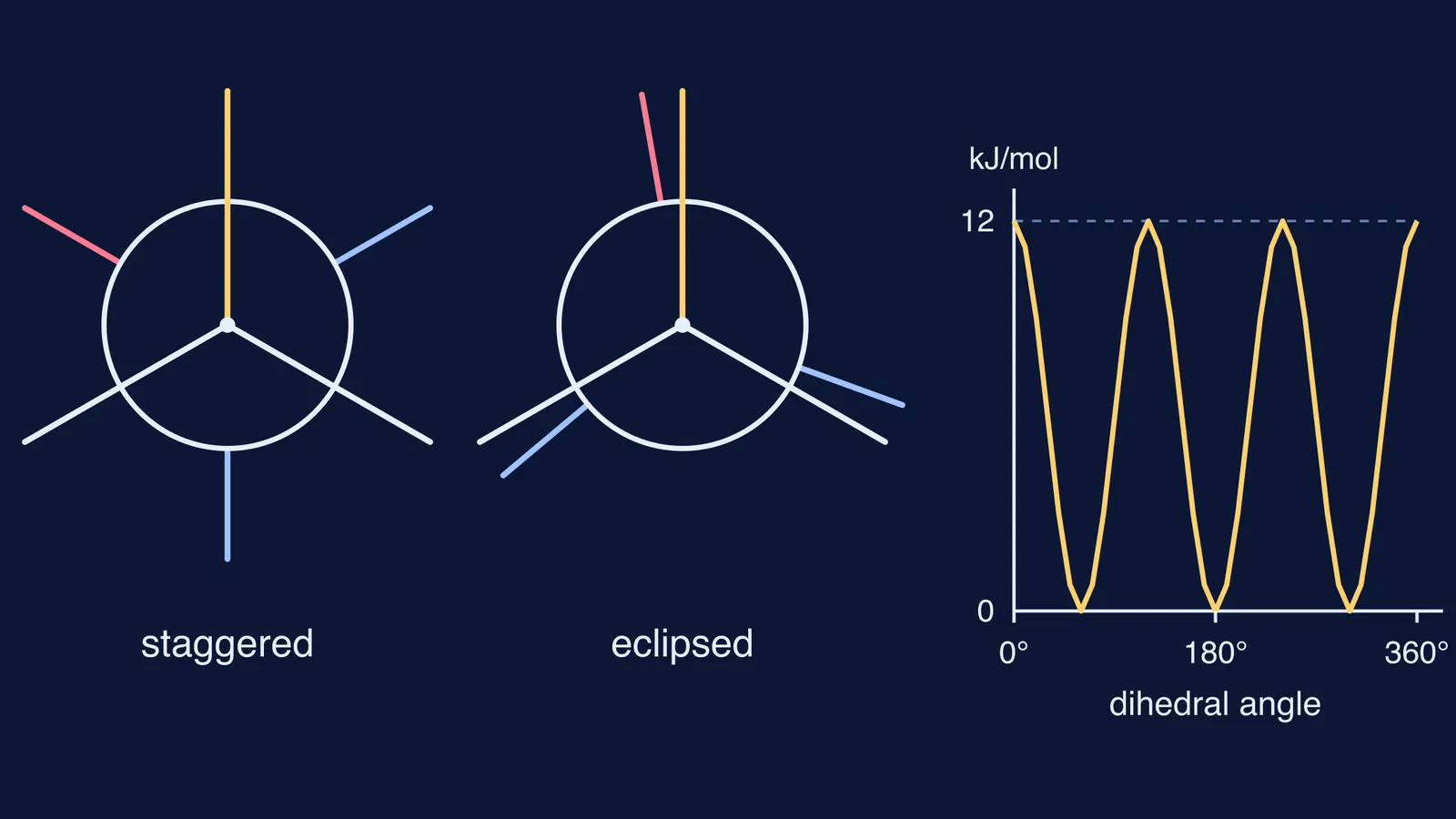
Newman's answer was to look straight down the bond, so that, in the memoir's words, "the front carbon eclipses the rear carbon." The front carbon becomes the point where three bonds meet. The rear carbon becomes a circle, with its three bonds coming out from the rim. With front and back no longer ambiguous, "a major problem with plane projections is finessed," Paquette and Orchin write, and the drawing is "admirably suited for assessing steric effects", meaning crowding between groups.
How much energy separates staggered and eclipsed ethane?
In ethane, the eclipsed conformation is 12 kJ/mol (2.9 kcal/mol) higher in energy than the staggered one, according to LibreTexts' chapter on the conformations of ethane/03:_Organic_Compounds-_Alkanes_and_Their_Stereochemistry/3.06:_Conformations_of_Ethane). That extra energy is called torsional strain. It comes from three equal H–H eclipsing interactions, so each one is worth about 4.0 kJ/mol. At any instant, about 99% of ethane molecules are close to staggered, the same chapter says. Our guide to ethane conformations and torsional strain goes further.
How do you draw a Newman projection, step by step?
Choose the bond. For butane, CH3CH2–CH2CH3, look down the C2–C3 bond.
Draw the front carbon as a dot with three bonds 120 degrees apart: one straight up, one down-left, one down-right.
Draw a circle around the dot. That is the rear carbon.
Add three rear bonds starting from the edge of the circle, never from the centre. For staggered, place them halfway between the front bonds. For eclipsed, place them just beside the front bonds so they stay visible.
Put the front carbon's groups on the front bonds and the rear carbon's groups on the rear bonds.
Turn the rear carbon in 60 degree steps and redraw. A full turn gives up to six distinct conformations, as the Wikipedia article explains.
Worked example: why does butane prefer the anti form?
Look down C2–C3 and put the front CH3 on the top bond. Now rotate the rear CH3 and read off the energies from LibreTexts' chapter on other alkanes/03:_Organic_Compounds-_Alkanes_and_Their_Stereochemistry/3.07:_Conformations_of_Other_Alkanes):
180 degrees apart (anti): the two methyl groups are as far apart as possible. This is the lowest energy.
60 degrees apart (gauche): still staggered, but the methyls are neighbours, 3.8 kJ/mol above anti.
120 degrees apart (eclipsed, each CH3 behind an H): about 16 kJ/mol above anti.
0 degrees (fully eclipsed, CH3 behind CH3): about 19 kJ/mol above anti.
You can rank all four from the drawing alone with two rules: staggered beats eclipsed, and methyl groups far apart beat methyl groups close together. Our post on butane's anti, gauche and eclipsed energies goes through the full energy graph.
If the rotation is hard to picture from flat drawings, the Fermi Simulation Lab has interactive simulations for ideas that are easier to see than to read. If torsional strain is still fuzzy, the Fermi Concept Library gives each chemistry concept its own lesson.
What mistakes do students make with Newman projections?
Drawing the rear bonds from the centre, which makes front and back look identical.
Calling gauche butane eclipsed. Gauche is staggered; only the methyl groups are close.
Leaving out the angle. Write the dihedral angle under each drawing so the examiner can follow you.
Rings need their own picture: start with Hermann Sachse and the chair and boat of cyclohexane. For chains, draw all six butane positions on one page this week.