
On this page
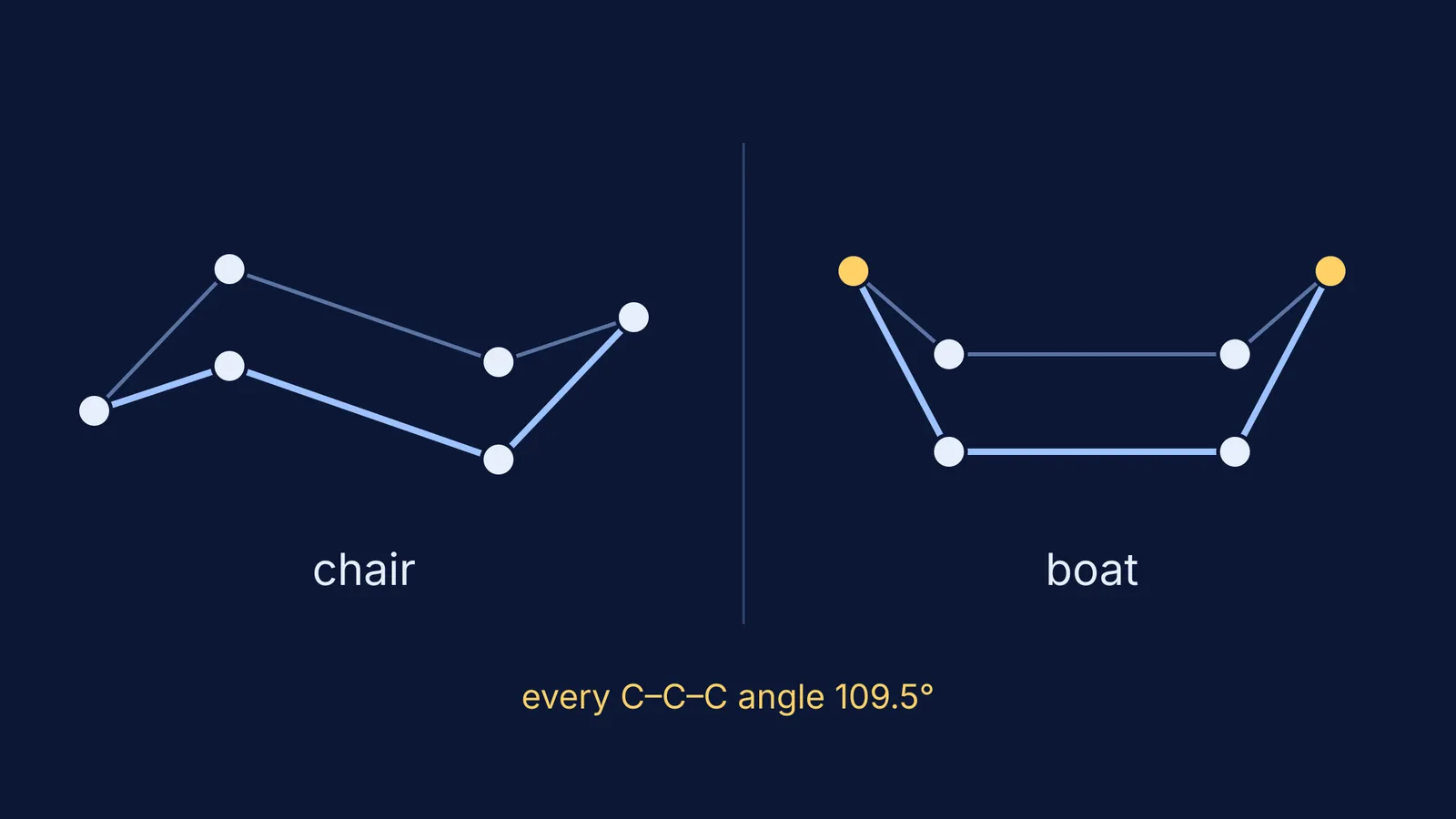
Every corner of a flat hexagon is 120°, but a carbon atom with four single bonds prefers 109.5°. In 1890 Hermann Sachse, a young assistant in Berlin, worked out what that means for cyclohexane: the ring folds. Few chemists of his day followed him. Today his chair and boat are a standard part of organic chemistry courses.
Who was Hermann Sachse and what did he propose in 1890?
Sachse's paper, "Ueber die geometrischen Isomerien der Hexamethylenderivate", appeared in Berichte der deutschen chemischen Gesellschaft, volume 23, pages 1363-1370, in 1890. (Hexamethylene was an old name for cyclohexane.)
He started from the tetrahedral carbon (see our post on van 't Hoff and the tetrahedral carbon) and asked whether six such carbons could form a ring with every angle at its natural value. They can, in two ways. According to the Wikipedia article on cyclohexane conformation, Sachse, then 28, even published instructions for folding a piece of paper into the two forms, which he called "symmetrical" and "asymmetrical". We call them the chair and the boat. The same source says he expressed his arguments in mathematical language that few chemists of the time understood, and that he died in 1893, aged 31.
Why did chemists ignore the chair and boat for decades?
At the time, ring strain was explained by Adolf von Baeyer, who believed cyclohexane was flat (see Baeyer and the strain in small rings). In the Roberts and Caserio organic chemistry text/12%3A_Cycloalkanes_Cycloalkenes_and_Cycloalkynes/12.04%3A_Strain_in_Cycloalkane_Rings), a flat cyclohexane needs bond angles 10.5° away from the tetrahedral value.
The same text explains why Sachse's alternative was not accepted. A puckered ring predicts several possible isomers of compounds such as chlorocyclohexane. Saying those isomers might behave as one substance because they interconvert rapidly seemed a needless complication. Yet the same text notes that cyclohexane is virtually strain-free: its heat of combustion per CH2 group, 157.4 kcal/mol, is the same as for open-chain alkanes.
How did the chair finally win?
In 1918 Ernst Mohr published "Die Baeyersche Spannungstheorie und die Struktur des Diamanten" in Journal für Praktische Chemie, volume 98, pages 315-353. Using the structure of diamond, recently solved by X-ray crystallography, he argued that Sachse's chair was the key building block (Wikipedia). The Roberts and Caserio text calls the result the Sachse-Mohr theory/12%3A_Cycloalkanes_Cycloalkenes_and_Cycloalkynes/12.04%3A_Strain_in_Cycloalkane_Rings) and says it confirmed that large rings are not planar.
Later, the Norwegian chemist Odd Hassel used gas-phase electron diffraction and dipole-moment measurements to establish the conformations of several alicyclic hydrocarbons, cyclohexane among them (EuChemS). In 1950 Derek Barton applied the idea to steroids in "The conformation of the steroid nucleus" in Experientia. Hassel and Barton shared the 1969 Nobel Prize in Chemistry "for the development of the concept of conformation and its application in chemistry" (EuChemS).
The same Wikipedia article gives those figures and puts the twist-boat 21 kJ/mol and the half-chair 43 kJ/mol above the chair. New to eclipsing? Read our post on ethane conformations, Newman projections and torsional strain.
How can you check Sachse's geometry yourself?
This version needs only Class 11 trigonometry. Call the C-C bond length b.
Flat ring: each interior angle of a hexagon is (6 - 2) x 180° / 6 = 120°, which is 10.5° more than 109.5°.
In any ring with ideal angles, carbons two apart (C1 and C3) are b x √(2 - 2 cos 109.47°) = 1.633b apart, by the cosine rule.
Chair: put the six carbons on a circle of radius r, alternately a height h above and below the mean plane. C1 and C3 are at the same height and 120° apart round the circle, so their distance is r√3. Setting r√3 = 1.633b gives r = 0.943b.
Neighbours are 60° apart round the circle, so the chord between them is r, and their heights differ by 2h. So r² + 4h² = b², which gives h = b/6.
Boat: take the chair and reflect one end carbon through the plane of the four middle carbons. No bond length or angle changes, so the boat has no angle strain either.
So each chair carbon sits just one-sixth of a bond length off the mean plane, and that small fold removes all of Baeyer's angle strain.
What should you remember about the chair and boat?
Chair: most stable form, staggered bonds, angles close to 109.5°.
Boat: no angle strain, but eclipsed bonds and higher energy.
In the chair, six C-H bonds are axial (parallel to the ring axis) and six are equatorial (pointing outwards), and a ring flip swaps them (source).
Energy order, lowest first: chair, twist-boat, boat, half-chair.
To revise conformations and ring strain one idea at a time, the Fermi Concept Library gives every concept in chemistry its own lesson.
Next time you draw a chair, remember that Sachse worked it out on paper decades before experiments proved him right.