On this page
Chromium is the element in stainless steel, chrome plating and the orange solution in your practical exam. It was found by Louis-Nicolas Vauquelin, a French chemist, in a bright red mineral from Siberia. The name comes from what still makes it useful in a Class 12 exam: its compounds come in a range of colours, and the colour is a quick clue to the oxidation state.
Who discovered chromium?
The story starts with the ore. On 26 July 1761, Johann Gottlob Lehmann found an orange-red mineral in the Beryozovskoye mines in the Ural Mountains and called it Siberian red lead (Wikipedia, Chromium). Today we call it crocoite, lead chromate, PbCrO4.
Vauquelin (1763-1829) learned chemistry as an apothecary's laboratory boy in Rouen and was an assistant in the laboratory of Antoine Fourcroy from 1783 to 1791 (1911 Encyclopaedia Britannica). The same entry says his name is associated with 376 papers, most of them records of patient analytical work, yet he detected only two new elements: chromium in 1797, in a red lead ore from Siberia, and beryllium in 1798.
His method was careful, ordinary chemistry. He powdered the mineral, used hydrochloric acid to precipitate the lead, and then heated the chromium oxide left behind with charcoal to get the metal (WebElements, University of Sheffield). WebElements also notes that he analysed an emerald from Peru and found that its green colour comes from chromium.
Why is it called chromium?
Because of colour, and Vauquelin put the reason in the title of his paper. It was dated 1 November 1797 and published in Annales de Chimie, volume 25, on 19 January 1798 (Wordorigins). The French title translates roughly as: on a new metallic substance contained in the red lead of Siberia, which it is proposed to call chrome, because of the property it has of colouring the combinations into which it enters.
The same source quotes his reasoning in English translation: he proposed the name, on the advice of Fourcroy and Haüy, "because its combinations are all more or less colored", while admitting the metal itself "does not have a very particular color". The name comes from the Greek chroma, meaning colour (WebElements).
What colours do chromium compounds have?
This is the part your d-block chapter tests. Here is the colour table for chromium, with every entry taken from NCERT's Class 12 unit on the d- and f-block elements:
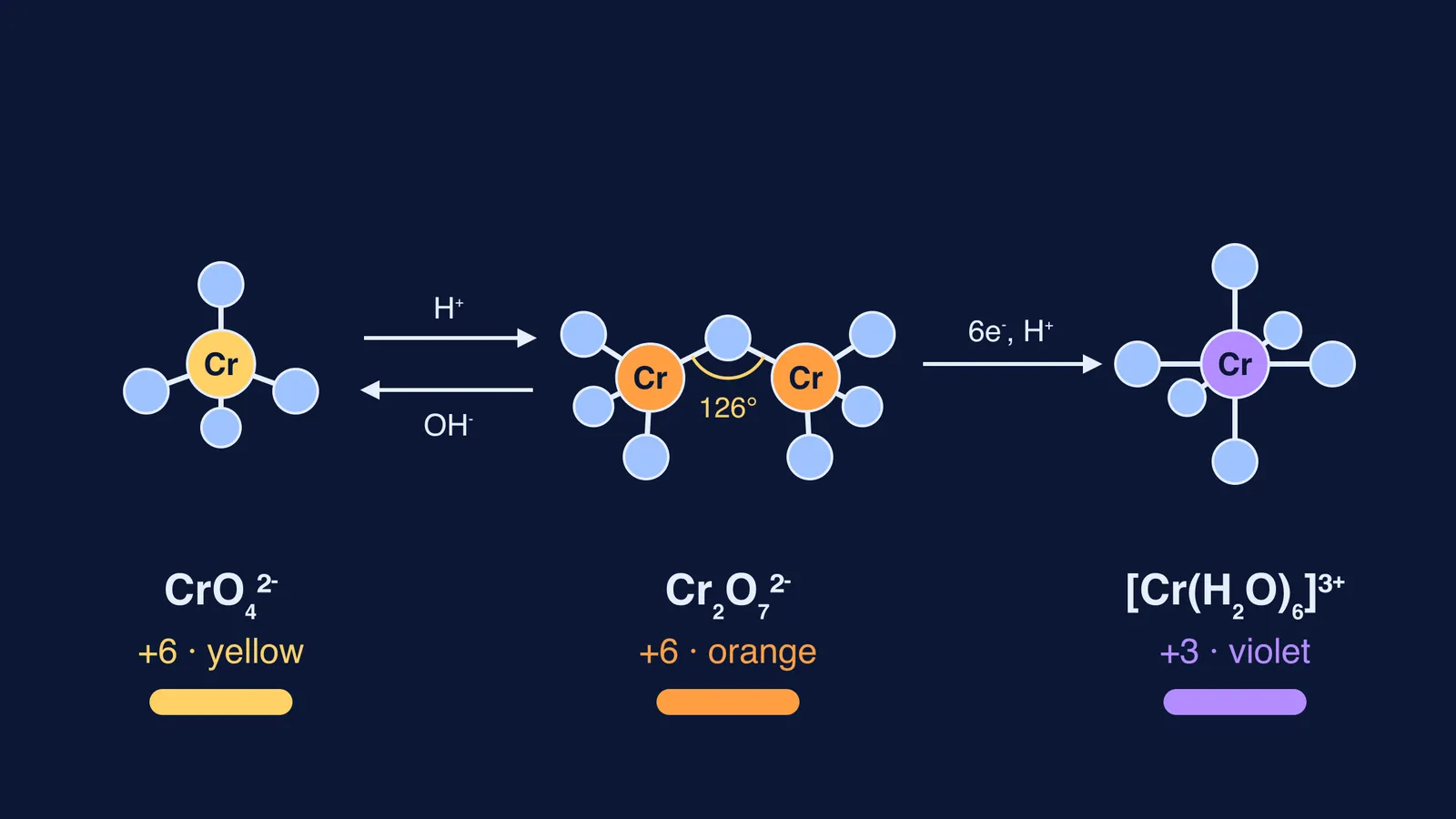
Chromate, CrO4 2-: chromium +6, yellow. A tetrahedral ion.
Dichromate, Cr2O7 2-: chromium +6, orange. Two tetrahedra sharing one corner, with a Cr-O-Cr bond angle of 126 degrees.
Hydrated Cr3+: chromium +3, 3d3, violet (Table 4.8).
Hydrated Cr2+: chromium +2, 3d4, blue (Table 4.8).
NCERT also says chromate and dichromate are interconvertible in water depending on pH, and the oxidation state of chromium is the same in both. Acid turns yellow chromate into orange dichromate; alkali turns it back. You can see the equilibrium worked through in our post on how pH changes the colour of chromate and dichromate.
The colour you see in a real lab can differ from the table. Commercial chromium(III) chloride hydrate is dark green, and related Cr(III) compounds are pale green or violet (Wikipedia, Chromium), because ligands other than water change the colour. For the gem side of the same chemistry, read why ruby is red and emerald is green from chromium.
How do you use the colour table to answer a question?
Try this three-step check on any chromium question.
Name the species from the colour: yellow means chromate, orange means dichromate, violet or green means Cr(III).
Write the oxidation state of chromium in each species before and after.
If it changed, count electrons; if it did not, the reaction is an acid-base equilibrium.
Worked example: acidified potassium dichromate oxidises iodide to iodine. What happens to chromium, and how many electrons does it gain?
Before: Cr2O7 2-, orange, chromium +6.
After: Cr3+, chromium +3.
Each chromium gains 3 electrons, and there are two, so 6 electrons in all.
That matches NCERT's half-equation, Cr2O7 2- + 14H+ + 6e- gives 2Cr3+ + 7H2O, with E0 = 1.33 V (NCERT Class 12, Unit 4). The iodide half-equation, 6I- gives 3I2 + 6e-, supplies exactly those six electrons.
Now the contrast: add sulphuric acid to yellow sodium chromate and it turns orange. Step 2 gives +6 before and +6 after, so no electrons move. Keep that distinction in mind whenever a question describes a colour change.
If a step like the electron count is where you lose marks, the Fermi Problem Library has worked problems with a step-by-step solver that explains the reasoning rather than printing an answer. To revise the surrounding ideas, such as oxidation states and why d-block ions are coloured, each one has its own lesson in the Fermi Concept Library.
For the practical side, see how the colour change from green to yellow is used in the confirmatory test for chromium ions.