

On this page
How does the same Cr³⁺ ion produce two different colours?
Natural ruby is aluminium oxide (corundum, Al₂O₃) containing trace chromium ions (Cr³⁺). Natural emerald is beryllium aluminium silicate (beryl, Be₃Al₂Si₆O₁₈) with the exact same Cr³⁺ impurity. In both crystals, Cr³⁺ has a 3d³ electron configuration and sits inside an octahedron of six oxide ions (O²⁻). Yet ruby transmits an intense red, while emerald glows green.
As mineralogist Kurt Nassau showed in *Color Research & Application*, their colours stem from ligand-field-induced d-d electronic transitions. In an octahedral complex, repulsion from oxygen ligands splits the five degenerate 3d orbitals into a lower triply degenerate t₂g set and an upper doubly degenerate e_g set. The energy difference is the crystal field splitting parameter, Δ₀ or 10 Dq. The host lattice determines the magnitude of 10 Dq, which sets which visible wavelengths are absorbed and which complementary colours pass through to your eyes.
Why does crystal field splitting shift between corundum and beryl?
For decades, textbooks assumed that the difference came purely from bond length. Because the Al³⁺ site in corundum is compact, classical crystal field theory assumed the Cr-O bond was squeezed 5 pm shorter than in beryl, raising 10 Dq through the R⁻⁵ distance dependence noted by Nassau (1987).
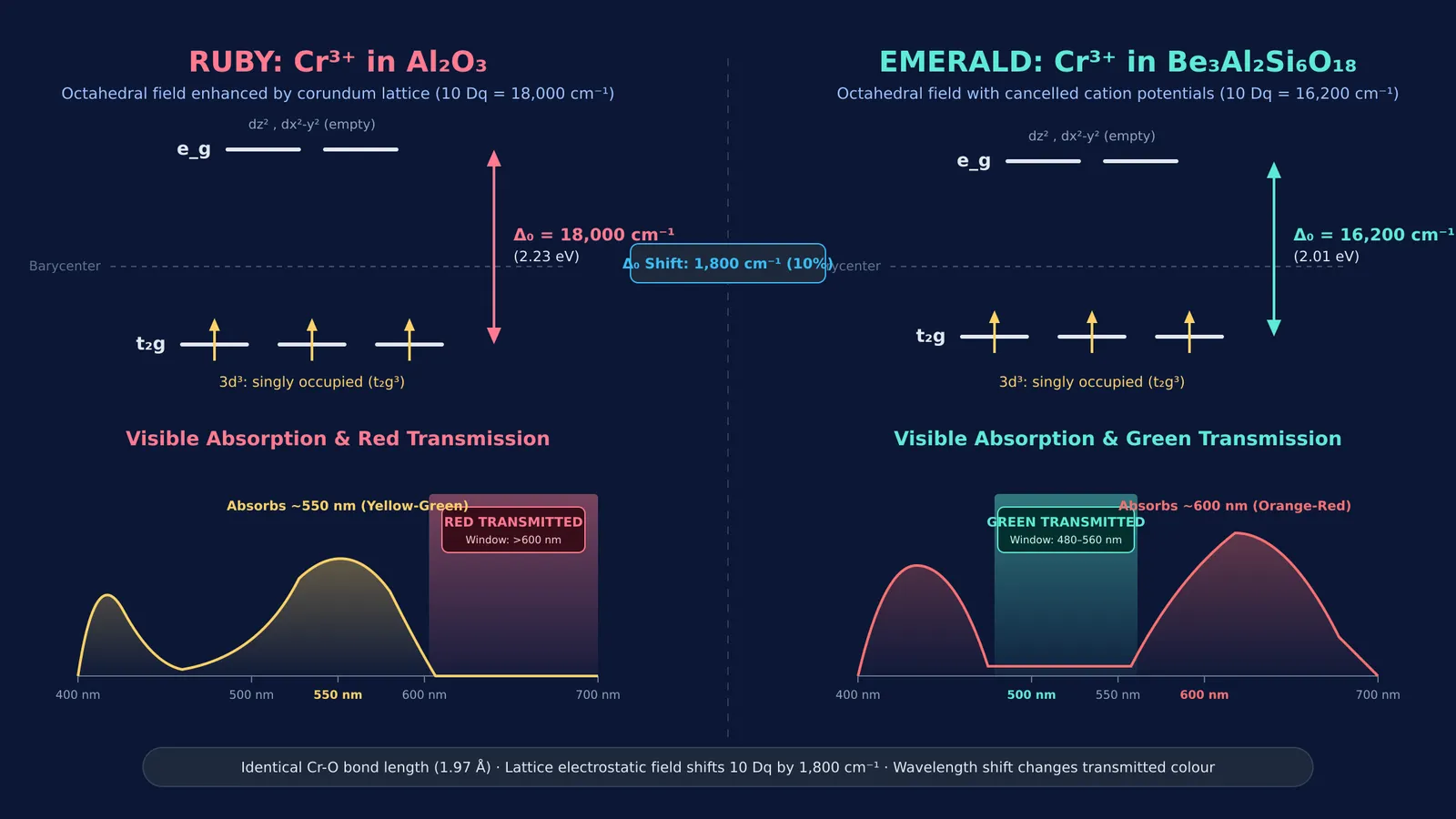
However, EXAFS measurements and electronic structure calculations by Aramburu and colleagues (2012) revealed that Cr³⁺ relaxes to an identical average Cr-O bond length of 1.97 Å in both gemstones. The colour shift actually comes from the internal electrostatic field of the surrounding crystal lattice. In beryl, electrostatic contributions from neighbouring Be²⁺ and Si⁴⁺ cations balance out at the chromium site. In corundum, the trigonal C₃ symmetry sets up a powerful internal electric field along the c-axis. As explained in the *Journal of Chemical Education*, this internal field depresses the t₂g levels by 0.24 eV more than the e_g levels, widening 10 Dq in ruby by roughly 10% relative to emerald.
To explore how crystal symmetry shapes orbital energy levels, visit the Fermi Concept Library, which maps every concept in chemistry with its own lesson.
How do visible absorption bands create red and green transmission?
In corundum, the enhanced field sets 10 Dq at approximately 18,000 cm⁻¹ (2.23 eV), as recorded by Burns (1993). This promotes the primary ⁴A₂g → ⁴T₂g transition, which absorbs yellow-green light near 550 nm, while a second transition (⁴A₂g → ⁴T₁g) absorbs violet light near 410 nm. Subtracting violet and yellow-green leaves a deep transmission window in the red (>600 nm). Non-radiative relaxation to the ²E_g state also triggers sharp luminescence at 694.3 nm and 692.8 nm (the ruby R-lines), giving ruby its rich red glow.
In emerald, the unperturbed beryl lattice maintains a lower 10 Dq of roughly 16,200 cm⁻¹ (2.01 eV), according to Burns (1993). This 1,800 cm⁻¹ reduction shifts the primary absorption band to 600 nm in the orange-red, while the secondary band moves to 430 nm in the blue-violet. With red and violet subtracted, an unobstructed transmission window opens across the green spectrum (480 nm to 560 nm), transmitting brilliant emerald green.
What is the alexandrite effect between ruby and emerald?
Chrysoberyl (BeAl₂O₄) doped with Cr³⁺ creates alexandrite, where 10 Dq sits at 17,200 cm⁻¹ (2.13 eV)—exactly between ruby and emerald, as analyzed by Nassau (1987). This intermediate splitting centers absorption at 570 nm in pure yellow, leaving two balanced transmission windows in the blue-green (490 nm) and deep red (>640 nm).
Under daylight rich in blue and green photons, human eyes perceive alexandrite as teal-green. Under candlelight or incandescent bulbs rich in red wavelengths, transmitted red photons dominate, shifting the stone to raspberry red. This switch shows how a shift of just 1,000 cm⁻¹ in crystal field energy changes the perceived colour, as verified by Burns (1993).
How to calculate absorption wavelengths for JEE and NEET?
In the NCERT Class 12 Chemistry coordination chemistry unit, exam questions frequently link crystal field splitting to transmitted colour. You can convert between wavenumber (ν̃ in cm⁻¹) and wavelength (λ in nm) using the relation λ = 10⁷ / ν̃:
Identify 10 Dq: Check whether splitting is in cm⁻¹ or eV (1 eV ≈ 8,065.5 cm⁻¹, as cited in Burns (1993)).
Calculate absorption peak: Use λ = 10⁷ / ν̃. Ruby's 18,000 cm⁻¹ gives an absorption peak at 555.6 nm (yellow-green); emerald's 16,200 cm⁻¹ gives 617.3 nm (orange-red).
Find transmitted colour: On the colour wheel, absorbing yellow-green yields transmitted red; absorbing orange-red yields transmitted green.
Check lattice effects: While ligands dictate the spectrochemical series, external lattice fields can modify 10 Dq by over 1,500 cm⁻¹ across different hosts.
For practice with coordination compounds and crystal field theory and d-orbital configurations and coloured transition metal ions, the Fermi Problem Library offers worked problems with a step-by-step solver that explains the reasoning rather than printing an answer. If you need help visualising orbital splits, Fermi's AI tutor works out what you already know and builds a plan for the session. To see how ruby's sharp electronic transitions enabled modern optics, read about Theodore Maiman's synthetic ruby laser.


