

On this page
When you perform salt analysis in the lab, identifying a Group III cation can feel like a sequence of colour changes. If you start with the chromium(III) ion (Cr³⁺), the standard confirmatory test revolves around oxidising it to a yellow chromate ion and then precipitating it as lead chromate.
Here is the step-by-step chemistry behind the confirmatory test for chromium, exactly as it happens in the test tube, and the science behind the shifting colours.
What happens in the Group III wet test?
In systematic qualitative inorganic analysis, chromium belongs to the 3rd analytical group of cations (Wikipedia). When you add the group reagents — ammonium chloride and ammonium hydroxide — to a solution containing Cr³⁺, a green gelatinous precipitate forms.
This green precipitate is chromium(III) hydroxide. Finding a green gelatinous precipitate here is your first strong hint that chromium is present in your given salt, though it must be distinguished from iron(II), which can also look pale green under similar laboratory conditions.
Chromium(III) hydroxide is an amphoteric compound. This means it can react with both acids and bases. In an acidic medium, it dissolves to form a violet hexaaqua ion, but when you add an excess of a strong base, it dissolves to form a green tetrahydroxochromate(III) ion.
Why do we use NaOH and H2O2?
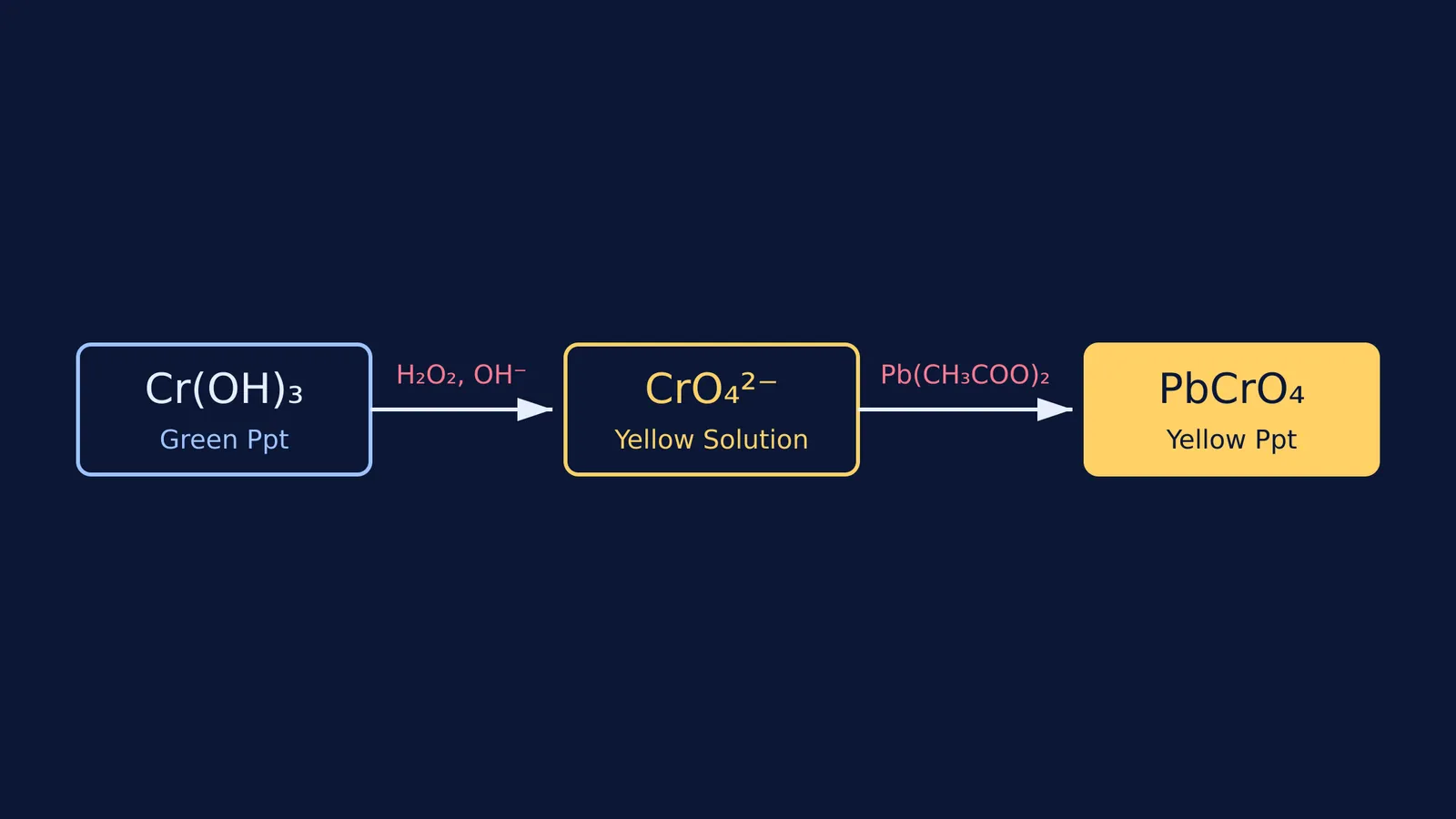
To confirm that the green solid is indeed chromium, you must convert it into a form that is easier to test. You do this by dissolving the precipitate in an excess of sodium hydroxide and then adding a few drops of hydrogen peroxide before heating the mixture.
In this basic medium, hydrogen peroxide acts as a strong oxidising agent. It oxidises the chromium from the +3 oxidation state up to the +6 oxidation state. The result is the chromate ion (CrO₄²⁻), which turns the mixture into a clear yellow solution.
Chromium compounds are famous for their intense colours, which is why the element is named after the Greek word for colour, *chroma*. The trivalent chromium ion is generally green or violet in aqueous solutions, depending on the ligands attached to it. However, when it loses more electrons to become hexavalent during the oxidation step, it shifts to bright yellow in the chromate form, or bright orange in the dichromate form.
How do you write the confirmatory chemical equations?
Once you have the yellow sodium chromate solution, the final confirmation is straightforward and visually striking. You first acidify the yellow solution slightly with a few drops of acetic acid, and then you add a freshly prepared lead acetate solution.
The lead ions react instantly with the chromate ions to yield a bright yellow precipitate of lead(II) chromate (Wikipedia_chromate)). Seeing this vibrant yellow solid confirms the presence of the chromium ion beyond doubt.
When you record the confirmatory test for chromium in your practical file or answer it in a board exam, examiners expect you to write the completely balanced chemical equations for both the oxidation and the precipitation steps.
The oxidation of chromium(III) hydroxide: 2Cr(OH)₃ + 3H₂O₂ + 4OH⁻ → 2CrO₄²⁻ + 8H₂O
The precipitation of lead chromate: Na₂CrO₄ + Pb(CH₃COO)₂ → PbCrO₄↓ + 2CH₃COONa
The downward arrow (↓) denotes the yellow precipitate.
How can you learn step-by-step chemistry with Fermi?
Memorising chemical reactions by rote is a fragile strategy for exams like JEE or NEET. When you understand why a reagent like hydrogen peroxide is needed to change the oxidation state, the equations become logical rather than random letters.
If you have concept gaps about reaction mechanisms or need help understanding redox reactions, the Fermi Concept Library covers every concept in chemistry, each with its own lesson and its place in the map. Fermi's AI tutor explains the reasoning at each step, making sure you know how the electrons move and why the colours change.
While you are mastering qualitative tests, you might also want to review the test for water using copper sulphate and cobalt chloride paper. For more inorganic chemistry, learn why anionic complexes end in -ate or how to predict high spin or low spin complexes.


