

On this page
Testing for water is a fundamental skill in laboratory chemistry, but it is easy to confuse testing for the presence of water with testing for its purity. In school and introductory chemistry courses, two classic chemical tests are widely used: white anhydrous copper(II) sulphate powder and blue cobalt(II) chloride paper. Both methods rely on clear colour changes triggered when water molecules bind to transition metal ions.
What is the anhydrous copper sulphate test for water?
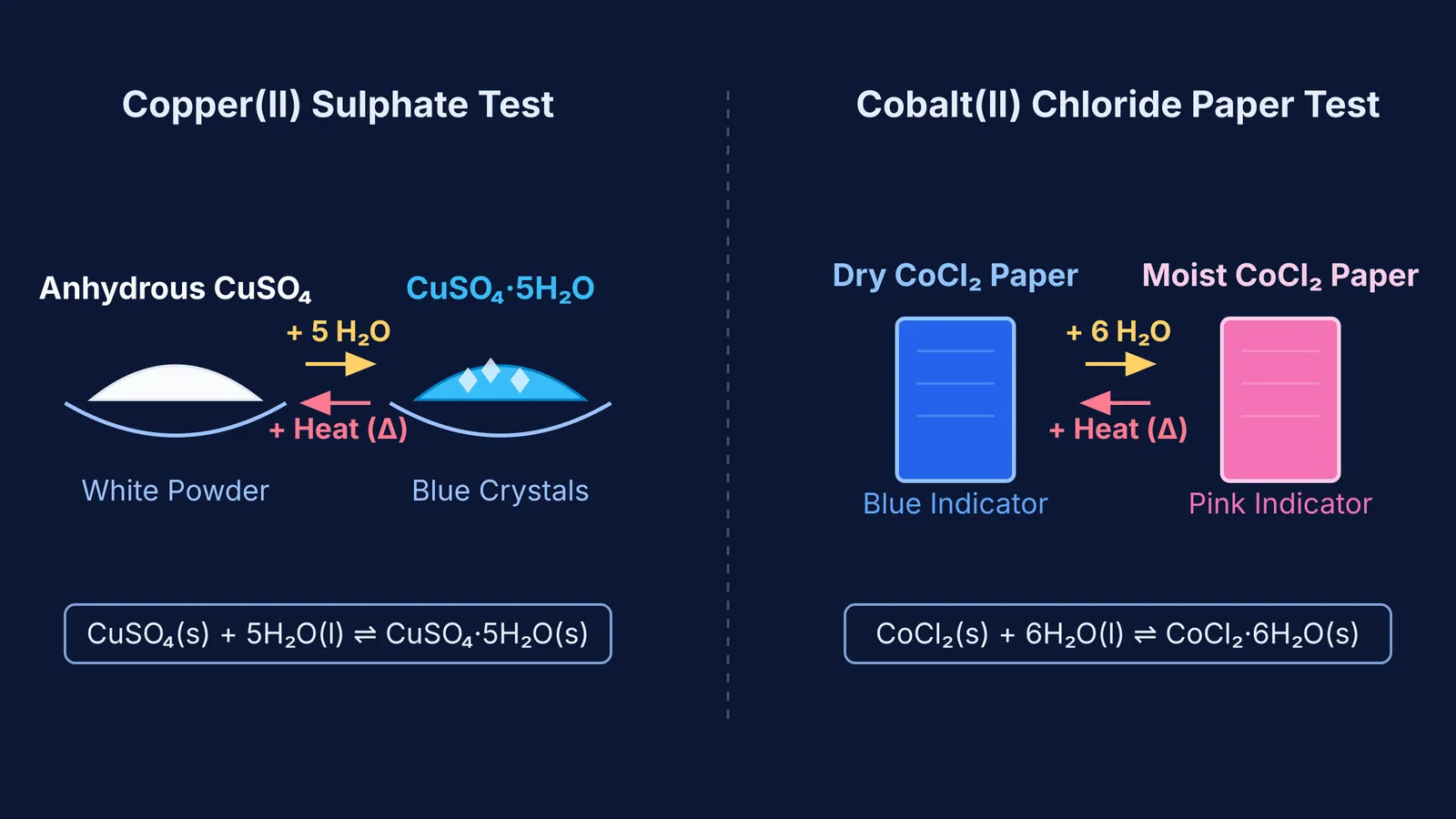
Anhydrous copper(II) sulphate (CuSO₄) is an off-white or pale grey powdery solid. The term "anhydrous" indicates that the salt contains no water of crystallisation within its crystal lattice. When anhydrous copper(II) sulphate comes into direct contact with liquid water or atmospheric moisture, it undergoes an exothermic hydration reaction. The water molecules coordinate around the central copper(II) ions, converting the powder into bright blue copper(II) sulphate pentahydrate (CuSO₄·5H₂O) (Chemguide).
The chemical equation for this reversible hydration reaction is: CuSO₄(s) + 5H₂O(l) ⇌ CuSO₄·5H₂O(s)
Because this hydration reaction is reversible, heating the blue pentahydrate crystals drives off the chemically bound water as steam, leaving the dry white anhydrous powder behind. In chemical equilibrium studies, the concentrations of pure solids do not appear in equilibrium constant expressions because their activity remains constant. If you are exploring how reactions reach dynamic balance depending on phase, reviewing Heterogeneous equilibria: why solids and pure liquids drop out of K explains the mathematical reasoning in detail.
How does cobalt chloride paper test for water?
Cobalt(II) chloride (CoCl₂) indicator paper operates on a similar principle of reversible hydration, but with a different visual palette. In its anhydrous state, cobalt(II) chloride is deep blue. According to the Royal Society of Chemistry, laboratories prepare these indicator strips by soaking strips of absorbent filter paper in an aqueous solution of cobalt(II) chloride and drying them thoroughly in an oven until they turn bright blue.
When a drop of liquid water touches the dry blue paper, or when the paper is exposed to moist air, the cobalt ions hydrate to form cobalt(II) chloride hexahydrate (CoCl₂·6H₂O). This hydration changes the coordination sphere and geometry of the transition metal complex, driving a noticeable colour shift from blue to pink. In anhydrous conditions, the cobalt complex adopts a tetrahedral geometry, whereas upon hydration with water molecules, it forms an octahedral hexaaqua complex.
The chemical equation describing this reversible hydration is: CoCl₂(s) + 6H₂O(l) ⇌ CoCl₂·6H₂O(s)
To explore how electron configurations, ligand fields, and hydration states determine the colours of transition metal compounds, you can study the interactive models in the Fermi Concept Library.
Why do these tests show water but not its purity?
Both anhydrous copper(II) sulphate and cobalt(II) chloride paper are qualitative tests for the presence of water molecules. They can confirm that H₂O is present in a liquid or vapor, but they cannot prove that the sample is pure water.
If you apply a drop of tap water, sea water, or even a liquid mixture containing ethanol and water to either reagent, the indicator will still change colour immediately. The transition metal ions react selectively with water molecules regardless of whether other substances, such as dissolved salts, sugars, or other solvents, are present. Because these tests detect the chemical presence of water molecules rather than the absence of contaminants, a positive colour change cannot be taken as evidence of purity.
How do you test for the purity of water?
To confirm that a clear liquid is 100% pure water, you must measure its characteristic physical constants. According to the USGS Water Science School, pure water has an exact boiling point of 100°C and an exact freezing point of 0°C at a standard atmospheric pressure of 1 atmosphere.
Any dissolved solute or volatile impurity alters these physical constants through colligative properties, specifically boiling point elevation and freezing point depression. For example, dissolving table salt in water causes the solution to boil at a temperature above 100°C and freeze at a temperature below 0°C. If a sample boils over a range of temperatures rather than at a sharp, constant 100°C, it contains impurities.
When an unknown sample is found to be impure, analytical chemists turn to quantitative procedures rather than qualitative colour strips. For instance, you might use Back titration: finding purity when direct titration fails to calculate the exact percentage of an unreactive or insoluble contaminant in a solution.
Checklist for testing water presence and purity in the laboratory:
Confirm presence first: Add a small drop of the liquid to white anhydrous copper(II) sulphate or touch it to dry blue cobalt chloride paper. A colour change to blue or pink confirms that water is present in the mixture.
Determine the boiling point: Place a portion of the sample in a distillation flask with a thermometer positioned at the neck. Heat the liquid to boiling and observe whether it boils at a steady, sharp temperature.
Determine the freezing point: Cool a small sample in an ice-and-salt cooling bath while monitoring the temperature with a precision thermometer until solid crystals form.
Evaluate against physical standards: If the sample boils sharply at exactly 100°C and freezes at exactly 0°C at standard pressure (1 atmosphere), it is pure water. Any deviation from these fixed temperatures proves the presence of dissolved impurities.


