

On this page
Lonnie Johnson was building a heat pump at home, not a toy, when a prototype sent a jet of water across the room. The Encyclopedia of Alabama dates this to 1982 and says he “decided to adapt the apparatus as a water toy.” That toy became the Super Soaker.
Who is Lonnie Johnson, the NASA engineer behind the Super Soaker?
According to the National Inventors Hall of Fame, Johnson was born on 6 October 1949 in Mobile, Alabama. He studied mechanical engineering, then nuclear engineering, at Tuskegee University, and joined the US Air Force. In 1979 he moved to NASA's Jet Propulsion Laboratory (JPL) to work on the Galileo mission to Jupiter. He later went back to the Air Force, then returned to NASA in 1987 to work on Mars Observer and Cassini. The Encyclopedia of Alabama places him at Air Force bases from 1982 to 1985. So in 1982 he was back in the Air Force.
How did a heat pump turn into a water gun?
Johnson was working on a more efficient, environmentally friendly heat pump. In an interview with Popular Mechanics, quoted by the National Inventors Hall of Fame, he said: “I accidentally shot a stream of water across a bathroom where I was doing the experiment and thought to myself, ‘This would make a great gun.’”
He built a first prototype from plexiglass pieces and gave it to his 7-year-old daughter. His patent for a “squirt gun”, US 4,591,071, was filed on 14 October 1983 and granted on 27 May 1986. He was quoted $200,000 to make the first 1,000 guns, and it took a 7-year search before he met the toy company Larami (National Inventors Hall of Fame). Before pitching it at Larami's headquarters, he redesigned the gun with a 2-litre soda-bottle tank. “I took the gun out of my suitcase,” he recalled. “They asked if it worked and I shot water across the conference room.” It went on sale as the Power Drencher in 1990 and became the Super Soaker in 1991. Its lifetime sales are over $1 billion.
How does a Super Soaker use air pressure to fire water?
A later patent by Bruce D'Andrade and Johnson, US 5,074,437, describes the mechanism. Sliding the handle pushes air through a one-way valve into the water tank, where it collects above the water and gets squeezed tighter with every stroke. Pulling the trigger opens a valve, and the trapped air drives water out through a narrow nozzle. The trigger valve also acts as a safety valve: at a set maximum, between 50 and 90 psi in the patent, it opens by itself and lets water out.
Two ideas from school physics explain it:
Boyle's law: at a fixed temperature, a gas's pressure times its volume stays the same. Halve the air's volume and you double its pressure. You can test this with the air-column Boyle's law experiment.
Bernoulli's equation: pressure energy becomes kinetic energy at the nozzle, so the exit speed is v = √(2ΔP/ρ), where ΔP is the gauge pressure and ρ is water's density. See what each term in Bernoulli's equation means.
Worked example: how far can the jet reach?
These are our own numbers for an ideal gun, not measurements of a real model. We assume no friction or drag, and air that stays at room temperature.
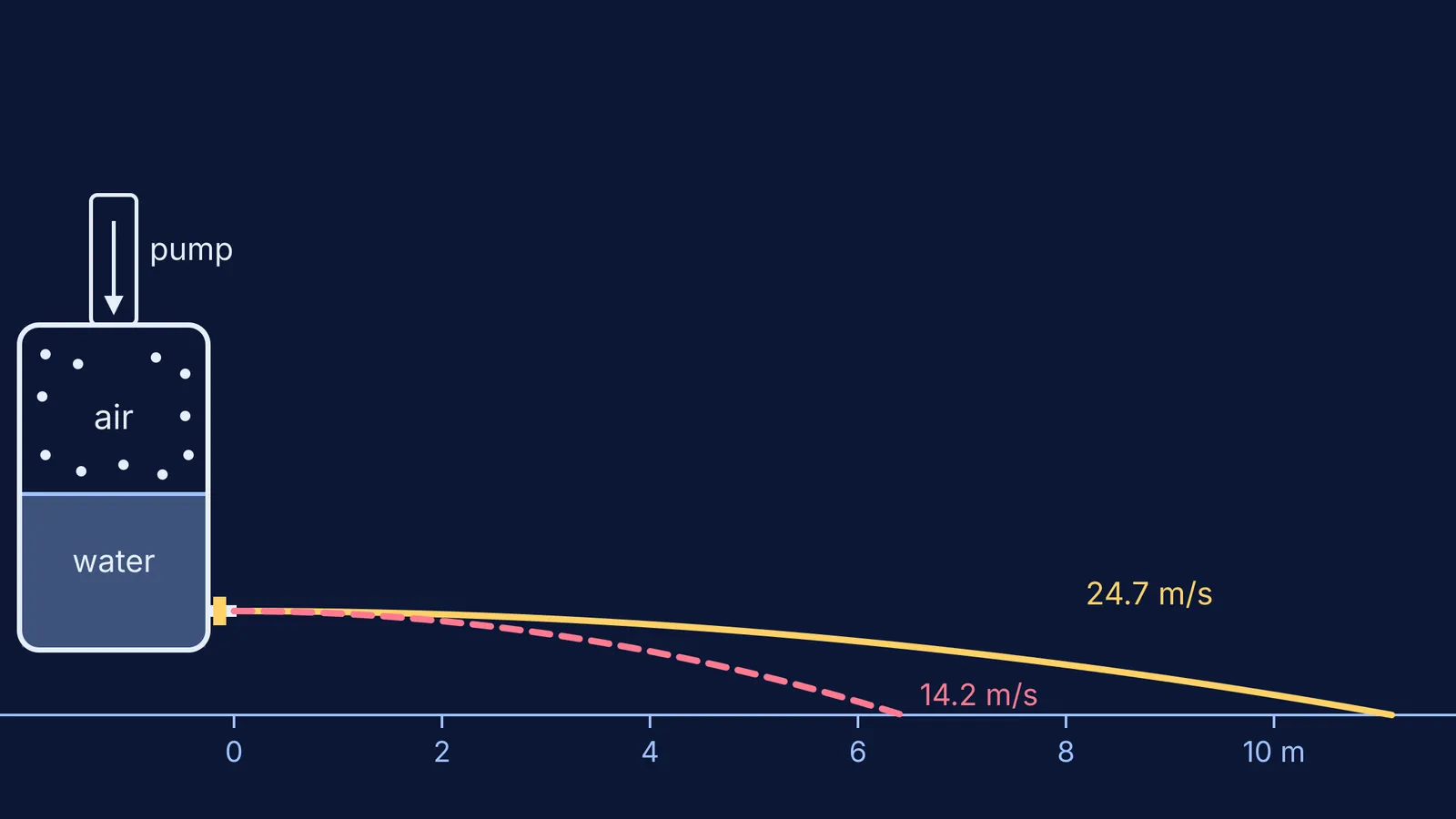
After pumping, the tank holds 0.25 L of air at 4 atm absolute. That is 3 atm, or about 304 kPa (44 psi), above the air outside.
Exit speed: v = √(2 × 304,000 Pa ÷ 1000 kg/m³) ≈ 24.7 m/s.
Fire level from 1 m above the ground. The water takes √(2 × 1 ÷ 9.81) ≈ 0.45 s to fall, so it lands about 24.7 × 0.45 ≈ 11.1 m away.
Now fire 0.25 L of water. The air expands to 0.5 L, so by Boyle's law its pressure falls to 2 atm absolute, or 1 atm gauge. The speed drops to about 14.2 m/s, and the range to about 6.4 m.
So range falls as the tank empties. More air space makes the drop smaller: with 0.5 L of air at 4 atm, firing 0.25 L only takes the pressure down to about 2.7 atm. Real jets fall short of these numbers because of air resistance.
If your answer to step 4 comes out different, the Fermi Problem Library has worked problems with a step-by-step solver that explains the reasoning rather than printing an answer. If it's hard to picture pressure turning into speed, the Fermi Simulation Lab has interactive simulations for ideas that are easier to see than to read.
What can students learn from Lonnie Johnson?
Notice the accident. The jet came out of a different project.
Build it rough first. Plexiglass, then a soda bottle.
Expect the long part to be making it. It took seven years to find a manufacturer.
The Super Soaker entered the National Toy Hall of Fame in 2015, and Johnson entered the National Inventors Hall of Fame in 2022 (Encyclopedia of Alabama). Next time you pick up a water gun, work out its exit speed.


