

On this page
Every packet of ham or salami depends on a problem Lloyd Hall spent much of his career on: how do you get salt and nitrite into meat evenly, safely and before it spoils? Hall was born on 20 June 1894 in Elgin, Illinois, held more than 100 U.S. and foreign patents, and was inducted into the National Inventors Hall of Fame in 2004. He joined Griffith Laboratories in 1925 as chief chemist and director of research, according to a Hall of Fame profile.
Who was Lloyd Hall?
Hall studied pharmaceutical chemistry at Northwestern University, then worked as a chemist for Chicago's health department, as chief chemist at the meatpacker John Morrell Company, and as chief inspector of powder and explosives for the U.S. Ordnance Department during the First World War, as his Wikipedia biography records. Western Electric turned him away after discovering he was Black, it notes. He stayed at Griffith until he retired in 1959, then consulted for the UN Food and Agriculture Organization.
The National Inventors Hall of Fame credits him with more than 100 U.S. and foreign patents, and records that President Kennedy appointed him to the American Food for Peace Council, where he served from 1962 to 1964.
How did Hall's curing salt work?
Hall's curing salts combined three compounds: sodium chloride (table salt), sodium nitrate and sodium nitrite. Nitrite forms nitric oxide, which bonds with the iron in myoglobin to fix cured meat's typical colour, and it helps control *Clostridium botulinum*, the bacterium behind botulism, as a 2022 study in the journal Foods explains.
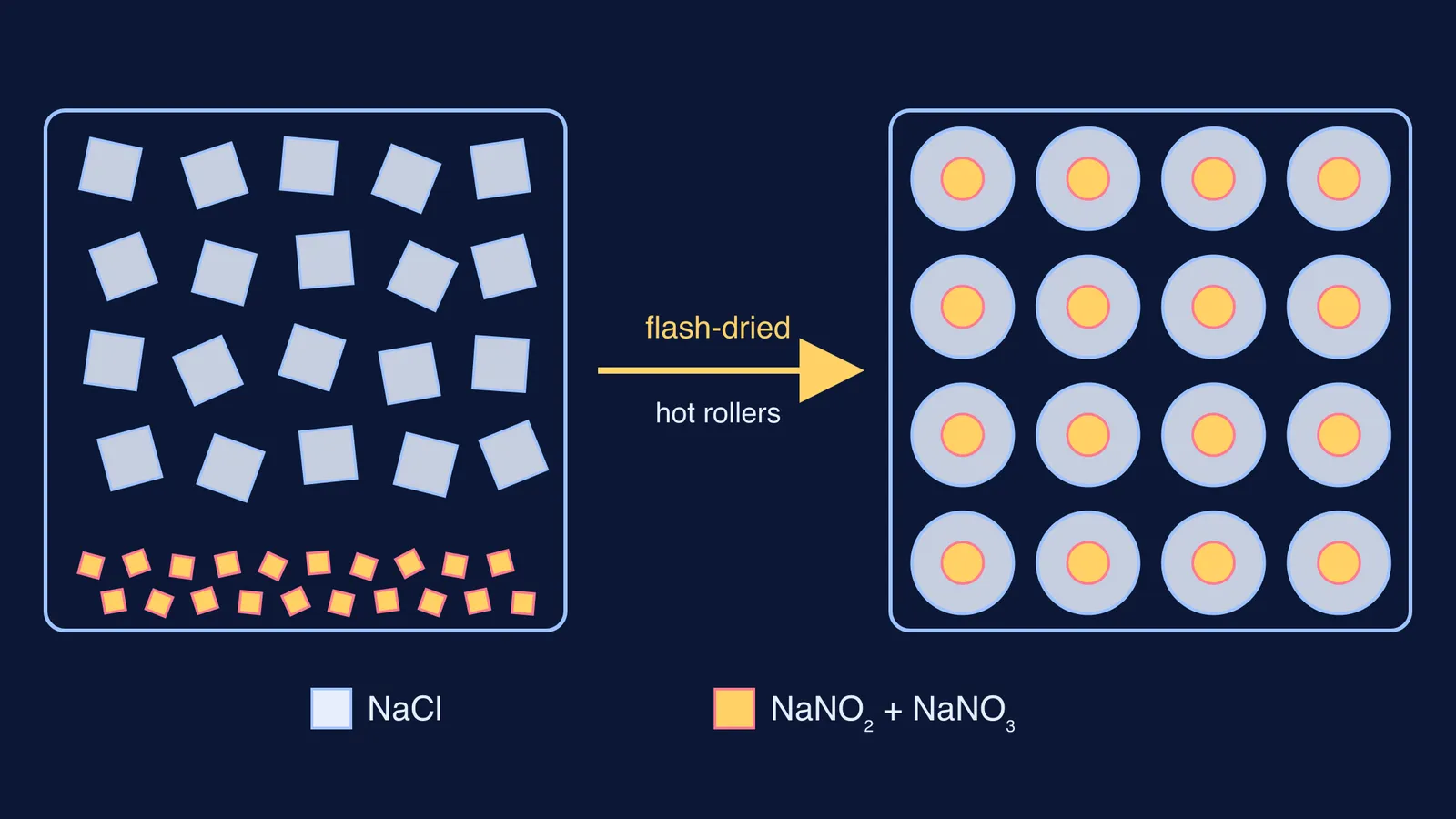
The trouble was speed. Hall found that the sodium nitrite and nitrate acted on the meat much faster than the table salt, so the meat broke down before it was preserved, according to the National Inventors Hall of Fame.
The fix was a grain built in layers, using a flash-drying process invented by the German chemist Karl Max Seifert. A 1936 Griffith Laboratories patent in Enoch L. Griffith's name, US 2,054,623, describes spreading a salt solution on a revolving roll heated to 140–160 °C, so that each grain is a jacket of sodium chloride around a core of nitrite and nitrate. The patent explains that mixed ingredients separated in handling and shipping, and that excess nitrite was a health concern. In a fused grain, every pinch carries the same ratio. Hall took a leading role in developing the process, his Wikipedia biography says.
The grains soaked up moisture and caked, so Hall added hygroscopic agents such as corn sugar and glycerine. His 1956 patent with Walter Kalchbrenner, US 2,770,551, says even those mixtures had caked as early as two weeks, and that adding at least 0.5% sodium citrate (1.5–2% preferred) kept the crystals free-flowing.
How did Hall sterilise spices without cooking them?
Heat kills microbes in spices, but it also spoils them. US patent 2,107,697, granted in 1938 to Carroll L. Griffith and Hall, notes that dry or moist heat above 240 °F destroys a spice's colour and flavour. Instead, the material was heated under vacuum, then exposed to undiluted ethylene oxide gas at about 150 °F for about 2.5 hours, then aired out. The patent reports killing more than 99% of bacteria, moulds and yeasts with no change in taste or odour.
The patent says the vacuum ensures deep penetration of the gas into the material, even in packaged goods. The Hall of Fame calls this the Ethylene Oxide Vacugas treatment.
What else did Lloyd Hall invent?
Fats go rancid when oxygen attacks them, so Hall also worked on antioxidants. His patent list on Wikipedia includes antioxidant salts, antioxidant flakes and "synergistic antioxidants" from 1949 to 1956. Knowing that unprocessed vegetable oils contain natural antioxidants such as lecithin, he found ways to combine them with salts so they could be added to other foods.
That classification is set out in the WHO's questions and answers on red and processed meat.
How can you think like Hall about a chemistry problem?
You can read Hall's patents as answers to four questions. Try them on any preservation method you study, from pickles to canning:
What spoils it? Microbes, oxygen or water.
Which chemical stops it, and how? (Nitrite gives nitric oxide, which binds iron in myoglobin and helps hold back bacteria.)
What goes wrong in practice? (The salts acted at different speeds and separated in the bag.)
What does the fix break? (Fused grains caked, so later patents added glycerine, then citrate.)
If step 2 is where you get stuck, for example why nitrite can act as both oxidising and reducing agent, the Fermi Concept Library has a lesson for each idea in chemistry and shows its place in the map. For the lab side, see our guide to the starch-iodide test for nitrite ions.
For older methods, read how Nicolas Appert invented canning before anyone knew about microbes, and our explainer on pasteurisation, salt, sugar and vinegar as preservatives.


