

On this page
In 1931 Libbie Hyman left Chicago, toured western Europe for fifteen months, and came back with one plan: to describe the animals without backbones. In the autobiography in her US National Academy of Sciences memoir, she says she "settled in New York to devote my entire time to the writing of a treatise on the invertebrates" (NAS Biographical Memoirs). The result, The Invertebrates, became a standard reference for zoologists. The way she organised it is still a good way to learn animal classification today.
What is Libbie Hyman's The Invertebrates?
The Invertebrates is a six-volume treatise on animals without backbones, written by the American zoologist Libbie Henrietta Hyman (1888–1969) and published between 1940 and 1967 (NAS Biographical Memoirs). The same memoir puts the six volumes at more than 4,000 pages.
In the Journal of Experimental Zoology, Ronald Jenner calls Hyman "the most influential comparative invertebrate zoologist of the 20th century in the English-speaking world" (Jenner, 2004). He describes The Invertebrates as "the most encompassing single-author synthesis of invertebrate structure and development of the 20th century". He also notes that her ideas about how animal body plans evolved made their way into textbooks and, until recently, were equated with the "classical" view.
What does each volume of The Invertebrates cover?
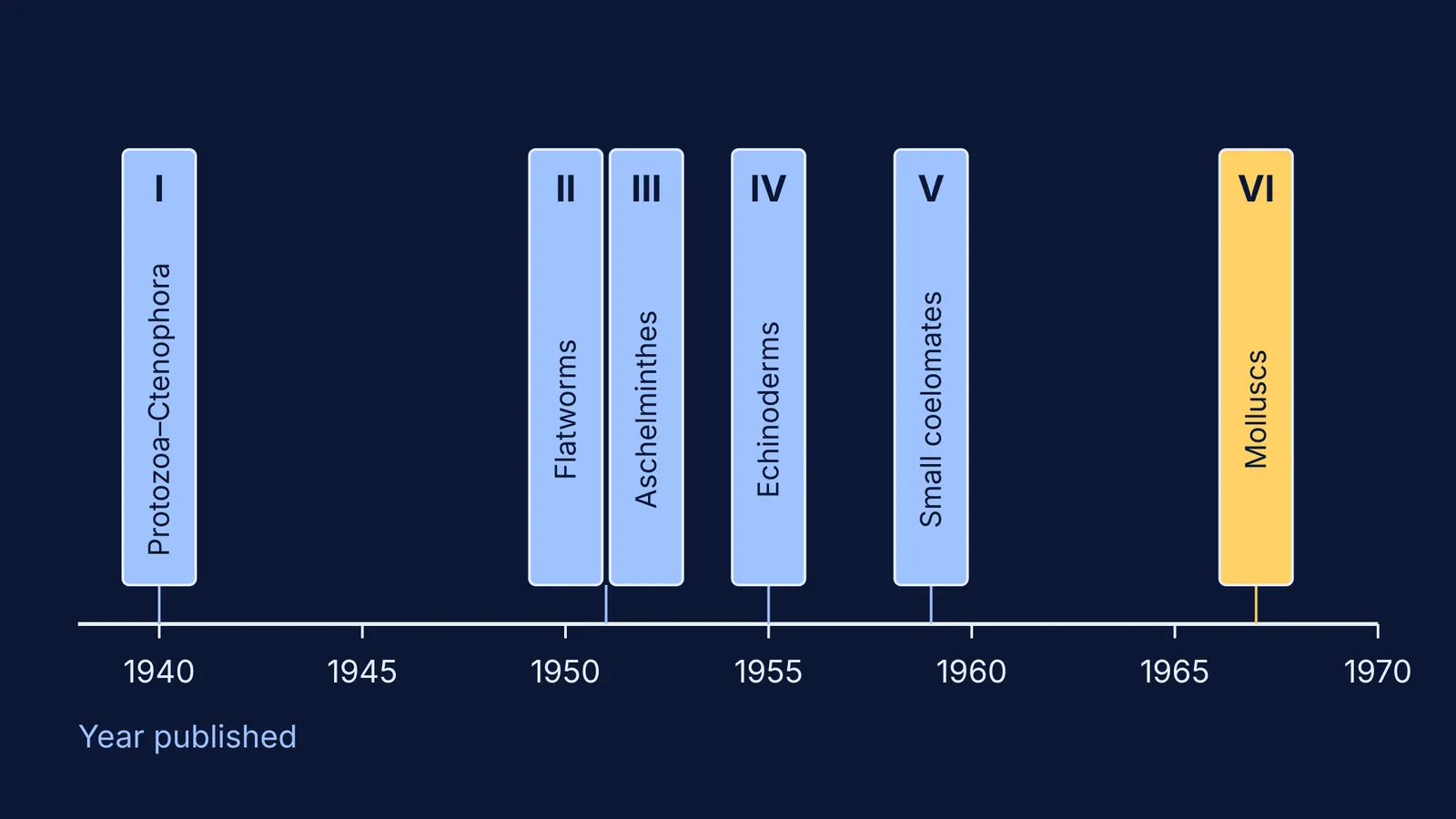
These are the six volumes, with years and groups as listed in the NAS memoir:
Volume I (1940): Protozoa through Ctenophora, including a full chapter on the sponges (Porifera).
Volume II (1951): Platyhelminthes and Rhynchocoela, the flatworms and ribbon worms.
Volume III (1951): Acanthocephala, Aschelminthes and Entoprocta.
Volume IV (1955): Echinodermata.
Volume V (1959): the smaller coelomate groups.
Volume VI (1967): Mollusca I.
The set was never finished. In her 1940 preface, Hyman planned that "the arthropods will occupy the final volume" (Volume I, Internet Archive scan). By 1967 she had Parkinson's disease, and in the preface to Volume VI she wrote that she was retiring, "satisfied that I have accomplished my original purpose—to stimulate the study of invertebrates" (NAS memoir).
Why did one person write the whole thing?
When Volume I appeared, her preface pointed out that no advanced text in English on invertebrate zoology had been published since Lankester's unfinished Treatise on Zoology, "almost forty years ago" (Volume I preface). She first planned a laboratory manual, then three volumes, and the plan kept growing.
The memoir explains how she paid for it: by about 1930 she could live on the royalties of her books, which by then included her laboratory manuals for elementary zoology and comparative vertebrate anatomy. She called the treatise "essentially a compilation from the literature". Her strengths, she said, were translating European languages and organising what she read. She also drew most of the figures herself. In the preface she admits this was "in large part responsible for the slow progress of the work."
The Linnean Society of London gave her its gold medal in 1960. The memoir quotes the zoologist C. F. A. Pantin: "The debt of every zoologist to her is immense."
Why did Hyman avoid teaching one "type" animal?
A common shortcut is to teach a phylum through one example animal. Hyman deliberately did not. Her preface warns that when a group is reduced to a single type form, "the student is left with a very narrow, and often erroneous, conception of the subject" (Volume I preface). Instead, she set out to show the range of variation within each group.
This matters for you if you learn one example per phylum and then lose marks on the exceptions. Our post on animal classification exceptions that appear in MCQs collects the usual traps.
How can you study a phylum the Hyman way?
Use her chapter layout as a one-page template. The table of contents of Volume I shows the sponge chapter in this order: the characters of the phylum, its classification, its general morphology and physiology, then each class in turn (Calcarea, Hexactinellida and Demospongiae), and finally general and phylogenetic considerations.
A worked plan for sponges, reusable for any phylum:
Characters: write the features every member shares, in one line each, from your textbook.
Classification: list the classes. For sponges, Hyman uses three.
Body plan and how it works: for sponges, this means water flow through the body. Our explainer on the Porifera canal system walks through it.
Range: for each class, name one textbook example and one way it differs from the others.
Comparison: place the phylum by its body cavity, using our guide to acoelomate, pseudocoelomate and coelomate animals.
Exceptions: end with one line on the member that breaks the rule.
A page like this turns revision into a comparison across phyla rather than a list to memorise.
If a term such as coelom keeps tripping you up, the Fermi Concept Library gives every biology concept its own lesson and shows where it sits on the map. If you are not sure which phylum to start with, Fermi's AI tutor works out what you already know and builds a plan for the session.
Start with sponges tonight. Fill in one page, then check it against your textbook.


