On this page
Push down on the ends of a plastic ruler and, for a while, nothing happens. Then, all at once, it bows out sideways. That is buckling, and the load at which it starts has a formula more than 280 years old.
What is Euler's buckling formula?
Euler's critical load is P = π²EI/(KL)², the compressive load at which a slender column buckles (Euler's critical load, Wikipedia). Here:
E is Young's modulus, how stiff the material is.
I is the smallest second moment of area of the cross-section: how far the material sits from the bending axis.
L is the unsupported length of the column.
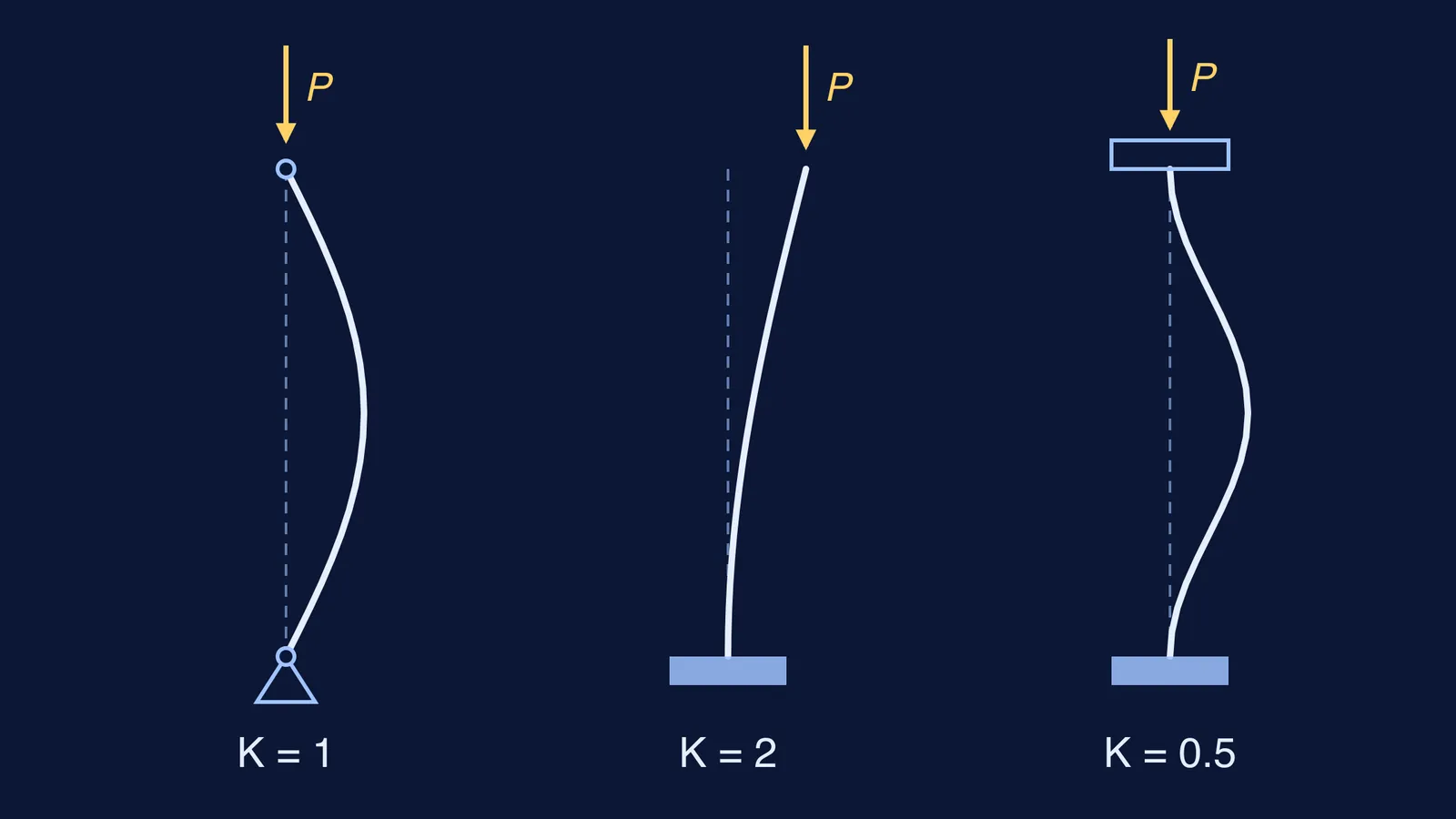
K is the effective length factor, set by how the ends are held.
The same page gives K = 1 when both ends are pinned, K = 2 when one end is fixed and the other free, about 0.7 for fixed-pinned and 0.5 when both ends are fixed.
The key idea is a threshold. The column stays straight for loads below the critical load and deflects sideways for loads above it (Bistafa, Euler's variational approach to the elastica). Notice what is missing: the strength of the material. A slender column fails by bending away, not by being crushed. If I is new to you, see why beams have an I-shaped cross section.
Who worked out the buckling formula, and when?
In October 1742, Daniel Bernoulli wrote to Leonhard Euler proposing that a bent elastic strip takes the shape that makes its stored bending energy smallest, and invited Euler to solve it, according to Sylvio Bistafa's history of the elastica (arXiv:2303.18126). Bernoulli had tried and got stuck on a fourth-order differential equation.
Euler's answer appeared in 1744 as *Additamentum I, De curvis elasticis* (On elastic curves), an appendix to his book *Methodus inveniendi lineas curvas*, a founding text of the calculus of variations (Euler Archive, E65). In it he sorted the shapes a bent elastic strip can take into nine kinds; the simplest is a straight line. From that straight-line case he obtained the critical load for a straight vertical column, as Bistafa's paper shows.
His later paper *Sur la force des colonnes* (On the strength of columns) was written in 1757 and published in 1759 in the memoirs of the Berlin Academy (Euler Archive, E238). This is the same Euler who solved the Seven Bridges of Königsberg puzzle.
How much load can a steel rod take before it buckles?
Take a solid steel rod 10 mm in diameter and 1 m long, pinned at both ends. Structural steel (ASTM A36) has a Young's modulus of 200 GPa and a yield strength of 250 MPa (Engineering ToolBox, Young's modulus table).
Second moment of area of a solid circle: I = πd⁴/64 = π × (0.01 m)⁴ / 64 ≈ 4.91 × 10⁻¹⁰ m⁴.
Flexural rigidity: EI = 200 × 10⁹ Pa × 4.91 × 10⁻¹⁰ m⁴ ≈ 98.2 N·m².
Both ends pinned, so K = 1 and KL = 1 m.
Critical load: P = π² × 98.2 / 1² ≈ 969 N, about the weight of a 99 kg mass.
Check the stress: 969 N over an area of π × (0.005 m)² ≈ 7.85 × 10⁻⁵ m² is about 12 MPa, roughly a twentieth of the 250 MPa yield strength. The rod bows long before the steel gives way.
Now change one thing at a time:
Make it 2 m long: KL doubles, so P falls to a quarter, about 242 N.
Fix the bottom and leave the top free (K = 2) at 1 m: also about 242 N.
Fix both ends (K = 0.5): four times the pinned value, about 3,880 N.
Double the diameter to 20 mm: I grows 16 times, so P rises to about 15,500 N.
When does Euler's formula stop working?
Euler's formula assumes a perfectly straight, uniform column of one material, loaded exactly along its axis and compressed only within the elastic range (Euler's critical load, Wikipedia).
The bigger limit is stockiness. For slender columns the critical buckling stress is usually below the yield stress, but a stocky column can reach yield first, so it crushes instead of buckling (same source). For those columns engineers use other rules, such as the parabolic formula John Butler Johnson devised in 1893. If yield is unfamiliar, see how to read the stress-strain curve of a wire.
How can you see buckling at home?
Stand a plastic ruler on a table and press down on the top. It bows across its thin side, never its wide side: the smallest I at work. Now grip it halfway up and press again. It takes clearly more force, because you have shortened L.
If it is hard to picture why the bent shape appears all at once, the Fermi Simulation Lab has interactive simulations for ideas that are easier to see than to read. If a column problem trips you up at the K or I step, the Fermi Problem Library has worked problems with a step-by-step solver that explains the reasoning rather than printing an answer.