On this page
In 1912 the Spanish engineer Leonardo Torres Quevedo finished a machine that played chess with no human hidden inside. It played one endgame only, king and rook against a lone king, but it played on its own and always won. Four years later, his cable car began carrying passengers over the Niagara Whirlpool.
What was El Ajedrecista?
El Ajedrecista ("the chess player") was completed in 1912 and first shown in Valladolid, Spain, in 1913, according to the Wikipedia article on El Ajedrecista. Earlier chess "automatons" such as the Mechanical Turk hid a human player. This one did not.
The machine played white's king and rook; a person played black's lone king. Each piece had a metal mesh at its base that closed an electric circuit, so the board sensed where the pieces stood. An illegal move lit a lamp, and after three the machine stopped playing.
Historian Allison Marsh writes in IEEE Spectrum that it debuted publicly at the University of Paris in 1914, and that a 1920 version moved pieces with electromagnets hidden under an ordinary board and used a gramophone recording to announce check and mate. Both machines are kept at the Museo Torres Quevedo in Madrid.
How did Torres Quevedo's chess machine decide its moves?
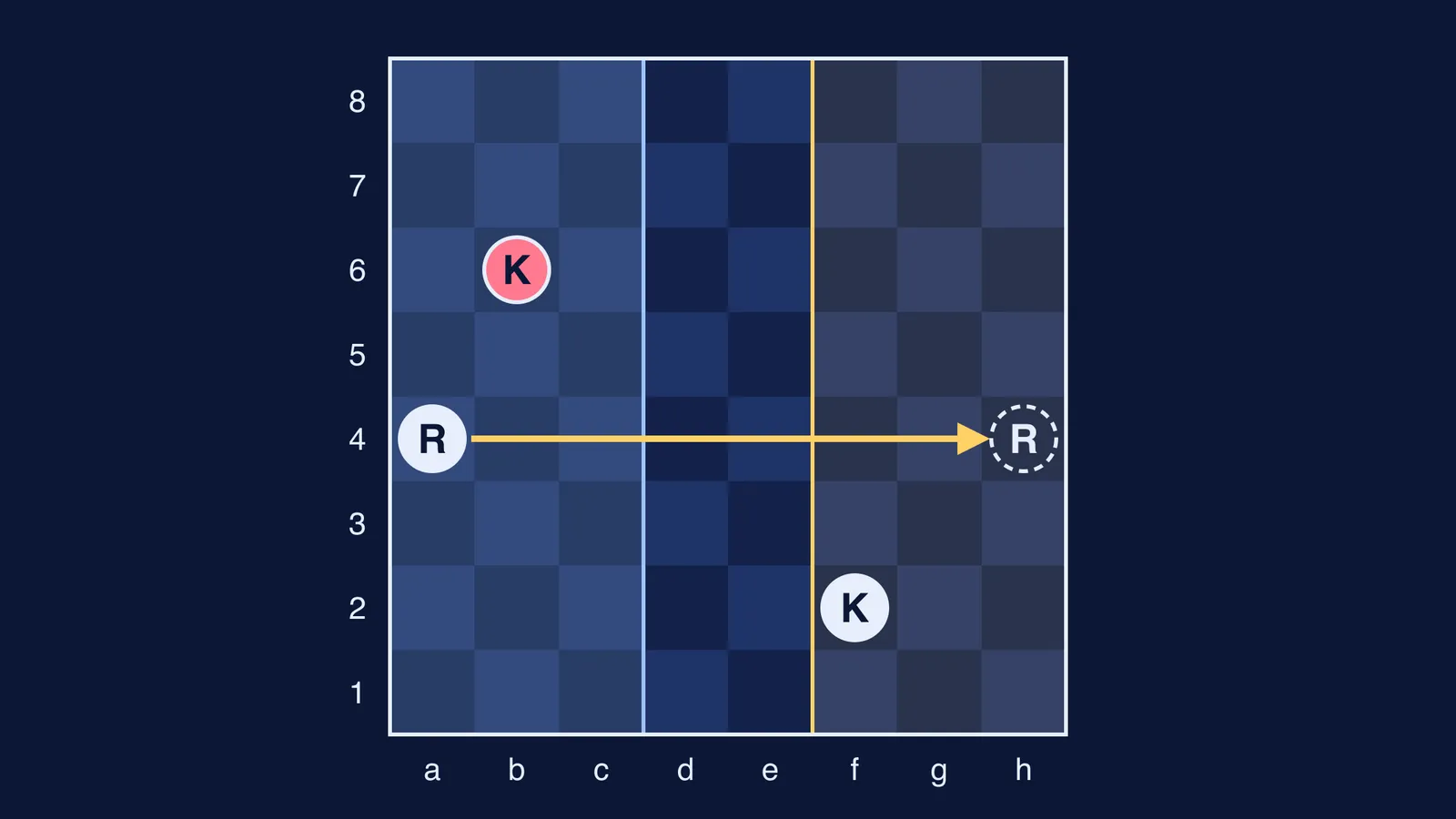
He split the board into two zones: files a to c, and files f to h. Files d and e belong to neither. Each time black moves, the machine checks these conditions in order, as described in the El Ajedrecista article:
If the black king is in the rook's zone, the rook leaves that zone, to the a-file or the h-file.
Otherwise, if the black king is more than one rank from the rook, the rook moves one square vertically towards it.
If the black king is one rank from the rook and the kings are more than two ranks apart, the white king moves one square vertically towards the black king.
If the black king is one rank from the rook and the kings are exactly two ranks apart, look at how many files apart the kings are. Odd: the rook shuffles sideways (a to b, h to g, or back). Even: the white king moves one file towards the black king. Zero: the rook moves one square vertically towards the black king.
There is no search and no memory of past games, just a fixed decision list built into wiring. Because the rules are simple, the machine does not mate in the fewest moves, and not always within the 50-move rule, but it mates every time.
Can you predict the machine's first four moves?
Try this worked example from the same Wikipedia article. White king f2, white rook a4, black king b6. Apply the rules before reading each answer.
Black king b6 is in the left zone, and so is the rook. Rule 1: rook a4 to h4.
Black plays king to c5. The black king (rank 5) is one rank above the rook (rank 4), and the kings (ranks 2 and 5) are three ranks apart. Rule 3: white king f2 to f3.
Black plays king to d5. The rook is still one rank below; the kings are two ranks apart; the f-file and d-file are two files apart, an even number. Rule 4: white king f3 to e3.
Black plays king to d6, two ranks above the rook. Rule 2: rook h4 to h5.
All four match the example line on the same page, which ends in mate on white's 21st move.
Checking each condition in order is the habit that saves marks in multi-step maths and physics problems. If you lose marks by jumping steps, the Fermi Problem Library has worked problems with a step-by-step solver that explains the reasoning rather than printing an answer.
What did Torres Quevedo build at Niagara?
Torres Quevedo (1852 to 1936) designed the Spanish Aero Car, which crosses the Niagara River's Whirlpool over about 520 metres, according to the Canadian Society for Civil Engineering. It was first tested on 15 February 1916 and officially opened on 8 August 1916. In 2010 the society unveiled a plaque marking it as an International Historic Civil Engineering Site.
The car hangs from six interlocking steel cables and still runs, notes IEEE Spectrum.
Why does a 1912 chess machine still matter?
Torres Quevedo argued that some tasks people think of as thinking could be done by machines following fixed rules. A 1915 Scientific American article, "Torres and His Remarkable Automatic Devices", put his view this way, as quoted in IEEE Spectrum: "There is, of course, no claim that it will think or accomplish things where thought is necessary, but its inventor claims that the limits within which thought is really necessary need to be better defined, and that the automaton can do many things that are popularly classed with thought."
Follow that question through Charles Babbage and his calculating engines, Alan Turing's definition of computing and Arthur Samuel's checkers program that learned from play.
Tonight, set up white king f2, white rook a4 and black king b6, and play the machine's side to mate.