

On this page
In 1959, an IBM researcher named Arthur Samuel did something new: he built a computer program that could beat its own creator at a game. His paper, "Some Studies in Machine Learning Using the Game of Checkers", introduced a concept that would change the trajectory of computer science (10.1147/rd.33.0210).
Before Samuel's work on the IBM 701 computer, machines were mostly seen as calculators that could only do exactly what a human programmer explicitly instructed. Samuel shifted this paradigm by showing that a machine could acquire its own expertise through practice and pattern recognition. His work occurred around the same time as other foundational computing research, such as Alan Turing's 1936 paper on what a computer can and cannot do and John McCarthy's Dartmouth proposal that named artificial intelligence.
When did Arthur Samuel coin the term machine learning?
Arthur Samuel coined the term "machine learning" in his 1959 paper published in the *IBM Journal of Research and Development*. He established it as a field of study focused on programming computers to learn from experience, rather than relying on detailed explicit programming.
This definition remains the standard today. Rather than writing a long list of rules for every possible checkers position—a mathematical impossibility—Samuel wrote a program that could deduce the rules of winning by evaluating its own experience.
How did Arthur Samuel's checkers program learn?
To make the program work within the tight constraints of the IBM 701, which had extremely limited memory, Samuel used a scoring function. The program evaluated a board based on features like piece count, the number of kings, and control of the centre. This mathematical function collapsed a complex board state into a single number that represented how favourable the position was for the computer.
It improved using two primary methods:
Rote learning: The program memorised board positions it had seen, alongside the game's final outcome. If it encountered that exact position again, it simply retrieved the stored value.
Generalisation: The program played many games against itself in a process called self-play. After a game, it adjusted the weighting of its scoring function. If a certain board feature consistently led to a win, the program increased that feature's importance for future games.
By 1962, the program had refined its generalisation enough to defeat Robert Nealey, a strong checkers player, surprising many observers.
What was the first machine learning program?
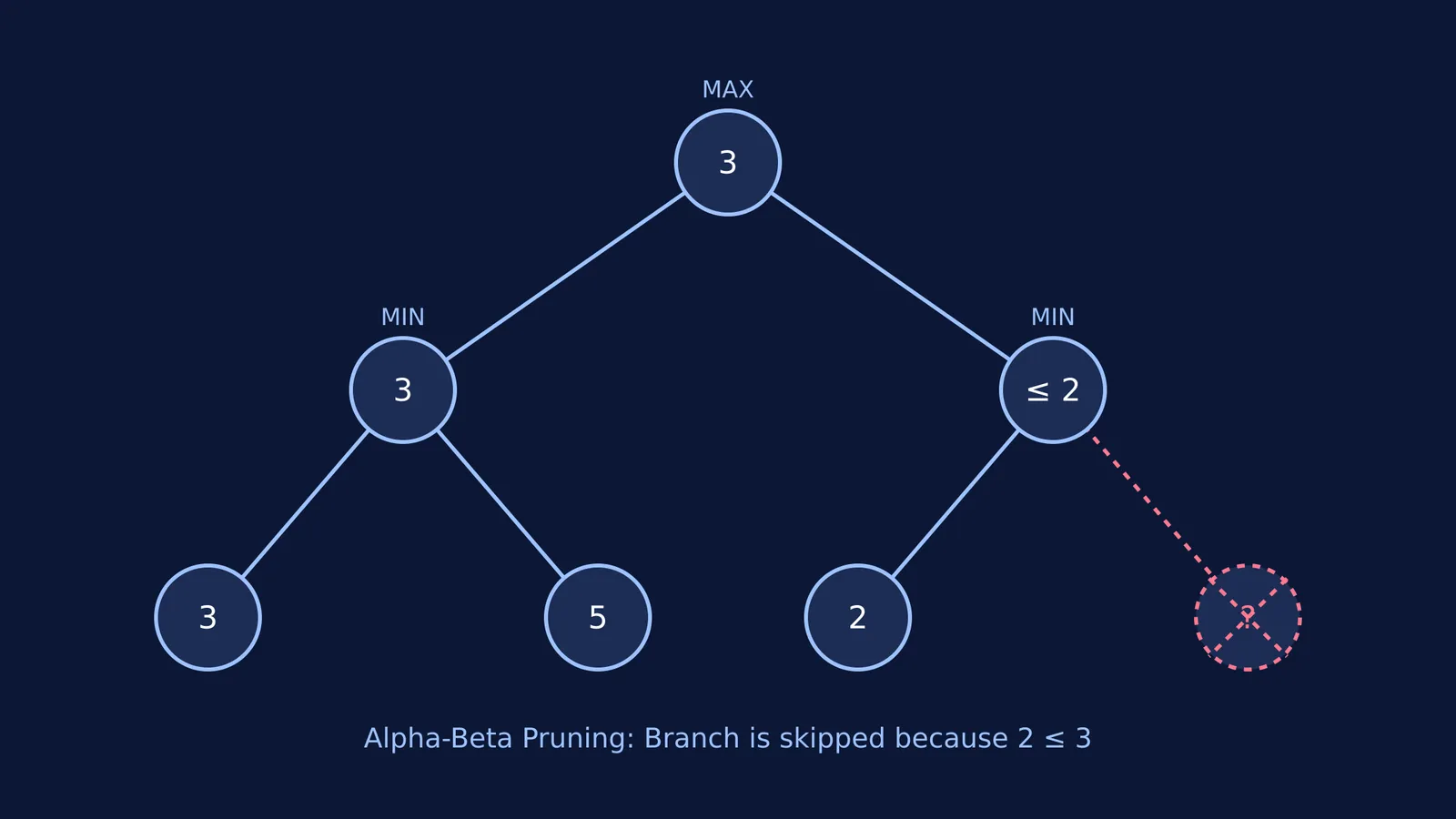
While there were earlier theoretical attempts, Samuel's checkers program is widely considered the first successful demonstration of machine learning. It also pioneered the practical use of the minimax algorithm and alpha-beta pruning. In a minimax search, the computer assumes its opponent will always make the best possible counter-move, and it seeks to minimize its own potential loss. Alpha-beta pruning is a technique that cuts off branches of a decision tree that represent clearly losing moves, saving computation time. By ignoring these unpromising paths, Samuel's program could look further ahead into the future of the game without running out of memory.
What is the legacy of self-play and learning?
Samuel demonstrated that games are an excellent environment for artificial intelligence: a closed, controlled space where complex decision-making can be tested and measured. His approach built upon the foundation laid by John von Neumann's mathematical work on games, bringing abstract game theory into practical computing. His concept of self-play directly paved the way for modern milestones in computing.
The core lesson from Samuel's checkers program is that learning happens through active practice and correcting mistakes, not just by being handed the answers. When you use Fermi's AI tutor, it holds a line of reasoning across a whole session, notices where you are stuck, and decides whether to explain, ask, or show. It teaches the method rather than just providing a solution. If you are struggling to bridge the gap between theory and execution, the Fermi Problem Library provides worked problems with a step-by-step solver that explains the reasoning rather than printing an answer.


