On this page
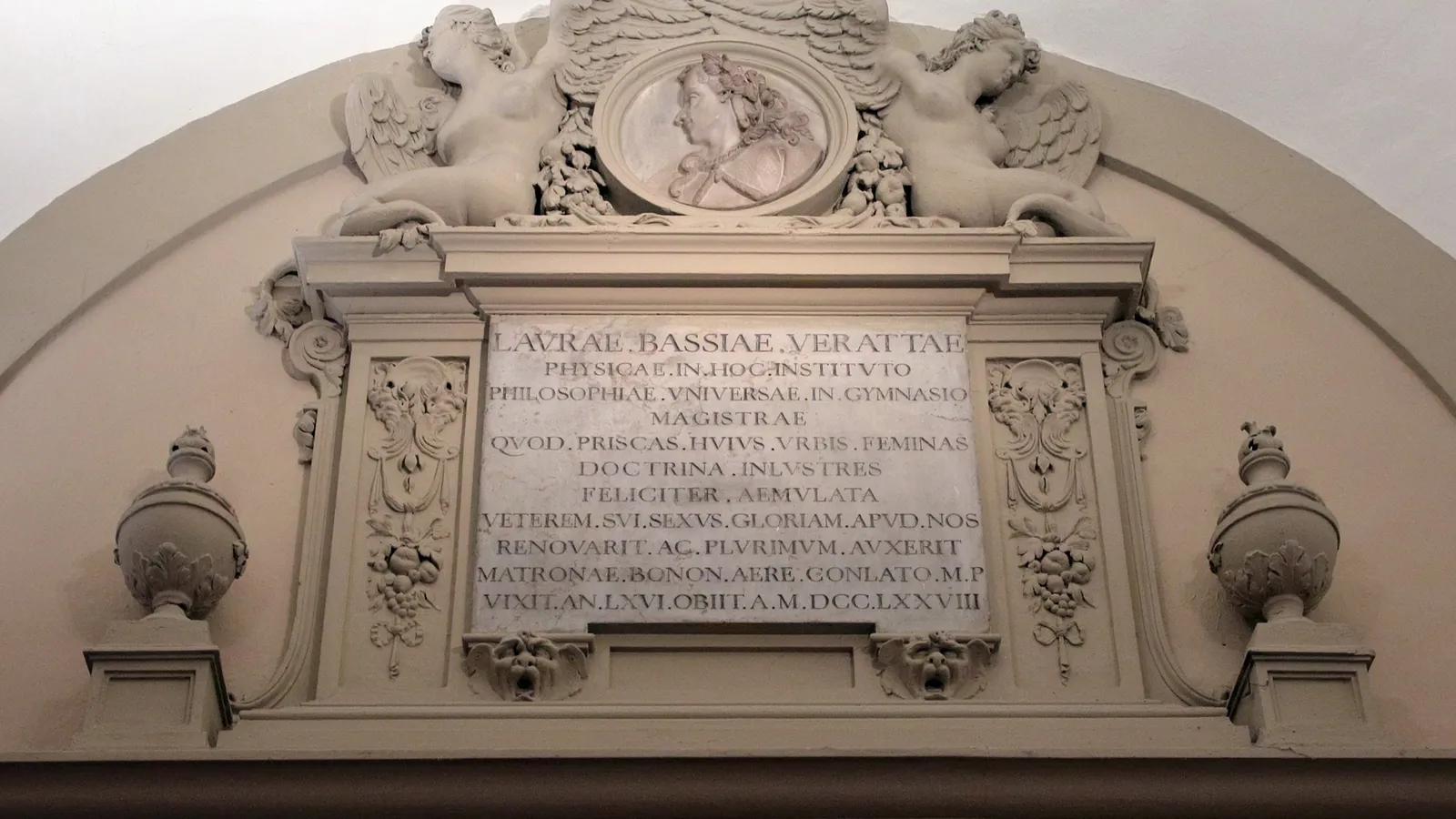
Laura Bassi was born in Bologna in 1711 and, according to Physics Today, became the first woman to be a physics professor at a European university. It took a whole career spent finding ways to do and teach physics when the rules allowed her only half a job.
Who was Laura Bassi?
The year 1732 made her famous. On 20 March, aged 20, she became the first woman elected to Bologna's Academy of Sciences. On 17 April she publicly defended 49 philosophical theses, and on 12 May the university awarded her a doctorate in philosophy, as the Wikipedia biography, which draws on historians Paula Findlen and Marta Cavazza, sets out.
Physics Today notes that her theses included arguments about Newtonian physics, defended in front of the archbishop of Bologna. In December 1732 the university gave her a largely honorary professorship. According to Encyclopedia.com's biography of Bassi, her salary started at 500 lire a year and had risen to 1,200 lire by 1760. In 1738 she married Giuseppe Veratti, a physician who became her partner in the laboratory.
Was Laura Bassi really the first woman physics professor?
Yes, with a catch. Her title came with limits: Physics Today says she became an honorary professor of physics at the University of Bologna, "though she was not allowed to teach at the school." Scholars have debated how often she lectured; some argued she did not teach regularly but only on certain occasions, as Encyclopedia.com notes.
Recognition kept growing anyway. Prospero Lambertini, the archbishop who became Pope Benedict XIV in 1740, later set up an elite group of scientists called the Benedettini and made Bassi its 25th member and only woman (Physics Today).
The full chair came last. In 1776, aged 65, she was appointed to the chair of experimental physics at Bologna's Institute of Sciences, with Veratti as her assistant (Wikipedia). She died in February 1778, so she held the post for about two years.
Why did she teach physics from her home lab?
Because the university would not give her a regular classroom, she built her own. In 1749 Bassi, helped by Veratti, opened a private school of experimental physics in their house, and it ran for almost thirty years, until 1778. Marta Cavazza's study of the laboratory, published in the journal Nuncius in 1995, says the lab was used for research on mechanics, electricity, physiology and eudiometry (the measurement of gases), and for teaching. It even includes an inventory of her instruments.
Electricity stands out. By 1746 she and her husband had bought an electrical machine, and in the 1760s she designed her own devices for electrical experiments (Encyclopedia.com). This was a lively time for the subject: not long before, Stephen Gray had shown that some materials carry electricity and others do not, and Charles du Fay had argued that there are two kinds of electric charge.
You can read Findlen's paper through its DOI record.
How can you run a Bassi-style experiment at home?
Bassi's students learned physics by watching claims tested on the table. You can do the same in ten minutes with a balloon (or a plastic comb) and some small torn bits of paper. Use this five-step plan.
Claim. Write one sentence you want to test, such as: rubbing a balloon on dry hair gives it an electric charge.
Predict. Before you try anything, write down what you expect the paper bits to do when the balloon is held just above them, and why.
Test with a control. Hold an unrubbed balloon over the paper first, then a rubbed one. The unrubbed balloon tells you whether the rubbing is what matters.
Explain. Compare what happened with your prediction. If you were wrong, name the step in your reasoning that failed.
Teach it. Explain the result to someone at home in two minutes, without notes. If you cannot, you have found your gap.
A practical tip: try it on a dry day. In humid weather, such as during the monsoon, moisture in the air lets the charge leak away and the effect is weaker.
Parents, you do not need to know the answer to help. Ask three questions: What did you predict? What actually happened? What would change your mind?
If the hard part is picturing why neutral paper is pulled towards a charged balloon, the Fermi Simulation Lab has interactive simulations for ideas that are easier to see than to read. The Fermi Concept Library gives each physics concept, from charge to induction, its own lesson.
To see the kind of experiment that made Newton's physics so persuasive, read how Newton's two-prism experiment showed that one colour never changes.