On this page
On the morning of 18 August 1868, the Moon slid across the Sun above a beach in southern Siam, and the king who had said it would happen was watching through his telescope. King Mongkut, also known as Rama IV, had calculated the eclipse two years earlier, according to the royal chronicle of his reign quoted by historian David Aubin in his chapter Eclipse Politics in France and Thailand, 1868. Then he took his court to the coast to see it.
How did King Mongkut predict the 1868 eclipse?
Mongkut spent more than twenty years in a Buddhist monastery before he was crowned in 1851, and in those years he learned English and befriended French Catholic and American Protestant missionaries (Aubin). In a note to the French astronomers in 1868, he explained that he first learned astronomy from Siamese sources and the Hindu treatise Surya Siddhanta, and only then “tested certain european books of astronomy” to calculate better (Aubin). Indian astronomers had refined eclipse methods over centuries; read about Parameshvara and the eclipse records that corrected Kerala's tables.
He was precise about where to stand, too: his invitation to Sir Harry Ord, Governor of Singapore, named a site at 11°39′ north and 99°42′ east (Aubin). Who chose the spot is disputed: the royal chronicle credits the king, French officials their own survey ship. The place was Wakor (also written Wa Ko or Wako) in today's Prachuap Khiri Khan province, as a Thai Astronomical Society page on Mongkut's bicentenary records.
NASA's modern calculation puts the point of greatest eclipse at 10.6° N, 102.2° E, with up to 6 minutes 47 seconds of totality inside a path about 245 km wide (NASA eclipse data).
What happened at Wakor on 18 August 1868?
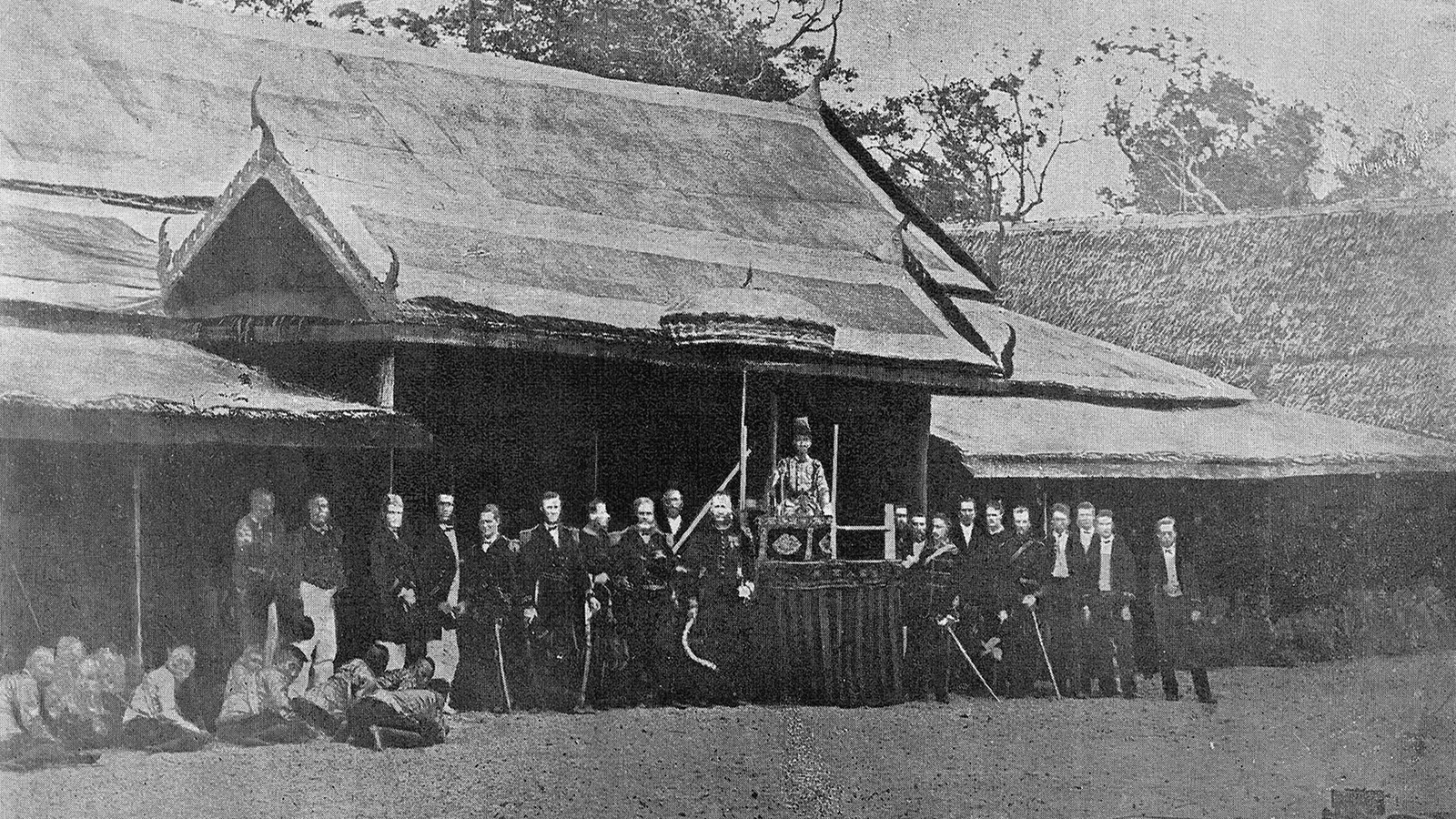
More than a thousand people from the court, including the heir apparent, travelled from Bangkok, 140 miles away, with fifty elephants (Aubin). A French team led by Édouard Stéphan of the Marseilles Observatory set up nearby. The royal chronicle, as translated in Aubin's chapter, records that totality began at thirty-six minutes and twenty seconds past eleven and that “it was dark as if it were nighttime”.
The trip was diplomacy as much as science. France had forced Cambodia, long under Siam's protection, to accept French “protection” in 1863, and eighteen steamships anchored near Wakor that August (Aubin).
The same shadow crossed India. Jules Janssen watched from Guntur, in today's Andhra Pradesh, and his spectroscope caught a yellow line in the Sun's prominences later credited to a new element, helium (Marshall and Marshall, The Hexagon, 2012). That story continues in our post on Norman Lockyer and the element found in the Sun before Earth.
Was the king really more accurate than the French?
Many people at Wakor reported the king's boast that his calculation was 2 seconds more precise than the French astronomers' (Aubin). Sam Kean's account for the Science History Institute takes the king's side. Aubin gives the French view: fixing their longitude to within one second needed at least forty observations of the Moon, roughly three months of work they had not had time for, so a 2-second gap sat inside their margin of error.
That is the useful lesson: one prediction beats another only if the difference is bigger than the uncertainty in both.
At home, court astrologers had doubted the eclipse would happen; during totality the prime minister reportedly asked several of his wives, “Will you now believe the foreigners?” (Aubin). The trip also cost Mongkut his life: he died on 1 October 1868 from a fever caught at Wakor, which Kean's account identifies as malaria.
Why does Thailand celebrate Science Day on 18 August?
On the eclipse's hundredth anniversary Mongkut was given the posthumous title “Father of Thai Science”, and in 1982, Bangkok's bicentennial year, 18 August became National Science Day (Aubin).
How can you predict the next eclipse in the same family?
NASA lists the 1868 eclipse in Saros 133, and one saros lasts about 6,585.3 days, or 18 years 11 days 8 hours (NASA Saros 133 catalogue).
Start from 18 August 1868.
Add 18 years: 18 August 1886.
Add 11 days: 29 August 1886 (four leap days fall in between; with five, add 10).
Handle the 8 hours: Earth turns 15° an hour, so 8 × 15 = 120°, and the path shifts about a third of the way round the world westward.
Check: NASA lists a total eclipse on 29 August 1886, with up to 6 minutes 36 seconds of totality (NASA Saros 133 catalogue).
The next total eclipse still to come in this family falls on 25 November 2030, by the same catalogue. The saros gives a date and a rough longitude; the exact path still needs careful tables of the Sun and Moon, the work Mongkut did.
If it is hard to picture why the Moon's shadow draws such a narrow path, the Fermi Simulation Lab has interactive simulations for ideas that are easier to see than to read. And before you look up at the 2030 eclipse or any other, read how to watch a solar eclipse safely and protect your eyes.