

On this page
In the 1650s William Harvey argued that every animal starts as an egg, yet for about 180 years nobody could find the egg of a mammal, as the Linda Hall Library's profile of von Baer puts it. Karl Ernst von Baer, born in Estonia in 1792, did most of his embryology at Königsberg between 1819 and 1834, according to the Embryo Project Encyclopedia. One dog's ovary there settled the question.
Why was the mammalian egg so hard to find?
Anatomists could not even agree on what the egg was. In 1672 Regnier de Graaf argued that the fluid-filled sac in the ovary, now called the Graafian follicle, was itself the egg, as the Embryo Project's account of von Baer's 1827 pamphlet explains.
The clues did not fit. In 1797 William Cruikshank reported seeing eggs in a rabbit's oviduct three days after mating, much smaller than the follicles. In 1824 the French researchers Prévost and Dumas could not confirm this in dogs and rabbits, according to Leonid Blyakher's history of Russian embryology, reproduced by UNSW Embryology. If the egg was smaller than the follicle, where in the ovary was it?
How did von Baer discover the mammalian egg?
Blyakher's chapter quotes von Baer's own later account, from his autobiography, and it reads like a lab notebook:
By 1826 he had already seen small transparent bodies, 1 to 3 mm across, in the uterus and oviducts of dogs, and took them to be eggs. He became convinced they came from the ovary.
In April or early May he told his colleague Burdach that he wanted a female dog mated a couple of days earlier. Burdach had such a dog in his house and sacrificed it.
In the ovary he found some follicles that had burst and others close to bursting. In one follicle he noticed a yellow spot, then the same in many others, always only one spot per follicle.
He opened a follicle, carried the spot with a knife to a watch glass filled with water, and put it under the microscope.
In that translation, he writes: "Looking into it, I jumped; how surprising the discovery was, because evidently I had seen a very small, distinctly formed, yellow yolk ball." He adds that he had to take a breath before looking again, afraid his eyes had deceived him.
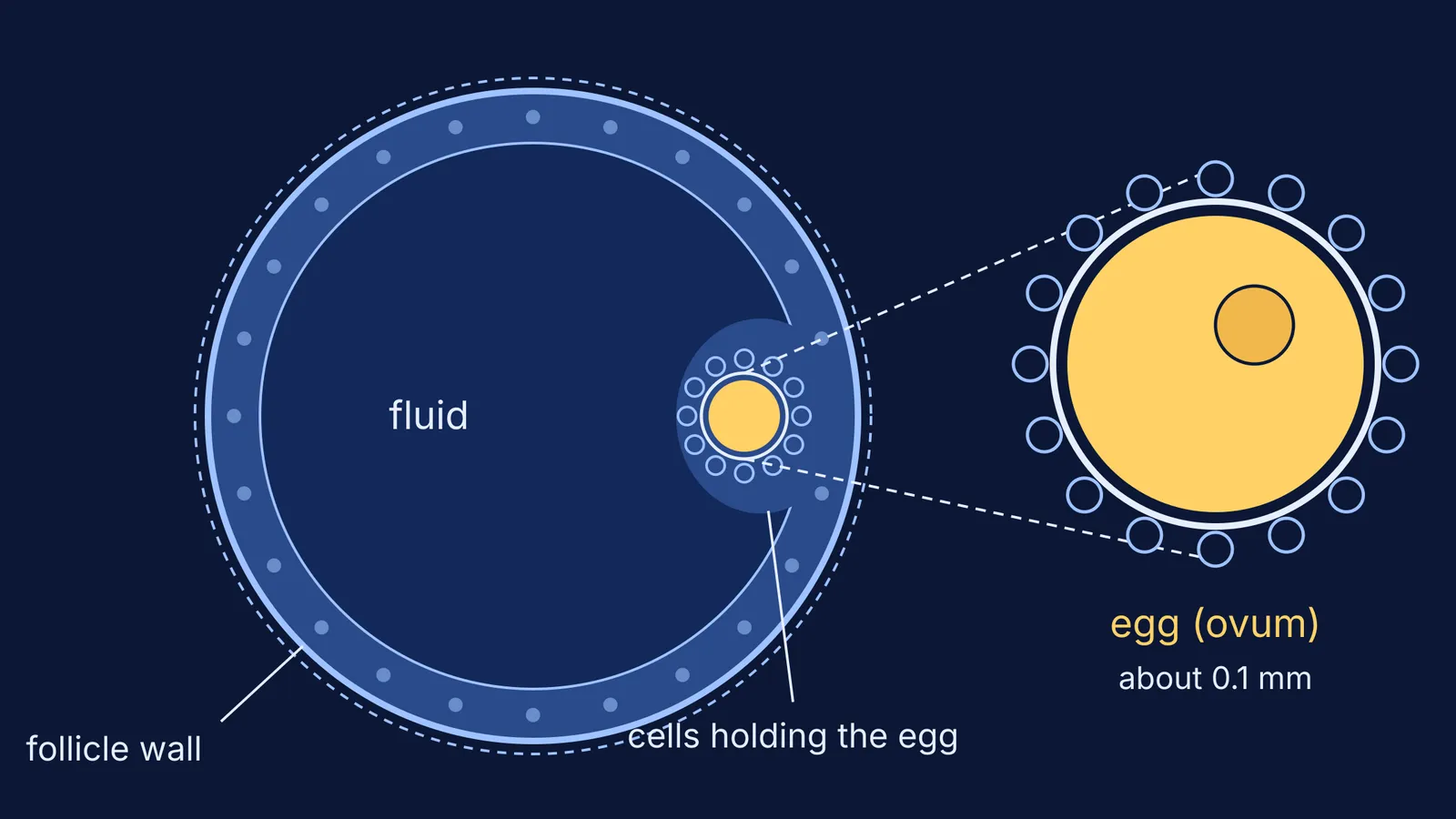
In the same account he says the egg did not float loose in the follicle's fluid. It was attached to the follicle wall and "held to it by a wide row of very large cells."
What did his 1827 paper prove?
Von Baer published *De ovi mammalium et hominis genesi* in 1827, in Latin, as a letter to the Imperial Academy of Sciences in Saint Petersburg, printed in Leipzig by Leopold Voss, according to the Embryo Project. He argued that the egg is not the follicle; it lies inside the follicle. From that he concluded that all animals develop from an egg, mammals included.
Blyakher's chapter records that he also examined ovaries of cows, pigs, sheep, rabbits, hedgehogs, dolphins and humans, and was convinced the follicles had the same structure in all of them. He found the smallest eggs in humans.
Worked example: how big was the egg he saw?
In the 1827 paper von Baer gave the egg's diameter as one-thirtieth to one-twentieth of a Paris line (Blyakher, via UNSW). A Paris line is an old French unit equal to 2.256 mm (Line (unit), Wikipedia).
Smallest: 2.256 mm ÷ 30 = 0.075 mm, or 75 micrometres.
Largest: 2.256 mm ÷ 20 = 0.113 mm, or about 113 micrometres.
So the egg was roughly a tenth of a millimetre across. With the naked eye he could see only a pale yellowish spot inside intact follicles; it took the microscope to show him the yolk ball.
How do von Baer's words match your Class 12 diagram?
Revising human reproduction for boards or NEET-UG? Translate the words of his account into today's labels:
"Graafian vesicle" is the Graafian follicle, the mature follicle on your ovary diagram.
"Fairly viscous fluid" is the follicular fluid filling the antrum (Antral follicle, Wikipedia).
"A wide row of very large cells" matches the granulosa cells of the cumulus oophorus, the mound that holds the egg to the wall.
"Yellow yolk ball" is what your textbook calls the oocyte.
Our guides to the stages of follicle development up to the Graafian follicle and labelling a sectional view of the ovary give you the modern names to check against. For his later work, read how von Baer's laws of embryos differ from Haeckel's.
If follicle stages still blur together, the Fermi Concept Library gives each biology concept its own lesson and its place in the map. Fermi's AI tutor can draw the figure with you and check your understanding as you go.


