

On this page
Josephine Cochrane had no engineering degree, no factory and, after 1883, very little money. Three years later she held a US patent for a machine that washed dishes, and her route there is a lesson in turning an annoyance into a design.
Who was Josephine Cochrane?
According to the National Inventors Hall of Fame, she was born in Ashtabula County, Ohio, in 1841, and took an interest in engineering at a time when higher education in the subject was rarely open to women. In 1858 she married William Cochran and settled in Shelbyville, Illinois.
Washing up was tedious, and it often chipped the dishes, so she set out to build a machine for the job. When her husband died in 1883 and left her with debts, the same Hall of Fame biography says, the idea became a necessity. IEEE Spectrum notes that engineering ran in the family: her father, John Garis, was a civil engineer.
She worked with a young mechanic, George Butters, on the prototype and filed the patent as "J.G. Cochran" in 1885 (National Inventors Hall of Fame). She was inducted into the Hall of Fame in 2006.
How did Cochrane's dishwasher work?
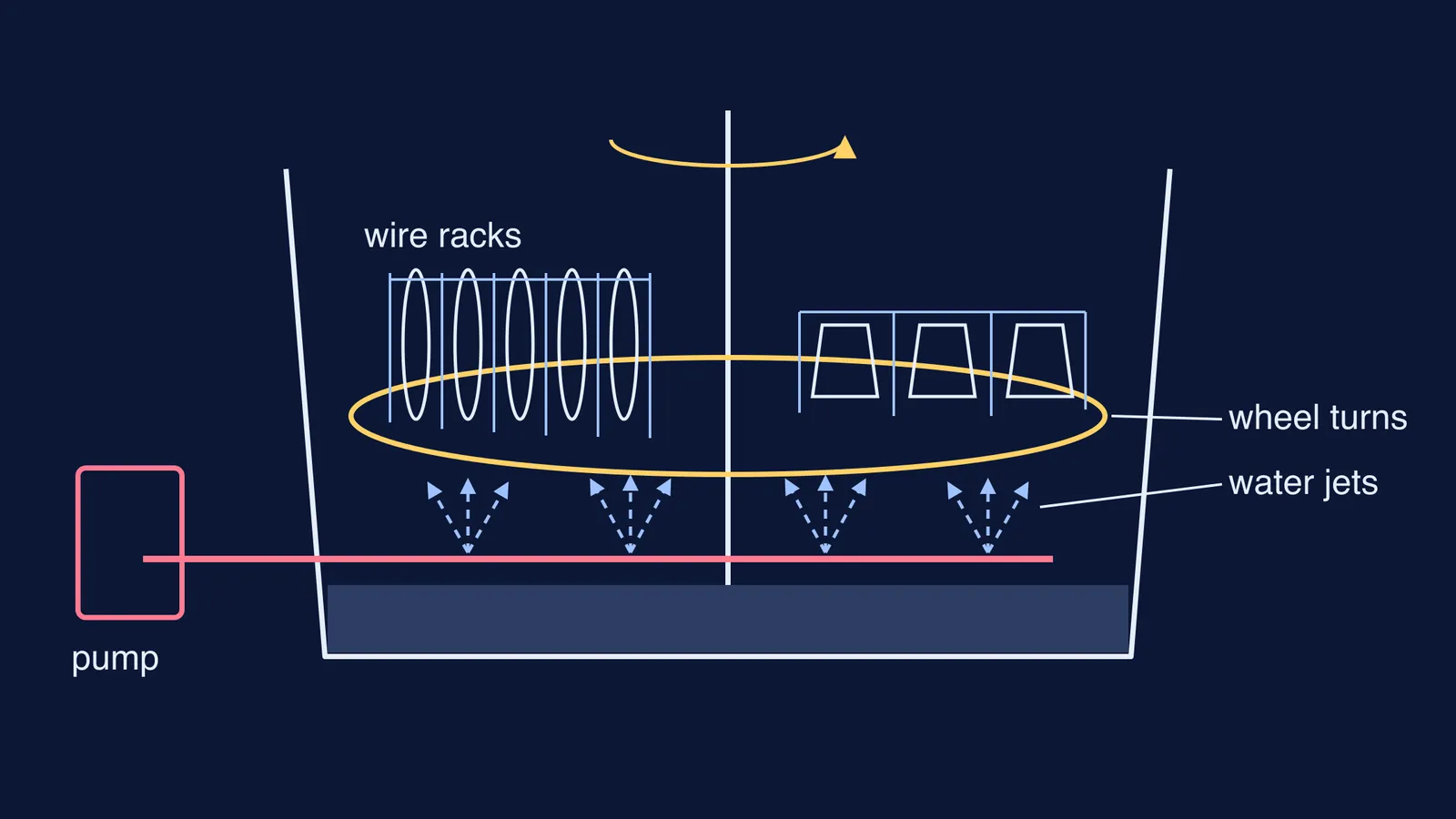
The patent, US 355,139 "Dish-washing machine", was filed on 31 December 1885 and granted on 28 December 1886. It describes a rotating wire crate holding racks for plates, cups and glasses, two force pumps used one at a time, a single hand lever that both turned the crate and worked a pump, and water-jet pipes with slotted or perforated ends that sprayed either soap-suds or clean hot water onto the dishes as the crate turned.
The key move was this: the dishes stayed still in their racks and the water did the moving. Cochrane measured her plates, cups and saucers and built a wire compartment to fit each one (National Inventors Hall of Fame). The compartments sat in a wheel lying flat inside a copper boiler, and as the wheel turned, hot soapy water was pumped up from the bottom.
Other dishwashing machines existed before hers, but hers was the first with racks shaped to hold dishes in place, and the first to use water pressure instead of scrubbers, the Hall of Fame says.
If pressure and fluid jets are hard to picture from a textbook diagram, the Fermi Simulation Lab has interactive simulations for ideas that are easier to see than to read.
Who bought the first dishwashers?
Not households. Cochrane sold first to hotels and large restaurants, and her large model, which could wash and dry 240 dishes in two minutes, also sold to hospitals and colleges (National Inventors Hall of Fame). Her machine was shown at the 1893 World's Columbian Exposition in Chicago, where it won a prize.
Homes were another matter. Household water heaters could not supply enough hot water, and the machines were said to leave soapy residue. Dishwashers became popular in homes only in the 1950s, once hot water, better detergent and new attitudes to housework arrived. Her company became part of KitchenAid, which introduced its first dishwasher based on her design in 1949, the same source says. Cochrane died in 1913 (IEEE Spectrum).
She ran the business herself, after first trying existing manufacturers. The Hall of Fame quotes her: "I couldn't get men to do the things I wanted in my way until they had tried and failed in their own."
How can you use Cochrane's method on your own project?
Her path breaks into five steps you can copy for a science fair entry, an Atal Tinkering Lab build or an engineering portfolio.
Name the real failure. Not "washing up is boring" but "plates chip when they knock together".
Measure before you design. She sized a compartment to each plate, cup and saucer.
Swap what moves. Keep the fragile thing still and move the cheap thing (here, water).
Get help for the skill you lack. She brought in a mechanic for the build.
Start with the buyer who needs it most. Hotels had the hot water and the dish volume; homes did not, yet.
A worked example: your hostel's steel tumblers come out streaky. Step 1: the streaks are dried hard-water drops, not dirt. Step 2: count the tumblers per wash and time how long they sit wet. Step 3: tilt them on a rack so water drains before it dries. Step 4: ask the lab assistant to help bend the rack. Step 5: try it in one mess first.
If step 1 stalls because you are not sure which concept explains the problem (surface tension, evaporation, pressure), the Fermi Concept Library has a lesson for every concept in physics, chemistry, biology, mathematics and computing.
Who else invented everyday machines like this?
Read how Margaret Knight built the flat-bottom paper bag machine and how Mary Anderson invented the windshield wiper. If patents themselves interest you, here is what the job of a patent examiner for science and engineering graduates involves.


