On this page
When STEM graduates explore public sector careers in India, most look towards civil services, PSUs, or defence laboratories. Yet one of the most intellectually demanding technical positions in government sits directly at the intersection of scientific research, legal drafting, and industrial innovation: the Examiner of Patents and Designs.
Operating under the Office of the Controller General of Patents, Designs and Trade Marks within the Department for Promotion of Industry and Internal Trade, patent examiners evaluate inventions before the government grants twenty-year statutory monopolies. For graduates in engineering or natural sciences, this post offers a rare technical career path where you analyse new scientific inventions daily as a Group 'A' Gazetted Officer.
What does a government patent examiner actually do?
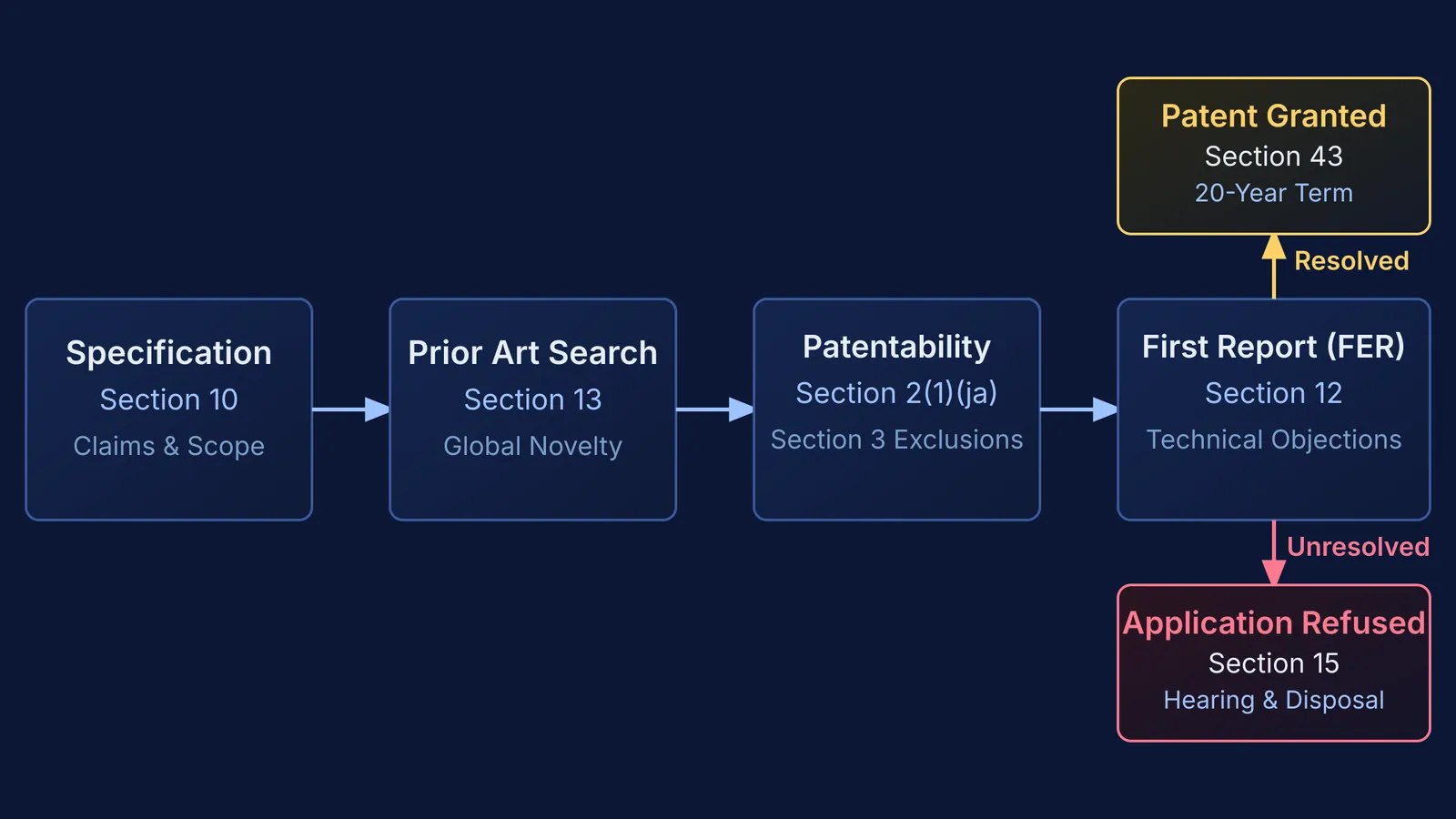
Under Section 12 of the Patents Act, 1970, when an applicant submits a Request for Examination, the Controller of Patents refers the application to an examiner. As detailed on IP India, the examiner conducts a forensic technical analysis of the claimed invention against global prior art.
The examiner's role centers on four statutory duties:
Reviewing the complete specification, technical claims, and drawings to determine the exact scope of the invention.
Conducting exhaustive prior art investigations across patent databases and scientific literature to verify novelty under Section 13.
Evaluating whether the invention shows an inventive step under Section 2(1)(ja), meaning it is non-obvious to a person skilled in the art.
Screening claims against statutory exclusions under Section 3, which bars patents for scientific principles, mere discoveries of known substances, or computer programs per se.
The examiner then issues a First Examination Report (FER) listing all technical objections the applicant must overcome before grant.
Who is eligible to become a patent examiner?
Eligibility is governed by technical qualifications outlined in IP India recruitment regulations. Candidates must be Indian citizens aged 21 to 35 years, with age relaxations of 3 years for OBC non-creamy layer, 5 years for SC/ST, and 10 years for persons with benchmark disabilities.
The criteria span 14 disciplines approved by IP India:
Engineering disciplines (such as Computer Science, Electronics, Mechanical, Electrical, Civil, and Chemical): a Bachelor's degree (B.E. or B.Tech) in the relevant field.
Natural sciences (including Chemistry, Physics, Microbiology, Biochemistry, and Biotechnology): a Master's degree (M.Sc.) in the relevant subject.
Many science graduates evaluating an MSc versus employment choose this path because an M.Sc. directly qualifies them for a Group 'A' post.
How does the CGPDTM recruitment exam work?
The selection process outlined in IP India examination notices follows a three-tier examination structure:
Preliminary Examination (Screening): A computer-based test with 150 objective questions for 150 marks over 2 hours. It tests English (15 marks), Reasoning (30 marks), Quantitative Aptitude (30 marks), General Knowledge (30 marks), General Science (30 marks), and IP legislation (15 marks). Qualifying marks are 30% for unreserved, 25% for OBC/EWS, and 20% for SC/ST, with roughly 20 times the vacancies advancing.
Mains Examination (Scoring): Paper I is an objective test of 100 marks over 2 hours covering general aptitude, elementary mathematics, and IP law. Paper II is a 300-mark descriptive technical exam over 3 hours testing your chosen discipline syllabus at degree level.
Interview: A 100-mark viva voce assessing technical reasoning, subject clarity, and communication.
Final merit assigns an 80% weightage to Mains (out of 400 marks) and a 20% weightage to the interview. Unlike the Engineering Services Examination, which tests field execution, this exam tests scientific depth and theoretical rigor.
What is the four-step patent assessment framework?
During substantive examination under Indian Patents Act guidelines, examiners follow a structured four-step evaluation sequence:
Subject-matter filtering: Verify that claims do not violate Section 3 exclusions, such as abstract algorithms or medical methods.
Search query construction: Translate claims into International Patent Classification (IPC) codes and keyword queries across global patent databases.
Novelty and inventive step evaluation: Identify the closest prior art. If a single document reveals every claim element, novelty fails. If new, evaluate whether combining known disclosures makes the step obvious to a domain specialist.
First Examination Report drafting: Issue formal objections citing specific prior art citations, giving the applicant statutory notice to amend claims or present counter-arguments.
How should candidates prepare for the technical papers?
Because Paper II accounts for 300 out of 400 marks in the written stage, as shown in IP India syllabus guidelines, your technical discipline decides your rank.
Focus on fundamental principles rather than rote shortcuts. Descriptive questions require deriving equations and explaining mechanisms step by step. For candidates revisiting university physics or chemistry concepts, the Fermi Concept Library covers every concept in physics, chemistry, biology, mathematics and computing, each with its own lesson and its place in the map.
For the quantitative aptitude and elementary mathematics sections in Prelims and Paper I, the Fermi Problem Library provides worked problems with a step-by-step solver that explains the reasoning rather than printing an answer.
Pair this technical preparation with structured job search strategies for freshers to maintain a diversified, clear career strategy.