

On this page
For B.Tech graduates looking for stable government roles that directly involve engineering work, the ESE, often called the Indian Engineering Services (IES), is the most prominent route. This examination opens the door to high-level technical management and nation-building projects.
What is the Engineering Services Exam for B.Tech graduates?
The ESE is a three-stage competitive examination that selects candidates for administrative and technical roles in central government departments. The UPSC ESE 2024 notification advertised approximately 167 vacancies across the country, highlighting the highly competitive nature of the test.
Selected candidates are appointed as Assistant Executive Engineers in crucial government departments. These include the Central Public Works Department, the Military Engineer Services, the Central Water Engineering Service, and various telecommunications and defence quality assurance boards. They hold Group-A gazetted officer rank, meaning they wield significant authority and manage large-scale national infrastructure and strategic defence projects.
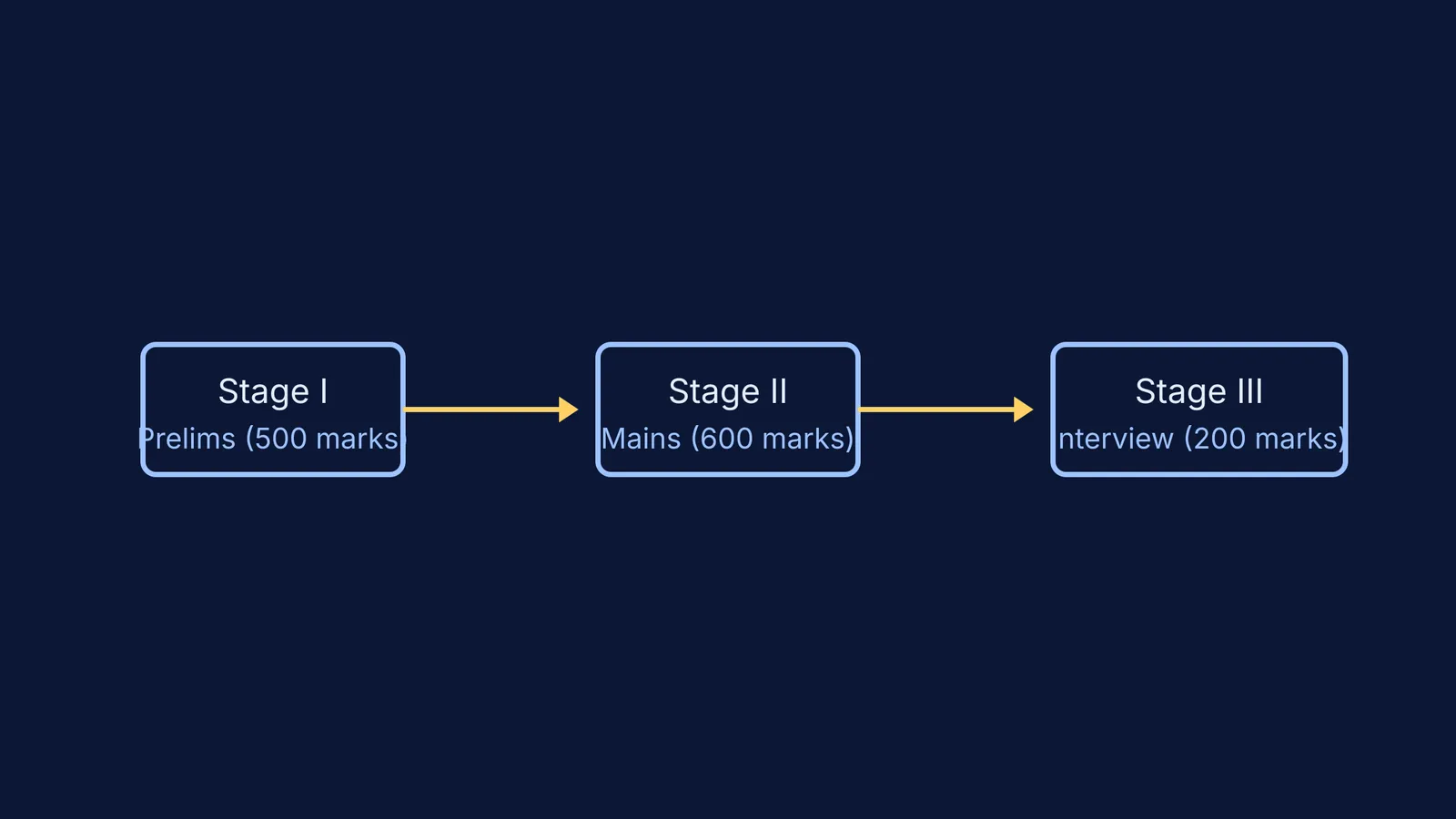
The selection process is rigorous and involves three stages, carrying 1,300 marks in total:
Stage I (Prelims): This stage consists of two objective papers. One covers general studies and engineering aptitude, while the other focuses on the specific engineering discipline. It carries 500 marks in total.
Stage II (Mains): Candidates who pass the Prelims face two conventional, descriptive papers in their chosen engineering discipline. This stage carries 600 marks and requires in-depth theoretical knowledge.
Stage III (Interview): The final stage is a personality test assessing a candidate's intellectual curiosity, leadership qualities, and initiative. It carries 200 marks.
Which branches does the ESE cover?
Unlike other graduate exams that cover dozens of modern and niche fields, the ESE focuses strictly on four core, traditional branches of engineering:
Civil Engineering
Mechanical Engineering
Electrical Engineering
Electronics and Telecommunication Engineering
Civil engineering typically sees the highest volume of vacancies and applicants, given the government's constant need for infrastructure development.
Graduates from other disciplines, such as computer science, information technology, or chemical engineering, can still apply. However, they must be prepared to write the exam in one of these four core subjects, which often requires studying an entirely new syllabus.
How does the Engineering Services Exam differ from GATE?
Both exams are for engineering graduates, but they serve different purposes and have vastly different statistics.
The Graduate Aptitude Test in Engineering (GATE) 2024 statistics released by IISc Bangalore showed that out of 6,53,292 candidates who appeared, 1,29,268 qualified, leading to a pass rate of nearly 19.8%. However, "qualifying" in GATE only means passing a cut-off mark, which is often around 25 to 35 out of 100. Securing a top job in a Public Sector Undertaking (PSU) or a seat in an IIT requires a very high rank. To understand how GATE works for non-engineering fields, see our guide to GATE for science graduates.
In contrast, the UPSC ESE final selection ratio is much steeper because it measures candidates against a strictly limited number of hard vacancies. You must clear sequential filters. Only a fraction of candidates from the Prelims make it to the Mains, and only about half the candidates from the Mains progress to the interview stage. This ultimately leaves a selection ratio close to 1 in 200 to 1 in 300 applicants.
The exam pattern is also vastly different. GATE tests technical and mathematical depth through mostly numerical and multiple-choice questions on a computer. The ESE requires massive syllabus coverage, including a general studies paper that tests current affairs, ethics, and project management, alongside long-form descriptive answers written on paper.
How does Fermi help you prepare?
Whether you are writing the objective Prelims or the descriptive Mains, the ESE syllabus is vast and requires strong conceptual clarity. Rote memorisation is rarely enough to clear the conventional papers.
When you are stuck on an unfamiliar topic, Fermi's AI tutor helps you understand the underlying concepts rather than just printing the final answer. The tutor holds a line of reasoning, notices where you are stuck, and writes on a board to build a plan for your study session.
If you struggle to visualise the complex machines in mechanical engineering or the electromagnetic field lines in electrical engineering, you can use the Fermi Simulation Lab. These interactive simulations make ideas easier to see than read, bridging the gap between textbook theory and practical application.
Tackling a multi-stage exam can be stressful, especially when balancing it with a final-year B.Tech project or a full-time job. To keep your nerves in check, you can learn about treating exam nerves as energy with reappraisal studies, and families can explore how to help children learn without pressure. Consistent practice with right feedback is the best way to handle the wide-ranging demands of the Engineering Services Exam.


