

On this page
In 1903, the automotive world was still in its infancy. Vehicles were mostly open-air carriages, and enclosed streetcars were one of the few forms of public transit that offered a cabin. Driving one in a snowstorm, however, meant keeping the front window open just to see the tracks. Mary Anderson, a real-estate developer visiting New York City from Alabama, watched a driver shivering as he repeatedly reached out to wipe sleet from the glass by hand. He would either drive with his head poking out the window or stop the tram entirely to clear the view.
She quickly sketched a practical solution in her notebook. Her idea—a rubber blade mounted on a spring-loaded arm and operated by a lever from inside the cabin—would become a standard safety feature on almost every vehicle in the world. Anderson was not a trained engineer, but her sharp observation of a daily struggle led to a design that improved transport visibility.
How did Mary Anderson's windshield wiper work?
Anderson's design, granted U.S. Patent No. 743,801 in November 1903, was an elegant application of classical mechanics and lever systems.
The invention consisted of a lever inside the vehicle that connected to a central spindle extending through the wooden window frame. On the outside, this spindle drove an arm equipped with a wooden strip carrying a rubber squeegee. To ensure the blade maintained a firm, uniform pressure on the glass despite wind or heavy snow, the arm was spring-loaded using coiled springs.
Anderson also included a counterweight to balance the heavy mechanism, allowing the driver to sweep the blade back and forth smoothly with minimal effort. This counterweight ensured that the centre of mass was close to the pivot, reducing the rotational inertia and the torque required to move the handle. Furthermore, her patent detailed a thumb-screw that allowed the entire outer apparatus to be easily removed during fair weather, preserving the clean look of the vehicle.
When students study Torque as r × F: finding torque about a point with vectors, they are looking at the exact physical principles that make a wiper blade sweep across a windshield without snapping. When you want to see how forces balance on a lever or why a counterweight matters, the Fermi Simulation Lab provides interactive simulations for the ideas that are easier to see than to read.
Why was the invention rejected at first?
Despite its practical brilliance, Anderson's windshield wiper was dismissed by early manufacturers. When she tried to sell the rights to a Canadian manufacturing firm, they explicitly told her it lacked commercial value.
At the time, personal automobiles were still a rare luxury, driven mostly in fair weather. Furthermore, many people falsely believed that the repetitive motion of a moving wiper would distract the driver, causing accidents rather than preventing them. Because the market was not ready, Anderson's 17-year patent (Wikipedia)) expired in 1920, meaning she never profited financially from her invention.
However, the automotive industry exploded shortly after the First World War. As cars became faster and enclosed cabins became the norm, clear visibility became a critical safety requirement. By 1922, Cadillac became the first manufacturer to install windshield wipers as standard equipment (National Inventors Hall of Fame), using a design based on Anderson's original principles.
How do you calculate the area cleaned by a wiper?
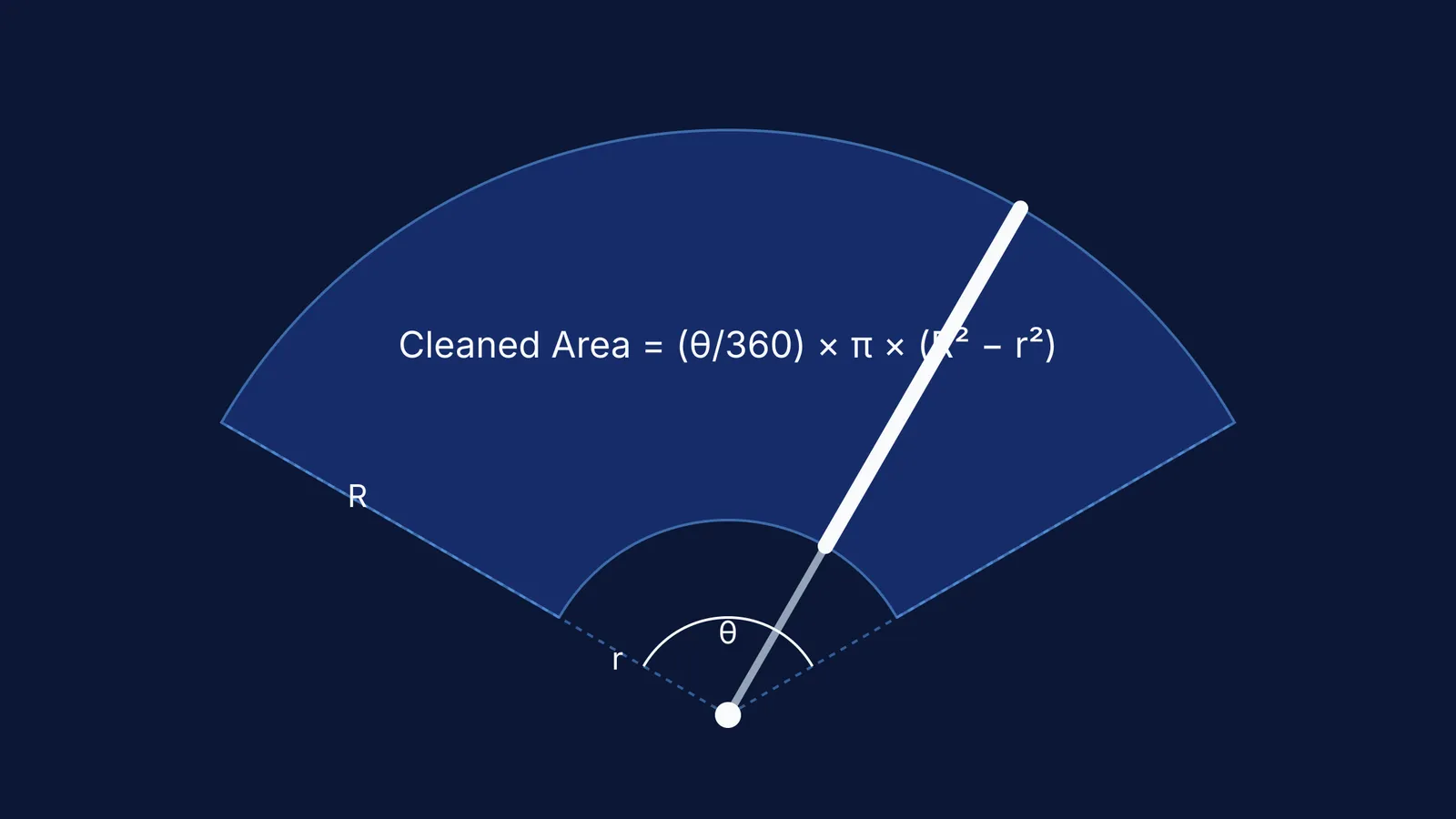
A windshield wiper is a classic example of rotational motion, making it a perfect real-world geometry problem. Because the wiper pivots around a fixed point, the blade sweeps out the shape of a circular sector.
However, the rubber blade does not usually stretch all the way down to the pivot point. The cleaned section is actually the difference between two sectors: a large one swept by the outer tip of the blade, and a small one swept by the inner tip.
To find this area, we need three measurements:
The distance from the pivot to the outer tip of the blade (R).
The distance from the pivot to the inner edge of the blade (r).
The angle the wiper sweeps through (θ).
The formula for the area of a complete sector is (θ / 360) × π × radius². Therefore, the actual area cleaned by the rubber blade is the area of the large outer sector minus the area of the small inner sector:
Area = (θ / 360) × π × R² − (θ / 360) × π × r² Area = (θ / 360) × π × (R² − r²)
If you want to practice more problems involving Areas related to circles, Class 10: sectors and segments solved, or if you want worked problems with a step-by-step solver that explains the reasoning rather than printing an answer, you can find them in the Fermi Problem Library.


