

On this page
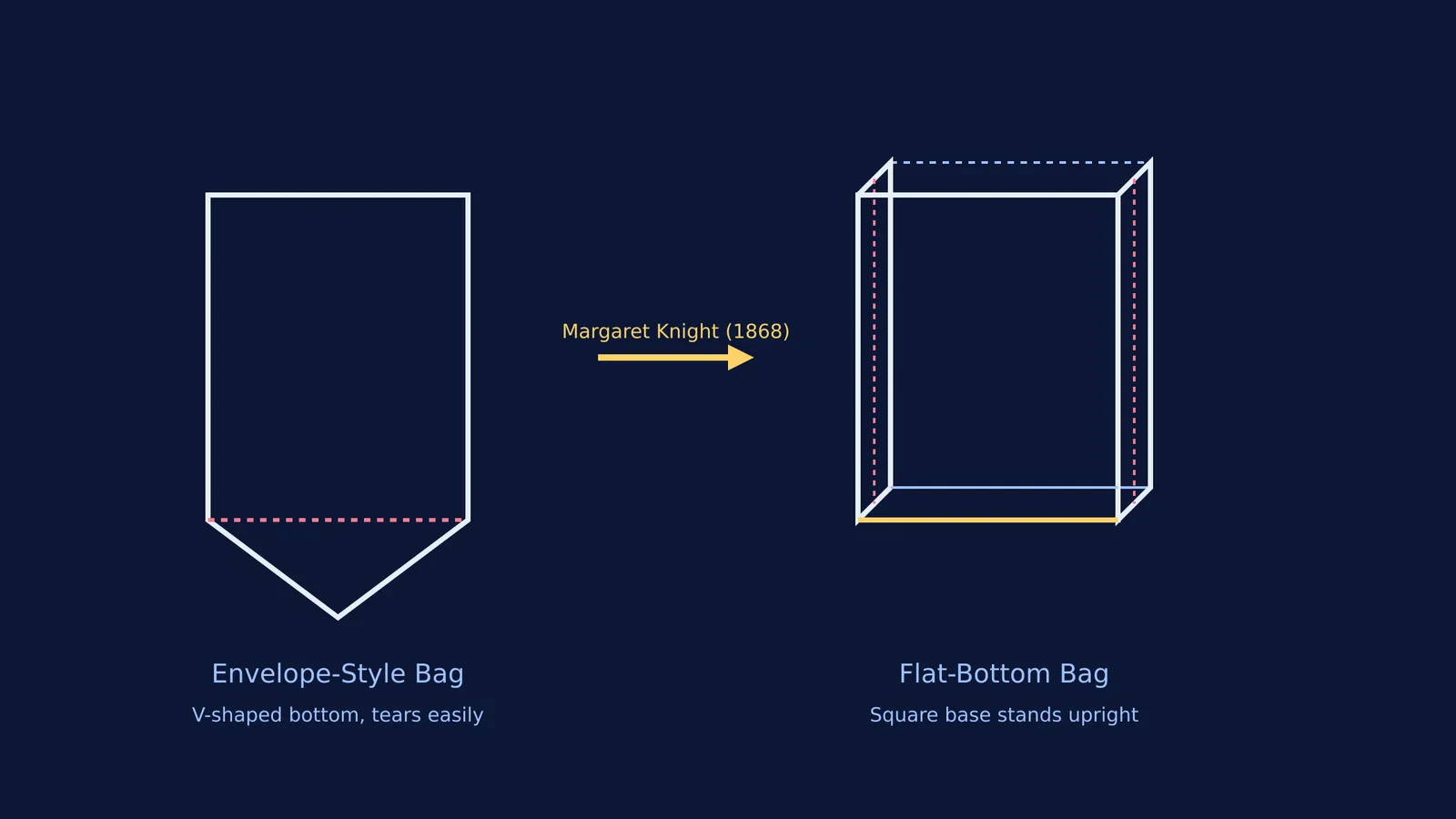
Until the late 1860s, paper bags were shaped like envelopes. They were flimsy, difficult to pack, and notoriously prone to tearing at the seams when filled with heavy grocery items. Flat-bottomed bags existed, but they had to be folded and pasted entirely by hand, making them too expensive for everyday retail use. The mass-produced, flat-bottomed grocery bags we use today exist because of Margaret Knight, an inventor who engineered a complex machine and fought in court to prove she built it.
What did Margaret Knight invent?
Margaret Knight was born in 1838 and began working in a cotton mill as a child, where she observed a workplace accident and created her first safety invention (Lemelson-MIT). By 1867, she had moved to Springfield, Massachusetts, and taken a job at the Columbia Paper Bag Company.
While working there, Knight recognised that automating the folding process would change the packaging industry. In 1868, she invented a wooden machine that fully automated the process: it fed from a continuous roll of paper, cut it to size, folded the bottom into a square, and glued it into a finished flat-bottomed bag (Lemelson-MIT). Her design allowed bags to be manufactured cheaply and in large volumes, changing how retail goods were carried.
To invent the machine, Knight had to master the mechanics of gears, cutting blades, and articulated folding arms. Understanding mechanics from first principles is the foundation of engineering. If you want to understand the physics behind how machines and forces work, the Fermi Concept Library has every concept in physics, chemistry, biology, mathematics and computing, each with its own lesson and its place in the map.
How did Margaret Knight win her patent fight?
To apply for an official U.S. patent, Knight needed a working iron model of her machine. She hired a machine shop in Boston to cast and assemble it. While the model was under construction, a man named Charles Annan visited the shop, saw her design, and filed a patent application for himself (Lemelson-MIT).
When Knight attempted to file her own patent and discovered the theft, she launched a patent interference lawsuit. Patent interference cases were gruelling, requiring inventors to prove exactly when they conceived of the idea and how they developed it. In court, Annan argued that a woman could not understand the mechanical complexities required to build such a machine, hoping the court would dismiss her claims.
Knight’s victory in court came down to her meticulous documentation. She did not just claim the idea was hers; she brought in her extensive hand-drawn blueprints, dated diary entries, and the original wooden prototype. Because she could show every step of her work and reasoning, the court ruled in her favour.
Building the habit of showing your work is just as important for students today. If you are learning how to set up complex equations and derivations, the Fermi Problem Library has worked problems with a step-by-step solver that explains the reasoning rather than printing an answer.
Why do we still use her design today?
Thanks to her detailed physical evidence, Knight won the lawsuit and was awarded U.S. Patent 116,842 for an "Improvement in Paper-Bag Machines" on July 11, 1871 (Wikipedia).
Following her victory, she went on to co-found the Eastern Paper Bag Company in Hartford, Connecticut, to manufacture the machines directly (Lemelson-MIT). The royalties funded her future work. Known as a pioneering female inventor, she patented over 25 inventions during her lifetime, ranging from shoe-cutting machinery to rotary engines, and was later inducted into the National Inventors Hall of Fame in 2006.
The next time you pack groceries into a paper bag that stands open on its own, you are looking at a design that Margaret Knight engineered—and fought to protect—more than 150 years ago.
If you enjoyed reading about Margaret Knight, you can explore the stories of other pioneering women in science, such as Agnes Pockels and the kitchen trough that measured surface films, or read about how Katharine Burr Blodgett and the glass that stopped reflecting changed modern optics.


