On this page
In the early 1990s, a team at CSIRO, Australia's national science agency, worked out how to send fast data through the air indoors. CSIRO's 2013 impact case study names the inventors as Dr John O'Sullivan, Dr Terry Percival, Diet Ostry, Graham Daniels and John Deane, all working in the CSIRO Division of Radiophysics. The same document says the main problem they solved was reverberation, "where radio waves bounce around in the surrounding environment causing echoes and fades that impede clear reception."
Why do radio signals echo indoors?
O'Sullivan explained it in a 2009 CSIRO release: "In reality the radio waves travel in all directions, bouncing off walls, furniture and people – making it very hard to deliver a clear signal to the receiver."
Their patent, US 5,487,069, describes reflections from walls, floor, ceiling and furniture: the receiver gets the direct signal plus several delayed copies. Engineers call this multipath.
Digital data travels as symbols, short bursts that each stand for a few bits. If the echo of one symbol arrives while the receiver reads the next, the two blur. The patent states the rule: the symbol period "must be substantially longer than the delay time". But on one channel, long symbols mean slow data.
How did radio astronomy help fix the echoes?
O'Sullivan had worked in radio astronomy. In 1978 he co-wrote a Nature paper with R. D. Ekers and P. A. Shaver setting limits on cosmic radio bursts lasting microseconds. In the 2009 release he said,"I was inspired to think about ways of cleaning up smeared radio signals to make searching for short pulses like those from exploding black holes easier. We ended up building a 'fast Fourier transform' chip to do these sorts of processing tasks efficiently and fast." Science in Public notes the team never found exploding black holes, but the methods stayed useful.
A Fourier transform is the maths that breaks a signal into the frequencies it is made of; a fast Fourier transform (FFT) computes it quickly. See how the 1965 fast Fourier transform cut the cost of computing.
The patent combines:
Many parallel sub-channels, so "each channel has a low bit rate but the total, or overall bit rate, is high".
Longer symbols, padded with a copy of part of themselves, so echoes die away in that extra slice.
Error correction (Reed-Solomon or convolutional coding) to repair damaged bits.
Interleaving, which spreads data across sub-channels so one faded frequency cannot wipe out a chunk.
FFT chips to split and rebuild the signal at speed.
How do slower symbols beat radio echoes?
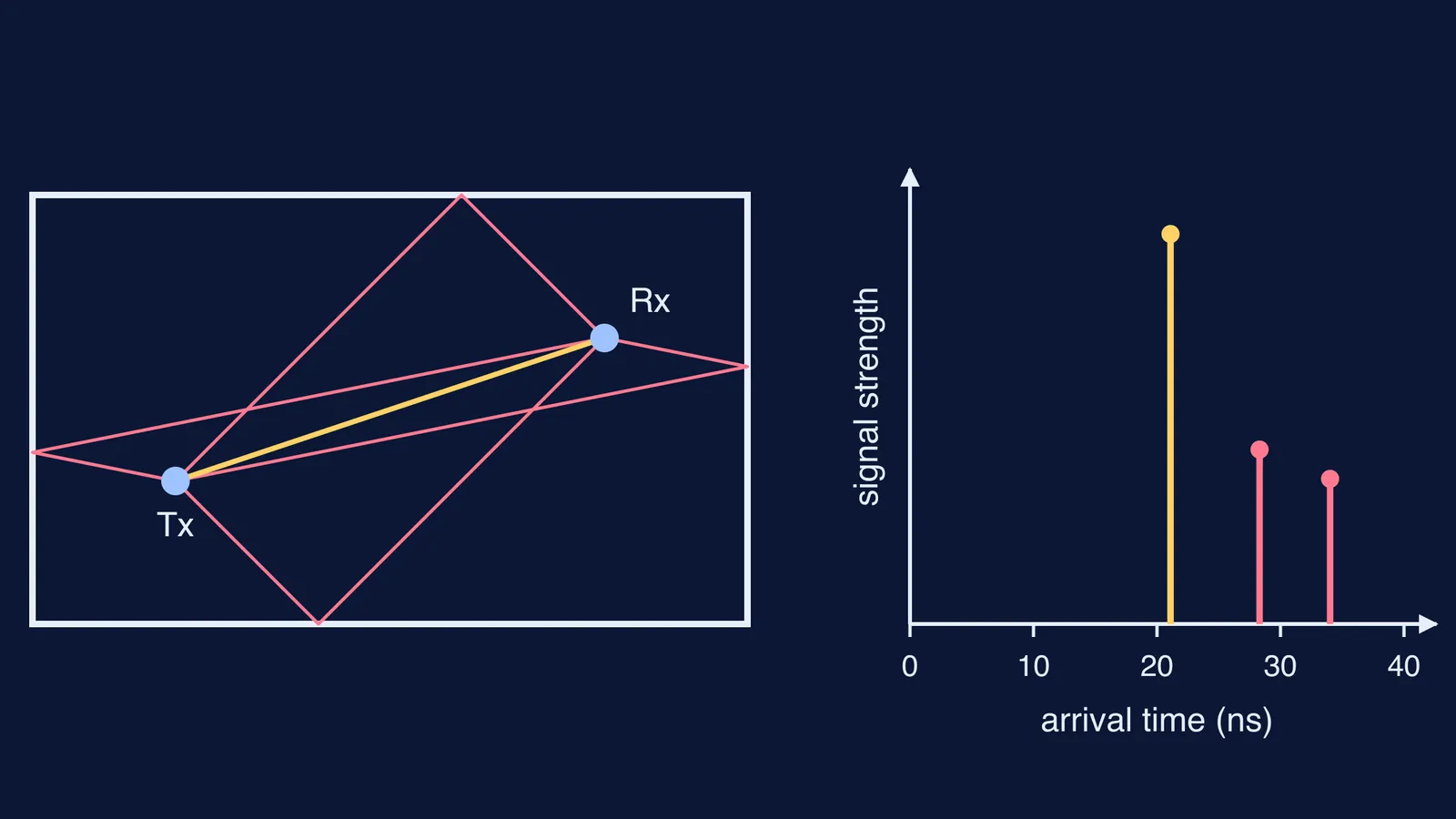
Our own numbers, matching the diagram above, not the patent's:
In a 10 m by 6 m room, the direct path from router to laptop is 6.3 m; a side-wall bounce is 10.2 m. The extra 3.9 m, at the speed of light (3 × 10^8 m/s), makes the echo about 13 nanoseconds late.
Send 100 million symbols per second on one channel. Each lasts 10 ns, so the 13 ns echo lands on the next symbol.
Split the same data into 100 sub-channels of 1 million symbols per second. Each symbol lasts 1,000 ns; the echo is 1.3% of it.
Add a 50 ns guard before each symbol. The echo settles inside it, at a cost of 50 in 1,050 ns, under 5% of airtime.
Try it: a hall reflection adds 30 m to the path. Is a 50 ns guard enough? (No: the echo is 100 ns late.)
If a wave plus its delayed copy is hard to picture, the Fermi Simulation Lab has interactive simulations for ideas easier to see than to read. Or revise the conditions for constructive and destructive interference.
What did the CSIRO Wi-Fi patent lead to?
According to Google Patents, the invention was first filed in Australia on 27 November 1992 and US patent 5,487,069 was granted on 23 January 1996. Science in Public reports that the IEEE built these ideas into the 802.11a, 802.11g and 802.11n wireless standards, and that O'Sullivan received the Prime Minister's Prize for Science in October 2009.
By 2013, CSIRO had licence agreements with more than 20 companies and around $430 million in licensing revenue, according to its impact case study. In October 2026, CSIRO reported that WLAN technology is in more than 20 billion devices, and the Royal Australian Mint added it to a Bright Ideas coin collection.
Engineers later found other ways to handle multipath; see how Arogyaswami Paulraj's MIMO sends many signals at once.
What can a student learn from this story?
A tool built for faint signals from space fixed a problem in offices and homes.
Reflection, path difference and interference from school physics are the whole problem here.
When a trade-off looks impossible (fast or reliable), try splitting the problem into many smaller ones.
If waves or Fourier ideas feel shaky, the Fermi Concept Library gives each concept in physics and mathematics its own lesson.
Next time your phone connects in a crowded room, estimate how late the echo from the nearest wall arrives.