

On this page
In February 1992, Arogyaswami Paulraj, a Stanford researcher who had spent years building sonar for the Indian Navy, filed a patent for an idea that sounds like it should not work. Split one fast data stream into several slower ones and send them from separate antennas at the same time, on the same frequency. A receiver with its own antennas pulls them apart again. That idea, MIMO (multiple-input, multiple-output), now sits inside your Wi-Fi router and your phone.
Who is Arogyaswami Paulraj?
Paulraj was born on 14 April 1944 in Pollachi, in present-day Tamil Nadu, according to his Wikipedia biography. The National Inventors Hall of Fame records that he joined the Indian Navy as a teenager and later earned a PhD on signal filtering theory. After the 1971 war with Pakistan exposed weaknesses in the Navy's sonar, he led a project to redesign it, and his team later developed APSOH, a sonar system that entered fleet service in 1983, says his Marconi Society biography.
How did Paulraj come up with MIMO?
By 1991 Paulraj had returned to Stanford, where he worked on signal separation experiments for airborne reconnaissance. He noticed that when signals scatter, signals on the same channel from transmitters close together could often be separated by an adaptive receiving antenna array, according to the Marconi Society's 2014 prize announcement. His Marconi biography adds that a few days later, sitting in a barber shop, he had the idea of using multiple antennas at both ends of the link.
US patent 5,345,599 was filed on 21 February 1992 and issued on 6 September 1994, naming Paulraj and Thomas Kailath as inventors (Google Patents). Its abstract describes a high-rate signal "split into several low-rate signals" that "are transmitted from spatially separated transmitters, all radiating into the service area in the same frequency channel."
The IEEE Communications Society credits the patent with "using arrays of multiple transmitting and receiving antennas to increase the number of distinct spatial channels" (IEEE ComSoc). Soon after, Gerard Foschini at Bell Labs laid theoretical foundations for MIMO in fading radio channels (Foschini and Gans).
How does MIMO send two streams on one frequency?
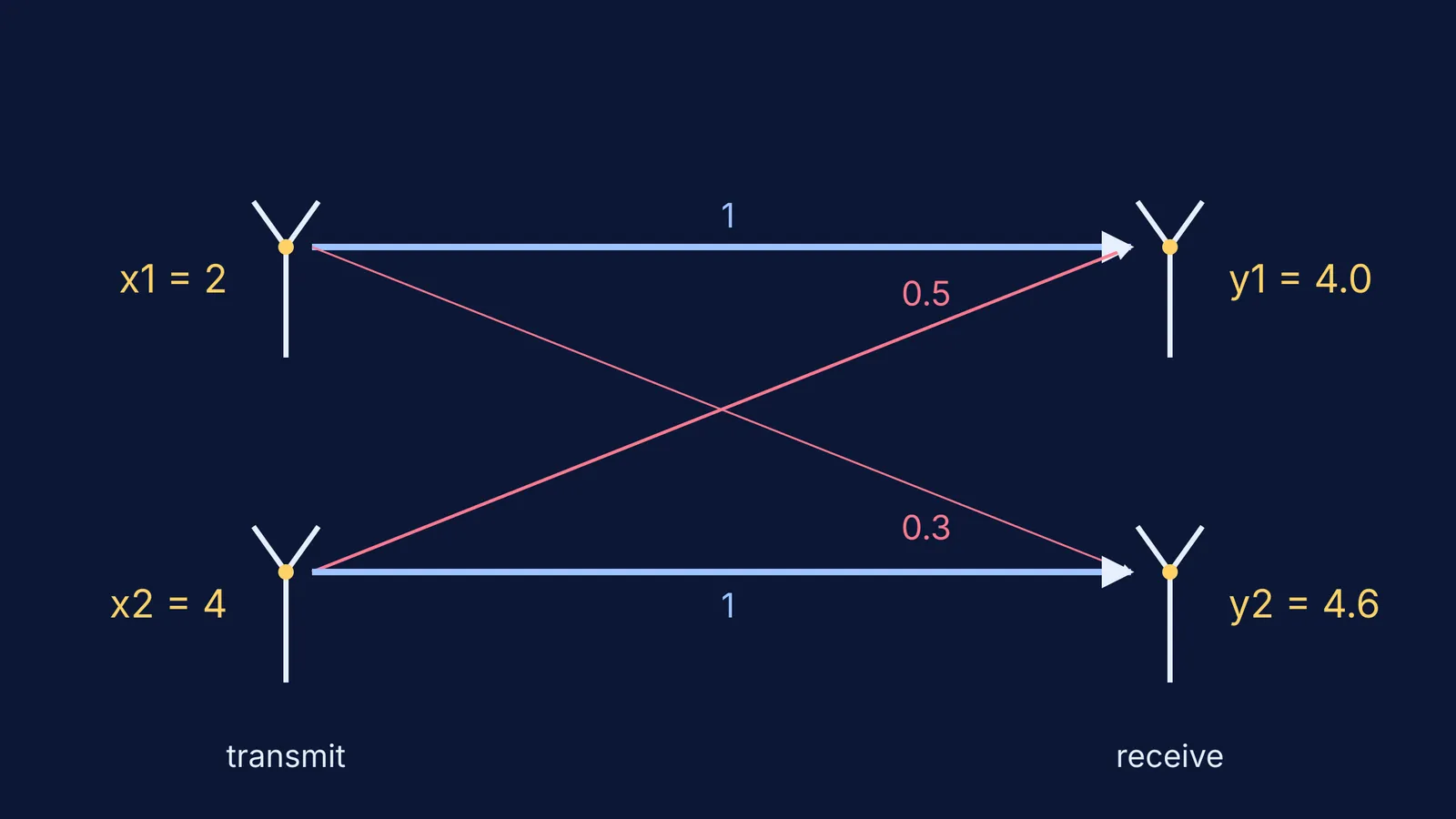
Here is a simplified worked example with two antennas on each side, the 2x2 case in the diagram above. Real systems add noise and complex numbers, but the logic holds.
Transmitter 1 sends x1 = 2 and transmitter 2 sends x2 = 4, at the same moment, on the same frequency.
Each signal reaches both receivers, weakened differently by its path. Receiver 1 gets all of x1 and half of x2. Receiver 2 gets 0.3 of x1 and all of x2.
Receiver 1 measures y1 = 1(2) + 0.5(4) = 4. Receiver 2 measures y2 = 0.3(2) + 1(4) = 4.6.
Assume the receiver knows the path strengths (real systems measure them). It has two equations: x1 + 0.5x2 = 4 and 0.3x1 + x2 = 4.6.
From the first, x1 = 4 − 0.5x2. Substitute: 1.2 + 0.85x2 = 4.6, so x2 = 4 and x1 = 2. Both streams come back.
That is two streams in the bandwidth of one. Now break it. If both receivers heard exactly the same mix, say 1 and 0.5 each, the two equations would be identical and unsolvable; in Class 12 language, the determinant of the path matrix is zero. So MIMO needs paths that differ, which walls, buildings and reflections supply.
If simultaneous equations or determinants feel shaky, the Fermi Concept Library gives every concept in mathematics its own lesson, so you can fill that gap first.
Where is MIMO used today?
Wi-Fi: IEEE 802.11n, ratified in September 2009 and later named Wi-Fi 4, made MIMO its defining innovation, with up to four spatial streams and a theoretical top physical-layer rate of 600 Mbit/s (four streams in a 40 MHz channel), according to IEEE TechNav.
4G: Paulraj founded Iospan Wireless in 1998, and its MIMO-based cellular technology became the basis for WiMAX and LTE networks, says the National Inventors Hall of Fame.
5G: Ericsson says massive MIMO has "already proven to be essential in today's 5G mid-band deployments" (Ericsson white paper).
Paulraj won the 2014 Marconi Prize, worth $100,000, according to the Marconi Society, and entered the National Inventors Hall of Fame in 2018.
What can students learn from Paulraj's story?
Skills travel. Sensor arrays for sonar became antenna arrays for wireless.
Look again at the nuisance. Echoes scatter radio signals; MIMO puts that scattering to work.
School maths is the maths in your router. Two equations in two unknowns is the step at the heart of MIMO.
Next, read how Claude Shannon measured information in bits, or go back to Guglielmo Marconi's first radio signals across the Atlantic and Jagadish Chandra Bose's millimetre-wave experiments.


