On this page
In November 1875 John Kerr, a Glasgow mathematics teacher, reported that an electric field could make glass bend light in two ways at once. That led to the Kerr cell, a light shutter with no moving parts.
What is the Kerr effect in simple words?
The Kerr effect is a change in the refractive index of a transparent material caused by an applied electric field (Kerr effect, Wikipedia). In symbols, Δn = λKE², where λ is the wavelength of the light, E is the field strength and K is the Kerr constant of the material (same source). Because E is squared, doubling the field quadruples the effect and reversing it changes nothing.
The key idea is double refraction. With no field, glass treats every direction of vibration alike. With the field on, light vibrating along the field travels at a slightly different speed from light vibrating across it. That is birefringence, the effect Erasmus Bartholin saw in Iceland spar, but switched by a voltage.
How did John Kerr discover it in 1875?
John Kerr (1824 to 1907) did research as a student under William Thomson, later Lord Kelvin, and taught mathematics and physical science at the Glasgow Free Church teacher training college for more than 40 years (Molecular Expressions, Florida State University). His paper "A new relation between electricity and light: Dielectrified media birefringent" appeared in the Philosophical Magazine in November 1875 (Kerr 1875, Philosophical Magazine).
His apparatus was simple: a glass slab with two holes drilled along it, about half an inch apart, metal probes from an induction coil in the holes, and a polariser and analyser set at right angles (Florida State University). Crossed polarisers block the light; when the coil charged the probes, light got through, because the field had made the glass doubly refracting.
Kerr found the effect in liquids as well as solids, and he was elected a Fellow of the Royal Society in 1890 (John Kerr, Wikipedia)).
How does a Kerr cell work as a light shutter?
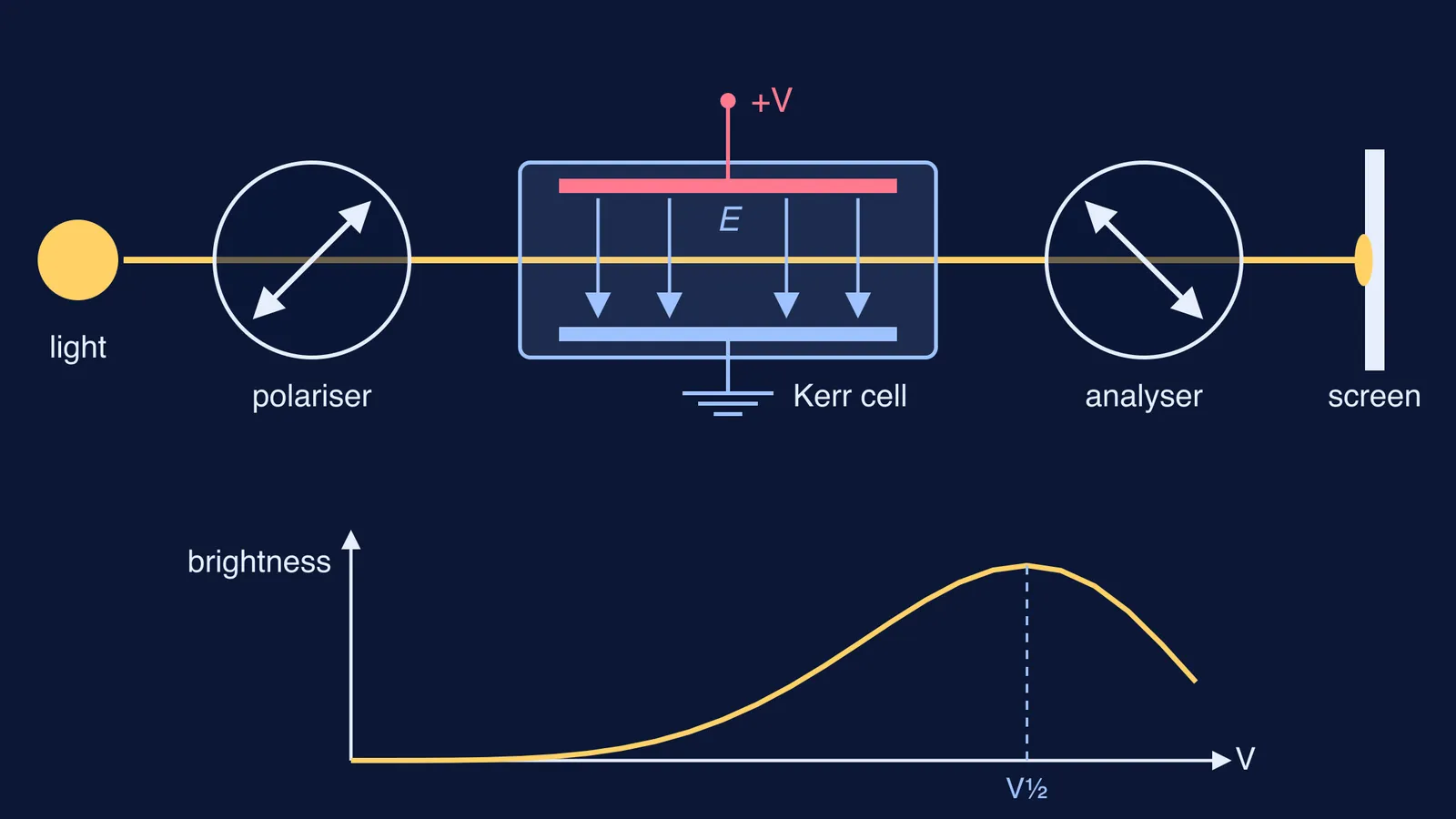
A Kerr cell is two metal plates in a liquid such as carbon disulphide, placed between crossed polarisers, with the first polariser at 45° to the field (J. W. Beams, Review of Scientific Instruments, 1930). With no voltage, no light passes. With the field on, the light leaves the cell elliptically polarised and part of it passes the analyser. The transmitted brightness is then I = I₀ sin²(πKlE²), where l is the length of the light path between the plates.
Speed is what made it useful. Kerr found that glass took several seconds to respond, but in liquids he could find no such lag (Beams 1930). In 1899 Abraham and Lemoine concluded that in carbon disulphide the effect did not persist for as long as 10⁻⁸ s after the field was removed (same source). As the physicist J. W. Beams of the University of Virginia put it in his 1930 review, "It is the absence of long time lags in liquids that makes the Kerr cell useful in the measurement of short time phenomena or as light shutters."
Modern Kerr cells usually contain nitrobenzene or another liquid and are often used as high-speed shutters for photography (Florida State University). They can modulate light at frequencies as high as 10 GHz, but a typical cell may need as much as 30 kV for complete transparency (Kerr effect, Wikipedia).
Worked example: how much voltage does a Kerr cell need?
Nitrobenzene has K = 4.4 × 10⁻¹² m/V² and water K = 9.4 × 10⁻¹⁴ m/V² (Kerr effect, Wikipedia). Imagine a cell with plates 5 cm long and 1 cm apart.
Full brightness needs sin²(πKlE²) = 1, so πKlE² = π/2, which means E² = 1 / (2Kl).
For nitrobenzene: E² = 1 / (2 × 4.4 × 10⁻¹² × 0.05) = 2.27 × 10¹² V²/m², so E ≈ 1.5 × 10⁶ V/m.
Voltage is field times gap: V = 1.5 × 10⁶ × 0.01 ≈ 15 kV.
Halve the voltage to 7.5 kV and the brightness is sin²(π/8), only about 15% of full, because the effect depends on E².
For water, E must rise by √(4.4 × 10⁻¹² / 9.4 × 10⁻¹⁴) ≈ 6.8 times, so the same cell needs about 103 kV.
The diagram's curve shows step 4: brightness creeps up, then rises steeply near full voltage.
How is the Kerr effect different from the Faraday effect?
Michael Faraday's effect uses a magnetic field and, instead of making the light elliptical, rotates its plane of polarisation: see how a magnetic field rotates polarised light. In both, an analyser decides how much light gets through, as worked out in three polaroids and Malus' law.
The Fermi Simulation Lab has interactive simulations for ideas like this, and if refractive index or polarised light still feels shaky, the Fermi Concept Library gives each concept its own lesson and its place in the map.
Next step: redo the worked example for a cell 10 cm long and check that the voltage drops by a factor of √2.