

On this page
On 30 September 1845, Michael Faraday wrote in his notebook: "Still, I have at last succeeded in illuminating a magnetic curve or line of force, and in magnetizing a ray of light."
After years of fruitless attempts to find a connection between electrical forces and light, Faraday placed a dense piece of glass between the poles of a powerful electromagnet (Wikipedia). When he switched the magnet on, the plane of the light passing through the glass twisted.
This discovery, now known as the Faraday effect, was the first concrete proof that light and electromagnetism are deeply connected.
What was the heavy glass of 1845?
The breakthrough relied on a very specific material. Fifteen years earlier (Wikipedia), Faraday had spent years trying to formulate better optical glass for telescopes. That project was deemed a failure because the resulting glass was too heavy and streaky for lenses.
However, Faraday kept blocks of this "heavy glass" — a dense borosilicate of lead — in his laboratory. Before this success, Faraday had tried to observe the effect by passing light through air, water, and ordinary crown glass. His early electromagnets were not strong enough, and those materials simply did not respond well to a magnetic field.
The heavy glass was the missing piece. Its high density and high refractive index made it uniquely sensitive to magnetic fields. When he finally placed it in his 1845 experiment, the heavy glass amplified the magnetic rotation enough to be seen with the naked eye.
How does a magnetic field rotate polarised light?
Normal light waves vibrate in all directions. When light passes through a polarising filter, it emerges vibrating in only one plane.
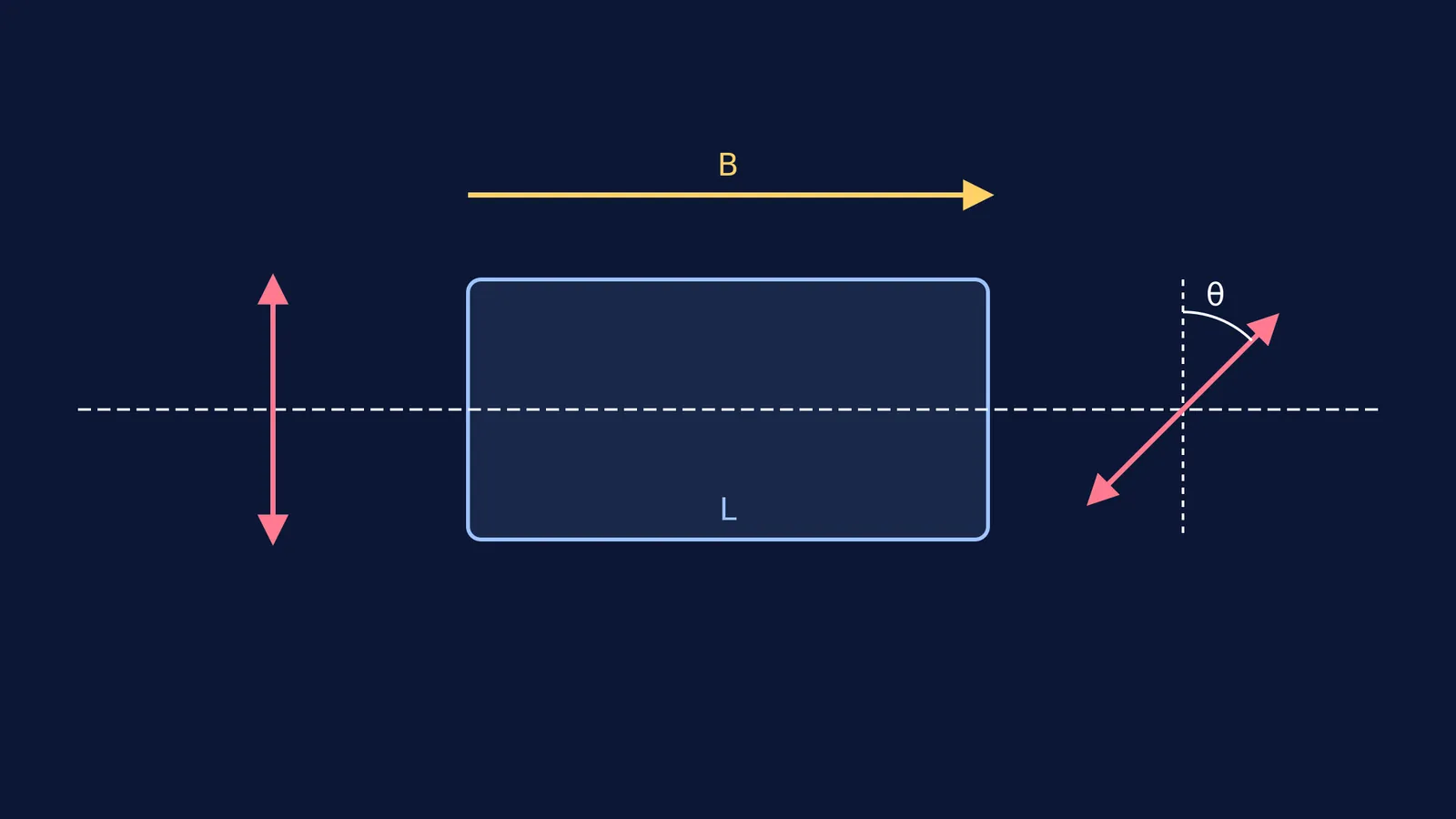
If this polarised light then travels through a material (like Faraday's glass) while a magnetic field runs parallel to the light's path, the plane of polarisation steadily rotates. The angle of this rotation, θ, is given by a simple formula (RP Photonics):
θ = V × B × L
Here, B is the strength of the magnetic field in teslas, and L is the distance the light travels through the material in metres. V stands for the Verdet constant, a specific number for each material that tells you how strongly it responds to the field.
The Verdet constant varies wildly depending on the material. For example, the Verdet constant of air is extremely small, which is why we do not see light twisting around magnets in everyday life. In contrast, heavy glass and modern synthetic crystals have very high Verdet constants. The effect is also dependent on the wavelength of the light; blue light typically rotates more than red light in the same magnetic field.
If you struggle to picture how fields interact in three dimensions, the Fermi Simulation Lab lets you adjust B and L on screen to watch the wave twist in real time.
Why does the Faraday effect matter?
Before 1845, electricity, magnetism, and optics were studied as separate forces of nature. Faraday's heavy glass experiment showed they were part of the same framework. This insight paved the way for James Clerk Maxwell: how his equations showed light is electromagnetic.
Today, the Faraday effect is not just a historical curiosity. It is actively used to build "optical isolators" for lasers. In high-powered lasers, any light reflecting off a target and travelling back into the cavity can cause instability or destroy the laser. An optical isolator acts as a one-way valve to prevent this.
Unlike normal rotation caused by sugar solutions, Faraday rotation is non-reciprocal. If light travels forward through the glass and gets rotated by 45 degrees (RP Photonics), and then reflects back through the same glass, it does not untwist. Because the magnetic field direction is fixed, the return journey rotates the light another 45 degrees in the same direction. It emerges rotated by 90 degrees in total, allowing a simple polarising filter to completely block it from re-entering the laser source.
How do you calculate Faraday rotation?
Let's put the formula into practice. Suppose a researcher wants to rotate a beam of light by a specific amount.
The problem: A block of heavy glass with a length of 0.1 m is placed inside a magnetic field of 0.5 T. For the specific wavelength of light being used, the glass has a Verdet constant of 20 rad/(T·m) (RP Photonics). By what angle will the plane of polarisation rotate?
The solution:
Identify the given values: V = 20 rad/(T·m), B = 0.5 T, and L = 0.1 m.
Apply the Faraday rotation formula: θ = V × B × L
Multiply the values: θ = 20 × 0.5 × 0.1
The result is 1 radian (about 57.3°).
If you frequently get stuck on where to start with optics calculations, the Fermi Problem Library breaks down the steps to help you set up the right equations before you plug in the numbers.
Faraday's experiment reminds us that in science, even a "failed" piece of glass can hold the key to an entirely new understanding of the universe.
For more on how early experiments revealed the nature of light, read about David Brewster and the angle of perfect polarisation.


