On this page
In 1837 John Deere, a blacksmith newly arrived in Grand Detour, Illinois, from Vermont, made a plough that could be used in the “sticky, root-filled soil of the prairie”. That is how Edward C. Kendall, curator of agriculture at the Smithsonian's Museum of History and Technology, opens his study John Deere's Steel Plow. The tests he reports on a very early Deere plough show the secret was as much “smooth” as “steel”.
Why did prairie soil stick to iron ploughs?
The richest prairie bottom lands, after a few years of continuous cultivation, became so sticky that they clogged the mouldboards, the curved plates that lift and turn the cut soil, according to Kendall's Smithsonian paper. Farmers carried a wooden paddle just to scrape the mouldboard clean, so often that it seriously slowed ploughing. Steel, Kendall notes, was smoother and shed sticky loam better than wooden mouldboards covered with wrought iron or the cast-iron ones of new factory-made ploughs.
Why does wet clay grab metal at all? Engineers studying clay that clogs tunnel-boring machines model it with water-film theory: capillary force and the viscous drag of a thin water film hold clay to metal, and moisture changes how hard (Fang and colleagues, Underground Space, 2024).
NCERT's Class 10 geography textbook says India's black soils are “sticky when wet and difficult to work on unless tilled immediately after the first shower” (NCERT, Resources and Development). Our explainer on why black soil suits cotton covers where that soil comes from.
What did John Deere actually change?
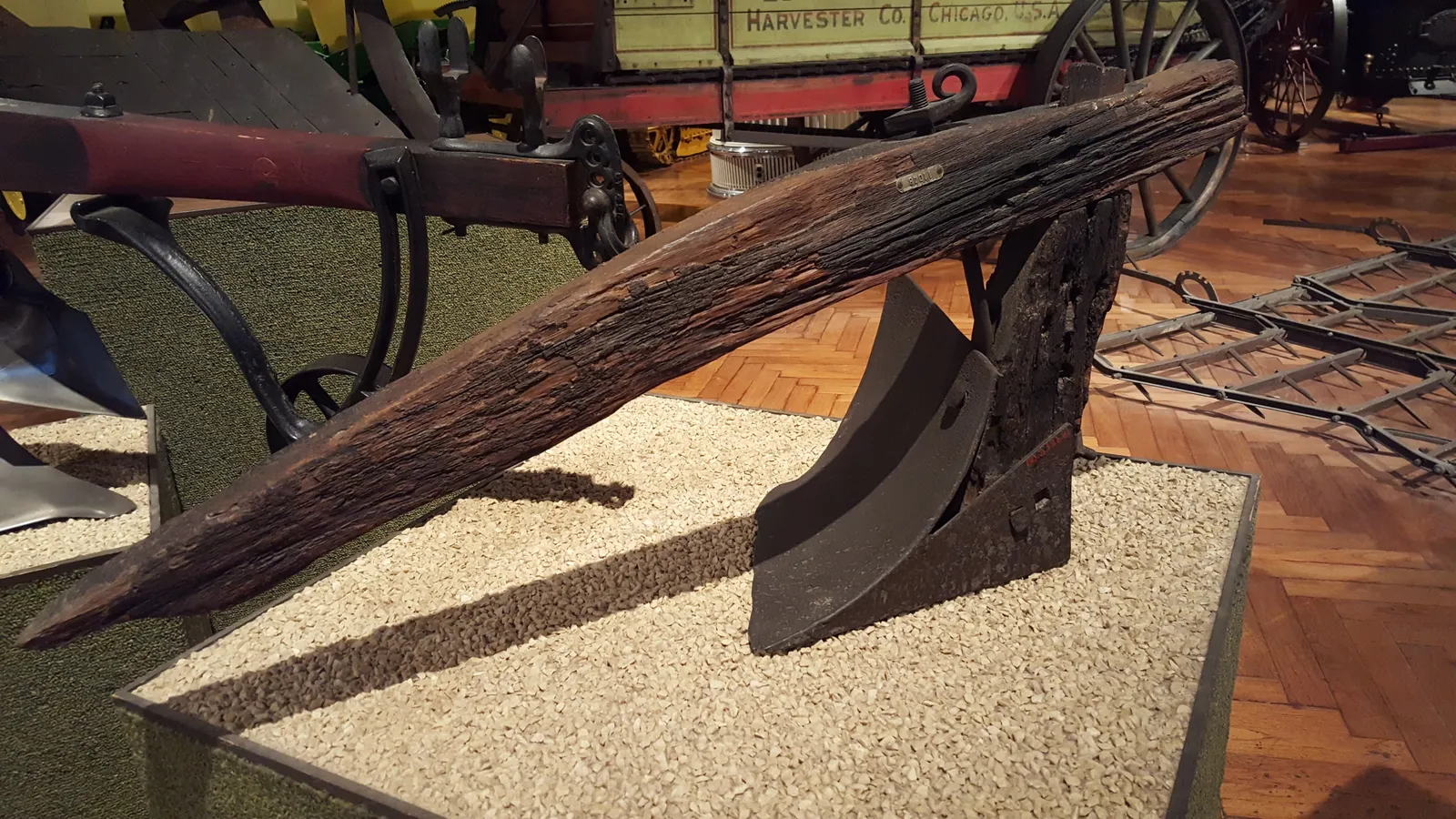
Kendall examined the plough Deere & Company gave the US National Museum in 1938, which company records say was made in 1838 and “probably substantially identical” to the first one of 1837 (Kendall). A spark test, in which a grinding wheel throws sparks whose pattern reveals the metal, showed the mouldboard was wrought iron and the cutting edge, the share, was medium-high-carbon steel. A laboratory analysis of filings agreed.
Deere's own 1843 newspaper advertisement, which Kendall reprints, said: “The whole face of the moldboard and share is ground smooth, so that it scours perfectly bright in any soil.” A plough scours when the soil slides off and leaves the metal bright.
Kendall's verdict: Deere's success “depended as much on the smooth surface he produced by grinding and polishing as on the material used.” His one-piece plate also lacked the nailheads and joints where earth stuck to strip-covered mouldboards.
Why does a polished surface shed sticky soil?
Soil sliding up the mouldboard meets two kinds of resistance: friction and adhesion, the water-film glue. Adhesion builds up: a computer-simulation study of paddy-field tillers, checked against soil-bin tests, found that the longer a tillage part worked in wet clay, the more soil particles adhered to it (Cheng and colleagues, Processes, 2021).
In 1857 the farm journal Country Gentleman, after a visit to Deere's factory, said the ploughs were “perfectly polished before they are sent out, and are kept bright by use, so that no soil adheres to them,” as quoted by Kendall.
The problem remains. A 2024 review in Biomimetics says tillage parts use 30–50% of their energy to overcome soil friction and adhesion (Xu and colleagues). It also describes engineers copying dung beetles, whose non-smooth surfaces break up the water film and cut contact area. The goal is to deny wet soil a firm grip; polish is one way.
If friction and adhesion blur together in your physics notes, the Fermi Concept Library gives each concept its own lesson and its place in the map, and the Fermi Simulation Lab has interactive simulations for ideas that are easier to see than to read.
How fast did the self-scouring plough spread?
Kendall quotes production figures from an 1894 history: 10 ploughs in 1839, 40 in 1840, 75 in 1841, 100 in 1842 and 400 in 1843 (Kendall). In 1847 Deere moved to Moline, Illinois, for better transport, and the new firm made 700 ploughs in its first year, 1,600 in 1850 and 10,000 in 1857. For another farm tool that changed fields, read about Jethro Tull's seed drill.
How can you check a famous invention story yourself?
Kendall tested the legend instead of repeating it. Use his method, with his paper as the worked example:
Find the real object, not the retelling. Kendall studied the 1838 plough itself and found earlier reconstructions had the handles wrong.
Read what the maker said at the time. Deere's 1843 advert names wrought iron for the mouldboard and steel for the share.
Test the material. The spark test settled what the mouldboard was made of.
Measure it. The mouldboard is 0.228 to 0.238 inches thick and 12 inches wide, close to the sizes of mill saws in an 1897 saw catalogue.
Separate what made it work from what it is called. Here, a sharp share plus a smooth face.
Then test the physics. Write a prediction, press wet garden mud onto a clean steel spoon and onto a rusty iron surface, tilt both and nudge the mud. Which surface comes away bright? Add water and repeat.
To see how soil behaviour became a full engineering science, read why Karl Terzaghi is called the father of soil mechanics.