

On this page
Before 1925, building on soil was largely a game of trial and error. Engineers knew that soft clay caused buildings to sink and that rain could bring down hillsides, but they lacked a mathematical way to predict these failures. That changed when the Austrian civil engineer Karl von Terzaghi (1883–1963) published his book *Erdbaumechanik auf bodenphysikalischer Grundlage* in 1925 (Wikipedia).
In it, he introduced a concept that would elevate geotechnical engineering from guesswork to a rigorous science, earning him the title of the father of soil mechanics (Wikipedia). His breakthrough was distinguishing between the total load placed on the ground and the load actually carried by the soil grains themselves.
What is the principle of effective stress?
Terzaghi realised that soil is a porous sponge made of solid particles with voids in between. If the soil is below the water table, these voids are completely filled with water. When you place a heavy load on the ground, such as a building, that total stress (σ) must be supported by the soil underneath.
However, water cannot be easily compressed. The principle of effective stress states that the engineering behaviour of soil is controlled not by the total stress, but by the effective stress (σ') carried by the solid soil skeleton (Wikipedia).
Terzaghi formulated this relationship as a simple equation: σ' = σ - u (Wikipedia)
Here, σ is the total normal stress pressing down, and u is the pore water pressure pushing outward from the voids. The effective stress (σ') is the difference between the two, representing the actual contact force pressing the soil grains together.
If you are trying to picture how microscopic forces act inside materials, the Fermi Simulation Lab has interactive simulations for the ideas that are easier to see than to read.
Why does water cause landslides?
Soil derives its shear strength primarily from interparticle friction (Wikipedia). Much like a block resting on a table, the frictional resistance depends on how hard the surfaces are pressed together (as seen in Angle of repose and angle of friction: the tan θ = μ result).
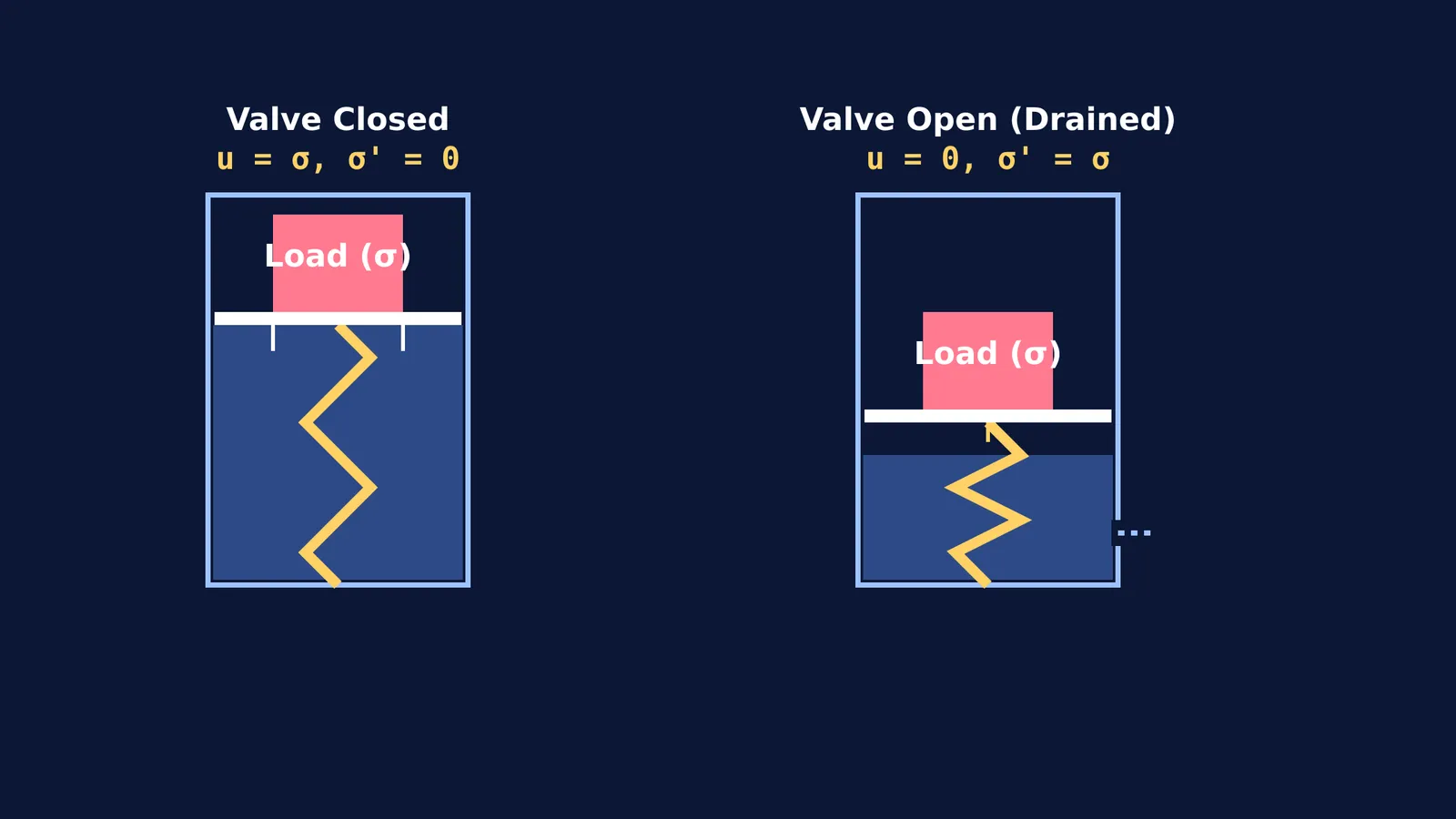
When pore water pressure (u) increases—for example, during heavy rainfall—the water pushes the soil grains apart. Because the total weight (σ) remains roughly the same, the equation σ' = σ - u shows that the effective stress (σ') must decrease. The soil grains lose their tight contact, friction drops, and the soil mass can slide along a failure plane, triggering a landslide (Wikipedia).
In extreme cases, such as an upward flow of groundwater, the pore pressure can become high enough to match the total stress. When u = σ, the effective stress becomes zero, and the soil loses all shear strength, turning into a liquid-like state known as quicksand (Wikipedia).
How does effective stress explain settlement?
When a new load is suddenly applied to saturated clay, the water initially takes all the extra pressure (Wikipedia). (This is similar to how fluids transmit pressure in closed systems, explained in Pascal's law in hydraulic machines: lifting a car with a small push).
Over time, this excess pore water pressure slowly forces the water to drain out of the clay. As the water leaves, the load is gradually transferred from the water to the solid grains. The effective stress increases, forcing the particles closer together. This volume reduction manifests as consolidation or settling at the surface, a process that can take years (Wikipedia).
Whenever you tackle physics problems involving fluid pressure and friction, Fermi's AI tutor works out what you already know, builds a plan for the session, and teaches through it—writing on a board, drawing the figure, running the simulation, and checking understanding as it goes.
What is Karl Terzaghi's legacy?
Armed with the effective stress principle, Terzaghi went on to solve some of the world's most complex engineering problems. His expertise was sought globally for massive infrastructure projects, such as:
Serving as the founding president of the International Society for Soil Mechanics and Geotechnical Engineering (ISSMGE) in 1936 (Wikipedia).
Chairing the Consulting Board for the construction of the Aswan High Dam in Egypt from 1954 to 1959 (Wikipedia).
His ability to blend rigorous physics with practical field observations made him a legendary figure. In 1965, the Mission Dam in British Columbia was renamed the Terzaghi Dam in his honour (Wikipedia).


