On this page
In 1647 a brewer in Gdańsk (then Danzig) published a book about one object: the Moon. Johannes Hevelius called it *Selenographia, sive Lunae descriptio*, "Selenography, or a Description of the Moon". You can repeat his core method this month with binoculars and a notebook.
Who was Johannes Hevelius?
Hevelius was born in Danzig on 28 January 1611 and died there on 28 January 1687, according to the MacTutor biography at the University of St Andrews. The same biography records that he joined the Brewers' Guild in 1636 and was elected an alderman of the city in 1641.
In 1641 he built an observatory on the roofs of his three connected houses (Wikipedia summary of his life). Lunar historians note he called it "Stellaburgum" and observed with self-built telescopes (the-moon.us lunar wiki).
What is in Selenographia (1647)?
Hevelius observed the Moon for about four years before self-publishing (the-moon.us); the University of Oklahoma's History of Science Collections says five. St Andrews notes he observed with a 12-foot telescope (MacTutor).
The heart of the book is the terminator, the line between lunar day and night. Forty copper-plate engravings show relief along that shadow-line at every angle of sunlight, as the University of Oklahoma describes it. Low sunlight there makes mountains cast long shadows. Galileo had used the same shadows decades earlier, as our post on how Galileo measured mountains on the Moon explains, and Thomas Harriot had sketched the Moon in 1609 (see Harriot's first telescopic Moon map).
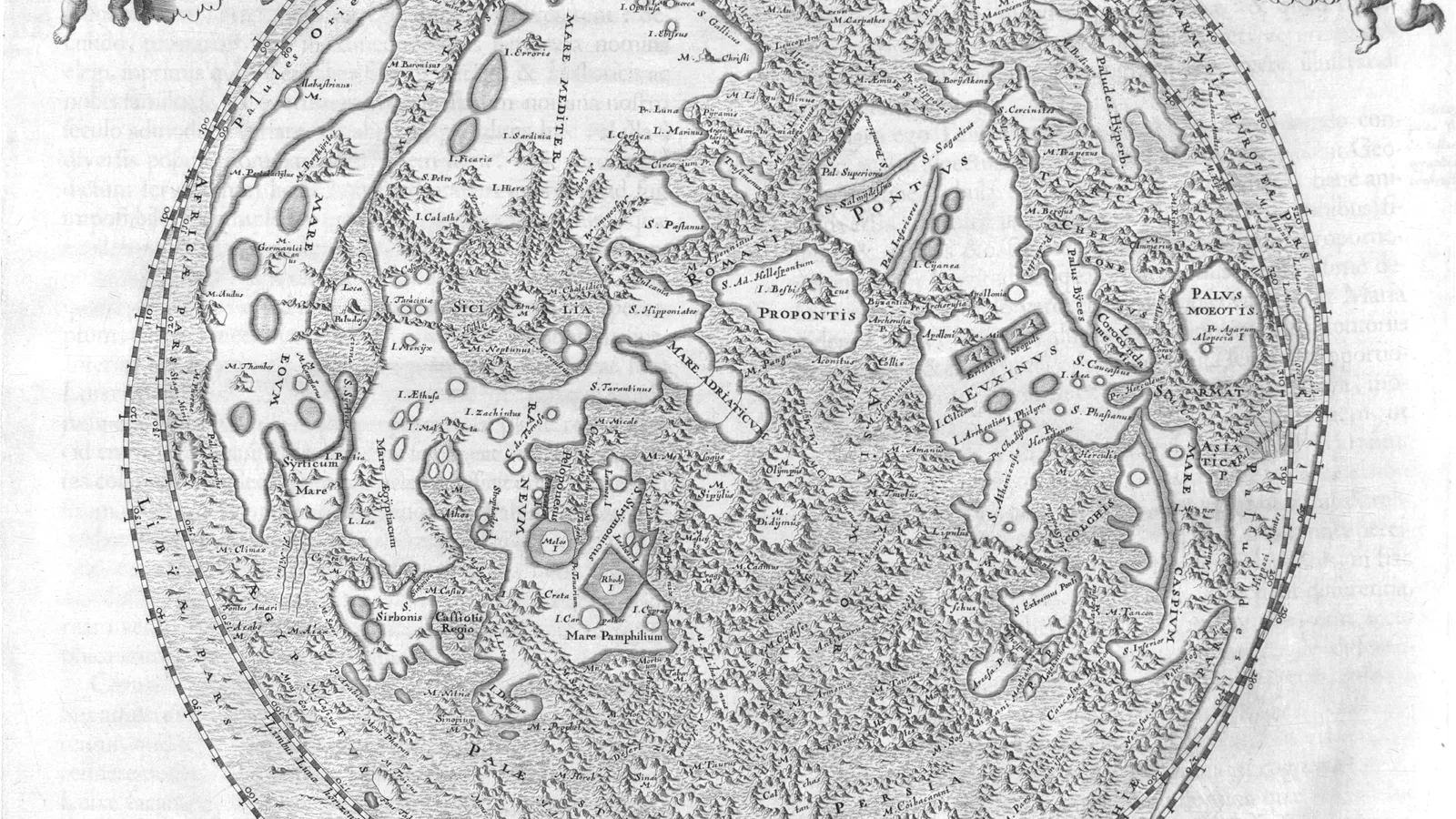
Hevelius went further. His double-page map is not a snapshot of the full Moon. It combines shadows recorded in opposite phases into one picture of the whole surface (University of Oklahoma). The same source says the atlas set a standard for precision that "remained unmatched for a century".
He also cut the plates himself: the University of Glasgow's special collections say Hevelius engraved the 137 full-page and partial plates. MacTutor counts 60 drawings, so totals vary by source.
Which of Hevelius' Moon names do we still use?
Hevelius named 275 lunar features after places on Earth, but the scheme was not widely adopted (University of Oklahoma). Today's maps keep only a very few of his names, mostly for mountain ranges (the-moon.us). Two you can find on any modern Moon map are Montes Alpes and Montes Apenninus, the lunar Alps and Apennines (the-moon.us list of his mountain names).
What is lunar libration, and what did Hevelius find?
Libration is the slight rocking of the Moon's face as seen from Earth: because of the tilt and shape of the Moon's orbit, we see it from slightly different angles over a month (NASA Scientific Visualization Studio). Hevelius discovered the libration in longitude, the east-west part of this wobble (MacTutor). He judged it by watching how the apparent separation of a pair of lunar features changed (Encyclopedia.com). His maps carry dotted libration circles around the disc, though lunar historians say it is unclear exactly what they were meant to represent (the-moon.us).
If you have wondered why we see only one side of the Moon at all, start with our explainer on why we always see the same side of the Moon. The Fermi Simulation Lab has interactive simulations for ideas like this that are easier to see than to read.
How can you map the Moon like Hevelius?
You need binoculars or a phone held to a small telescope, a pencil, and two weeks of evenings. Start two or three evenings after the new moon, when a thin crescent shows in the west after sunset.
Night 1 to 3 (thin crescent): sketch the Moon as a circle, shade the dark part and draw the terminator. Write the date and time.
Night 4 to 7 (towards first quarter): pick one crater or mountain chain near the terminator and draw its shadow.
Night 8 to 14 (towards full): keep sketching the same features. The shadows shorten as the Sun rises higher over them.
Full moon: compare your sketches with a modern map. Find the Alps and Apennines, Hevelius' names.
Libration check: on photos taken several days apart while it is lit, measure how far the dark oval of Mare Crisium sits from the nearest edge, and divide by the Moon's width in the same photo, which cancels changes in zoom and distance. If the fraction changes, you have seen libration in longitude.
Worked example, with made-up numbers: a 6 mm gap on a 60 mm Moon (0.10) one night and 4 mm (0.07) a few nights later means Crisium has moved towards the edge: that side has turned slightly away from you.
If the geometry of phases or shadows does not click, Fermi's AI tutor can work out what you already know and build a plan for the session, drawing the figure as it explains.
Hevelius' home and observatory burned on the night of 26 September 1679 (MacTutor), but his method survives: draw the shadows night after night and let the changes show you the shape.