

On this page
In the summer of 1609, the newest piece of technology in Europe was the "Dutch trunke" (what we now call a refracting telescope). While most people saw this combination of lenses as a military or surveying tool for spotting ships and troops, English mathematician Thomas Harriot had a different idea. He pointed his new instrument toward the night sky, fundamentally changing how humanity viewed the cosmos.
When was the first telescope moon drawing made?
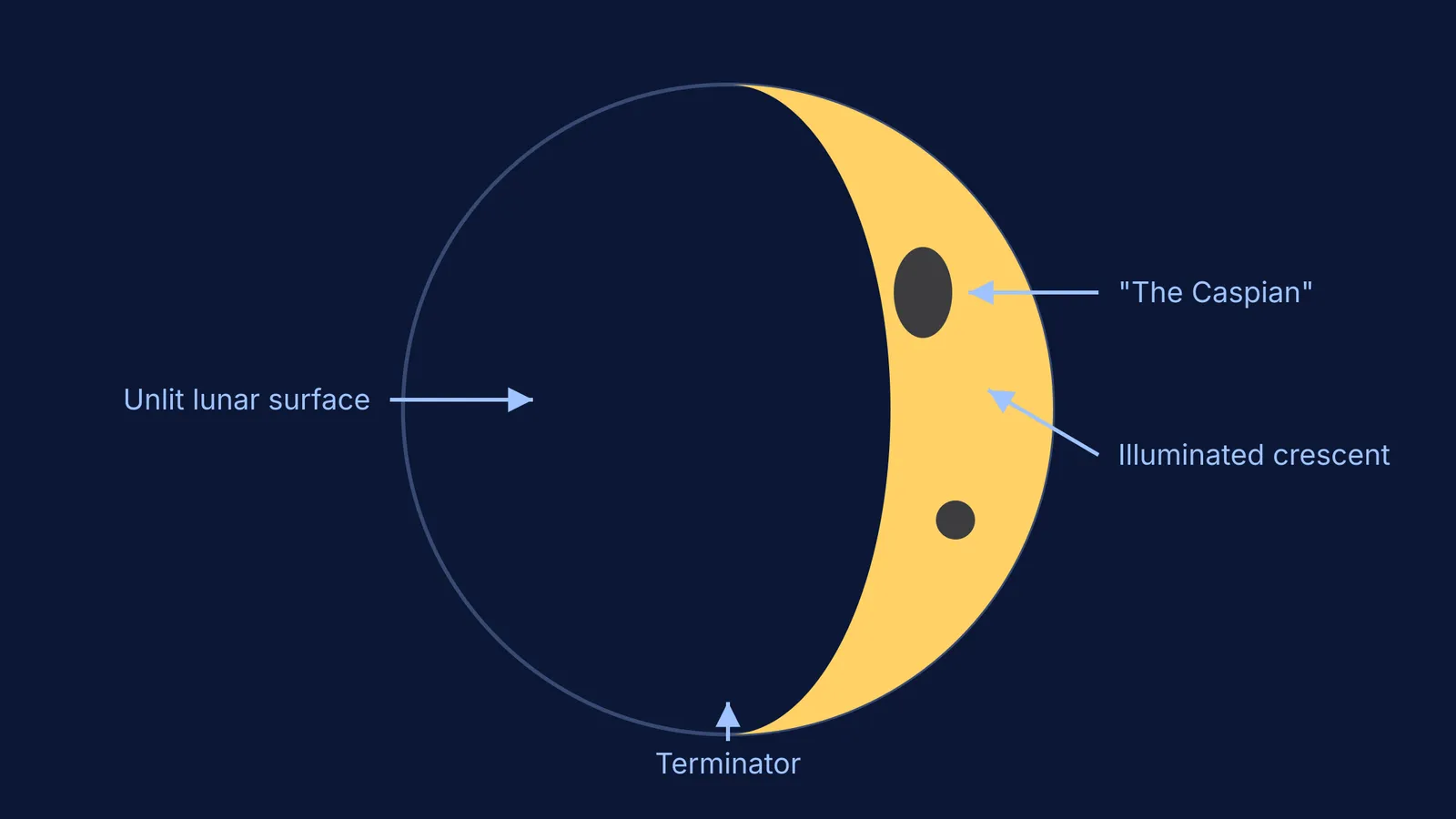
Thomas Harriot made the first recorded telescopic drawing of the Moon on 26 July 1609 (Source). Working from the grounds of Syon House in west London, he used a simple refracting telescope providing 6x magnification to sketch a crescent moon.
His initial drawing was a simple but accurate sketch. It captured the round shape of the Moon and the "terminator"—the jagged dividing line between the bright and dark halves. While Galileo Galilei is often credited as the pioneer of telescopic astronomy, Harriot's lunar sketch actually predates Galileo's first known moon observations by about four months.
Harriot did not stop with that first sketch. Over the next few years, he acquired and built stronger telescopes that reached 32x magnification (Source). These improved instruments allowed him to draw incredibly detailed, full-phase maps of the lunar surface that would not be surpassed in accuracy for decades.
Why didn't Thomas Harriot publish his 1609 map?
If Harriot was the first to map the Moon through a telescope, why did Galileo become a household name? The difference came down to patronage, financial pressure, and personal ambition.
Harriot was a gentleman scholar supported by a wealthy patron, Henry Percy, the 9th Earl of Northumberland. In 1609, the Earl was imprisoned in the Tower of London due to political suspicions. With a guaranteed private salary and a patron more concerned with survival than public glory, Harriot felt no pressure to print his astronomical findings. He shared his maps only with a small circle of friends.
Galileo, on the other hand, was seeking a prestigious, well-paid position with the Medici family in Italy. When he pointed his telescope at the Moon in late 1609, he knew he had to announce it quickly to secure his funding. Galileo rushed to publish his short book, *Sidereus Nuncius* (Starry Messenger), in March 1610, successfully cementing his place in history. Because he kept his work private, Harriot's maps remained hidden in manuscripts for centuries, and were not published in full until 1965.
How did Harriot's moon map differ from Galileo's?
The two astronomers also looked at the Moon in completely different ways, shaped by their different goals. Galileo approached the Moon as a physicist trying to prove a point. He focused heavily on the topography, using the shadows of mountains and craters along the terminator line to prove that the Moon was a rugged, rocky world just like Earth. This was a direct challenge to the ancient belief that all celestial bodies were perfect, smooth spheres.
Harriot approached the Moon as a cartographer and a surveyor (Source). He wanted to map its features accurately in two dimensions, carefully recording the relative positions of the light and dark patches. He viewed the lunar surface as lands and oceans, and he even gave names to the regions he mapped, labelling one prominent dark patch "the Caspian" (Source).
How can you approach physics like a surveyor?
When you study the magnifying power of telescopes today, you use ray diagrams and formulas to understand exactly what a lens can reveal. Sometimes having the right formula is only half the battle; knowing how to approach the problem step-by-step is just as important.
If you are trying to master ray optics, treat it like Harriot mapping a new world:
Define the knowns: Write down the focal lengths and object distances before drawing any lines.
Draw the map: Sketch a clear ray diagram to see where the image will form.
Check your work: Use the lens formula to verify what your drawing shows.
Fermi's AI tutor can work out what you already know and build a plan for the session, so you sit down to a clear next step. If you are struggling with the physics of lenses and mirrors, you can look up the core ideas in the Fermi Concept Library. Whether you are mapping the Moon like Harriot or looking to the stars like the planners of the Hubble Space Telescope, a structured method makes the unknown much clearer.


