

On this page
In 1800 William Herschel found invisible rays beyond the red end of the spectrum, which we now call infrared, as Ritter's Wikipedia biography recounts. A year later a young German physicist, Johann Wilhelm Ritter, asked the next question: is there something invisible beyond the violet end too? His answer gave us ultraviolet light, and his method is still a good model for finding what your eyes cannot see.
Ritter lived from 16 December 1776 to 23 January 1810, dying in Munich aged 33, according to the same biography.
How did Johann Ritter discover ultraviolet light?
The experiment, as described by Caltech's Cool Cosmos lesson on the Ritter experiment, went like this:
He passed sunlight through a glass prism to spread it into a spectrum.
He placed silver chloride, a white salt that turns black in sunlight, in the different colours.
He saw little change in red and more darkening towards violet.
He then put silver chloride just past the violet end, where no light could be seen, and it reacted strongly anyway.
The lesson says Ritter called this new light chemical rays, a name that fits how he found it: by the chemistry it caused, not by sight. NASA's page on ultraviolet waves tells the same story with light-sensitive paper: it turned black beyond violet, proving ultraviolet light exists.
Historians Jan Frercks, Heiko Weber and Gerhard Wiesenfeldt studied the discovery in a 2009 paper in Studies in History and Philosophy of Science. As this history of the discovery reports from their translation, Ritter's short 1801 note dated the find to 22 February and said the rays outside the violet "reduce even more strongly than violet light itself".
Why did Ritter look beyond the violet end?
Ritter followed Naturphilosophie, a German movement whose members believed nature works through opposite pairs, or polarities, as the same history of the discovery explains. If Herschel had found hidden heat rays past red, the opposite end of the spectrum ought to have a partner. He first looked for invisible cooling rays, found none, and then tried silver chloride.
The philosophy has not lasted, but the prediction was testable, and he tested it with a detector that did not depend on his eyes.
Why does ultraviolet darken silver chloride faster than red light?
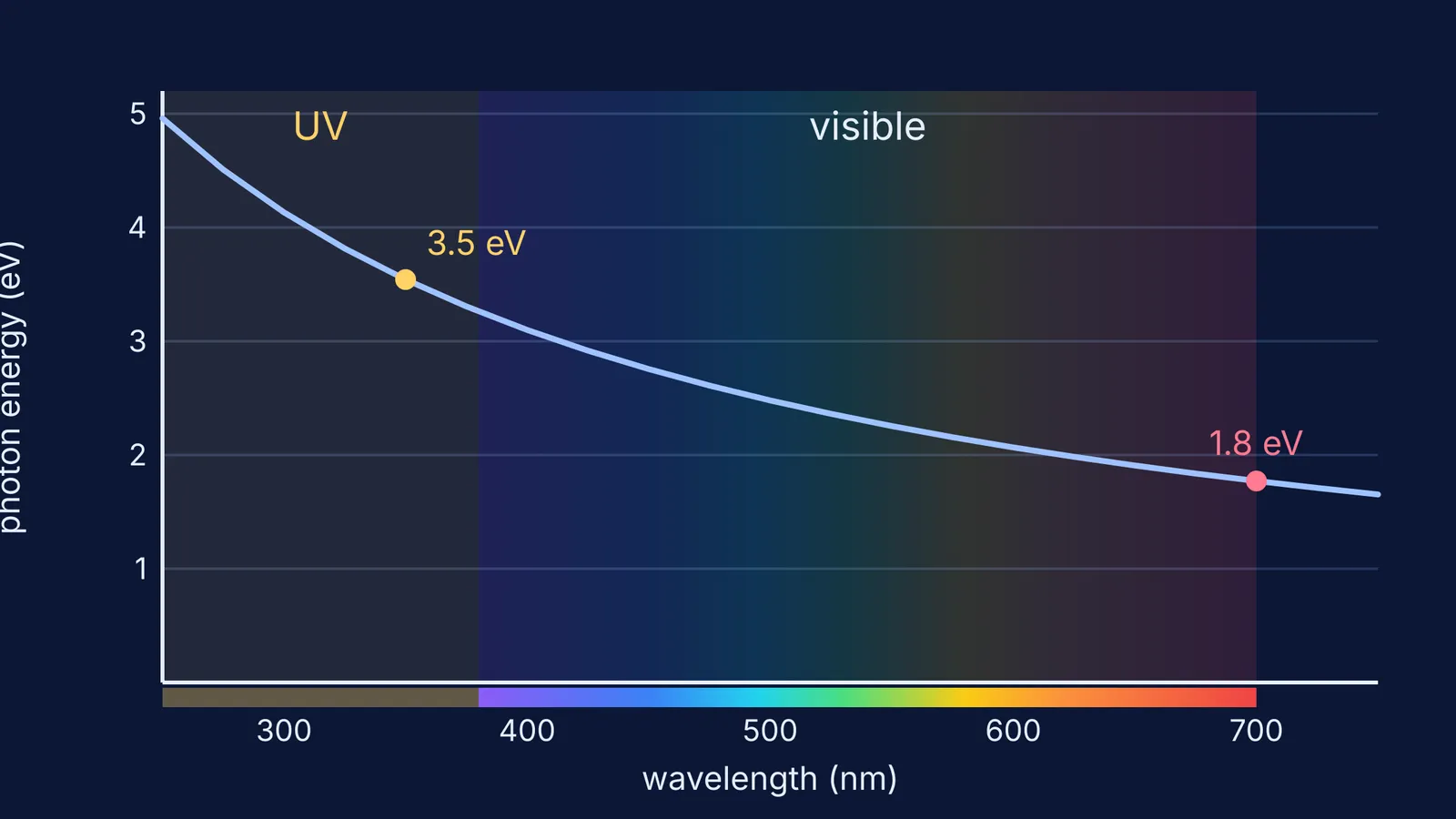
Ritter had no idea of photons, but you can explain much of his result with one Class 12 formula: the energy of one photon is E = hc/λ. Using NIST's values of the Planck constant in eV per hertz (about 4.136 × 10^-15 eV s) and the speed of light (299,792,458 m/s), hc comes to about 1240 eV nm.
Worked example.
Red light at 700 nm: E = 1240 ÷ 700 ≈ 1.8 eV per photon.
Violet light at 400 nm: E = 1240 ÷ 400 ≈ 3.1 eV.
Ultraviolet at 350 nm: E = 1240 ÷ 350 ≈ 3.5 eV, about twice a red photon.
Light-driven chemistry happens one photon at a time, and each photon must carry enough energy to break or rearrange bonds. That helps explain why the salt darkens more as you move from red through violet into ultraviolet. Similar light-triggered silver chemistry is behind why photochromic glasses darken in sunlight.
The human eye typically detects wavelengths from 380 to 700 nanometres, says NASA's page on visible light, so Ritter's chemical rays lay just past the shortest wavelengths anyone could see. The WHO's guide to ultraviolet radiation) divides UV into UVA (315-400 nm), UVB (280-315 nm) and UVC (100-280 nm), and says UVA is about 95% of the UV that reaches the ground. Sunlight's UV is also why your skin tans.
If the jump from wavelength to photon energy feels abstract, the Fermi Simulation Lab has interactive simulations for ideas that are easier to see than to read. When you practise E = hc/λ numericals, the Fermi Problem Library has worked problems with a step-by-step solver that explains the reasoning.
How can you repeat Ritter's experiment at home or in school?
The Caltech lesson linked above swaps silver chloride for blueprint paper. You need a glass prism, blueprint paper, a cardboard box, a shallow pan, warm water and household ammonia. Project the sunlight spectrum into the box, lay the paper across the colours and well past violet for about 30 seconds, then hold it above a mix of 90% warm water and 10% ammonia for about 90 seconds to develop it.
Before you start, mark the visible violet edge on the paper and write a prediction: how far past that line will the paper react? On blueprint paper the exposed part turns light-coloured, so measure how far the light region runs beyond your line. That one measurement is the whole discovery.
What can students learn from Ritter's method?
Three habits worth borrowing for anything you cannot see directly:
Follow the pattern to its edge. Darkening rose from red to violet, so Ritter asked what happens one step further.
Use a detector that is not your eye. Silver chloride responded where he saw nothing.
Compare with a baseline. Red light barely changed the salt, so a strong change beyond violet meant something.
The other invisible end of the spectrum has its own story: read how Macedonio Melloni showed infrared behaves like light.


