

On this page
Stepping out of a classroom into bright sunlight, you might notice your glasses automatically tinting to protect your eyes. This everyday convenience is driven by precise photochemistry. Whether they are made of traditional glass or modern plastic, photochromic lenses rely on molecules that change their structure when struck by ultraviolet (UV) radiation.
What is the chemistry of traditional glass lenses?
Photochromic glass was invented in the early 1960s by William H. Armistead and Stanley Donald Stookey at Corning Glass Works (Wikipedia). In these traditional lenses, millions of microscopic silver halide crystals—usually silver chloride—are embedded in the glass matrix.
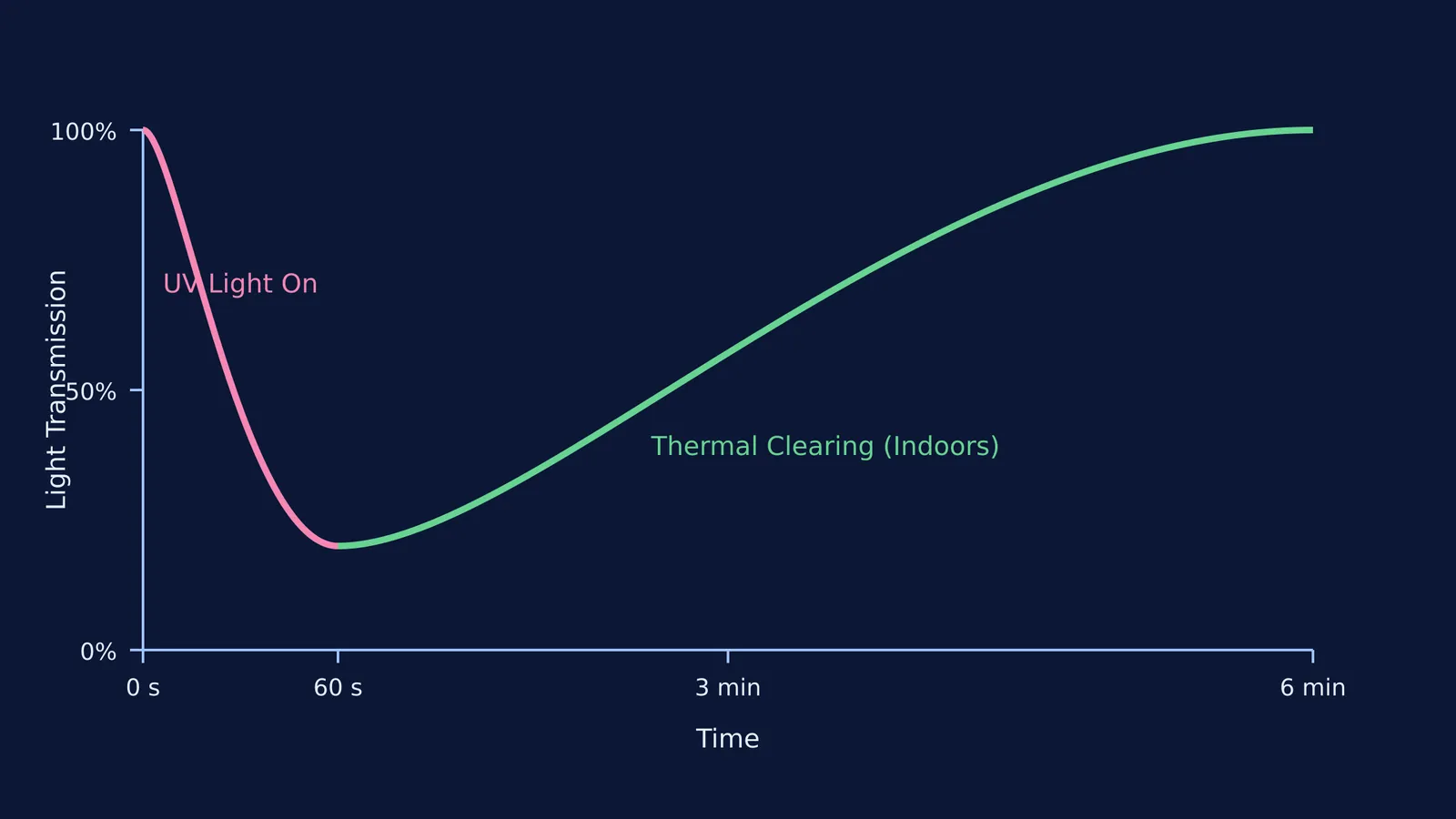
When UV light hits the lens, it provides the energy needed to transfer an electron from a chloride ion to a silver ion. This reduces the transparent silver ions into elemental silver atoms. These newly formed metallic silver particles absorb visible light, turning the lens dark and opaque. The process is remarkably fast, with lenses darkening substantially in less than one minute (Wikipedia).
This reaction is identical to the one used in old photographic film. However, in a glass lens, the silver and chlorine atoms are locked inside the rigid structure. When the UV source is removed, a catalyst such as copper chloride helps the silver atoms give up their extra electron, reverting to transparent silver ions.
How do modern plastic lenses work?
Today, most prescription lenses are made of lightweight plastics like polycarbonate. Because silver chloride cannot be easily embedded into plastic, these lenses use organic carbon-based dyes, such as naphthopyrans or oxazines.
These molecules undergo a conformational change when exposed to UV light. In their resting state indoors, the molecules have a "closed" shape that allows visible light to pass through. When a UV photon strikes the molecule, a specific chemical bond breaks, causing the molecule to unfold into an "open" structure. This new shape absorbs visible light, tinting the lens gray or brown. As you learn about Nil Ratan Dhar's work on photochemistry and sunlight, you see that photon energy is the key driver of these structural shifts. To visualise how energy alters molecular geometries, you can experiment in the Fermi Simulation Lab.
When you step indoors, the UV radiation stops. Thermal energy in the environment causes the molecules to snap back to their lower-energy closed state. This clearing phase takes several minutes, usually becoming mostly clear within five minutes (Wikipedia).
Why do photochromic glasses fail inside a car?
A common frustration is that photochromic lenses do not darken well when you are driving. This happens because the chemical reaction is highly specific to UV light. Modern car windshields are built with a laminated layer that blocks nearly all incoming UV rays. Without sufficient UV exposure, the molecules in your glasses remain in their transparent state, regardless of how bright the visible sunlight is. For a broader look at how visible light behaves in the atmosphere, you can read about the scattering of light and how rainbows form.
A practical checklist for students
If you are a student considering photochromic glasses for long study days, keep these factors in mind:
Commuting vs driving: They are excellent if you walk or cycle to campus, but you will still need standard sunglasses for driving.
Indoor lighting: They will not darken under most LED or fluorescent lights, which emit very little UV radiation.
Transition times: Expect less than a minute for them to darken outdoors, but a wait of up to five minutes for them to mostly clear when returning to a lecture hall (Wikipedia).
Temperature effects: Be prepared for them to stay darker for longer during the colder winter months.
By understanding the photochemistry at play, you can see how a simple lens manages to harness the power of invisible light to protect your vision. Fermi's AI tutor teaches, explains and works through problems alongside the student, helping you connect classroom chemistry to everyday phenomena.


