

On this page
Have you ever wondered what exactly happens when your skin turns darker after a day at the beach? Tanning is not just a colour change; it is a rapid, microscopic defense mechanism. When sunlight strikes your skin, it sets off an intricate chemical alarm designed to protect your genetic material from further harm.
Why does skin get darker in the sun?
Tanning is a biological "SOS" response. When the ultraviolet (UV) energy in sunlight hits your skin, it causes structural damage to the DNA inside your skin cells.
This damage activates a tumor suppressor protein called p53, which acts as a molecular sensor. The p53 protein forces the cells to release a signaling hormone called α-melanocyte-stimulating hormone (α-MSH). This hormone is the alarm bell that tells your skin to start building a shield.
How does the skin make a tan?
The pigment responsible for a tan is called melanin. It is manufactured by specialized, star-shaped cells in the lower layer of the epidermis known as melanocytes.
When the α-MSH alarm reaches the melanocytes, an enzyme called tyrosinase begins converting an amino acid (L-tyrosine) into melanin. These new pigment molecules are packed into tiny transport vehicles called melanosomes.
The melanocytes then use their long, arm-like extensions (dendrites) to deliver these packages to the surrounding skin cells, the keratinocytes. Each melanocyte interacts through its dendrites with 30 to 40 keratinocytes in the epidermis (Videira et al., 2013).
Once inside the keratinocyte, the melanin packages arrange themselves into a "supranuclear cap." This acts exactly like a microscopic umbrella, sitting physically above the cell's nucleus to absorb and scatter incoming UV rays before they can mutate the DNA.
Does UVA or UVB cause tanning?
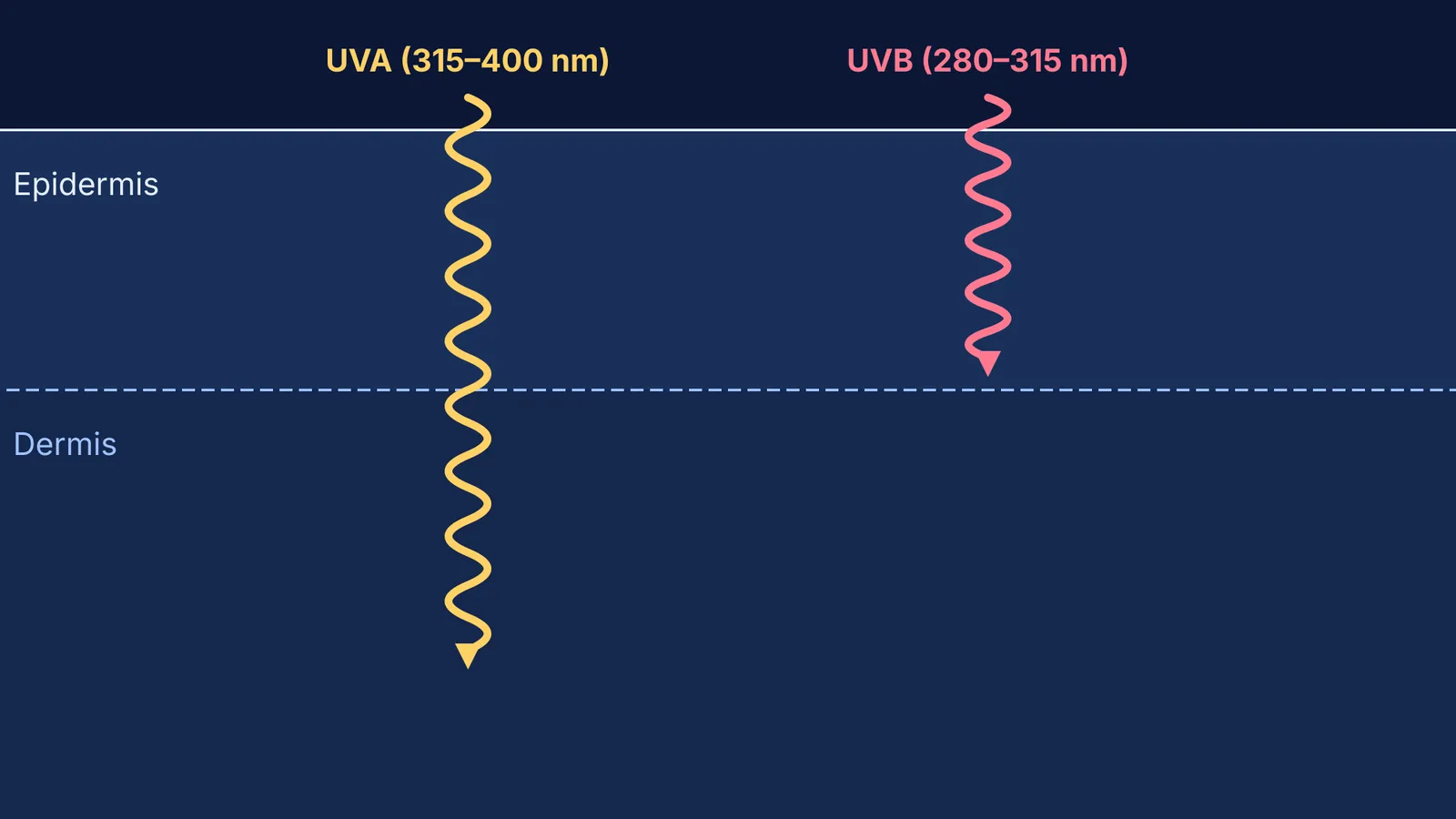
Sunlight contains different bands of ultraviolet radiation, and they trigger tanning in two very different ways. Ultraviolet radiation is divided into bands based on wavelength: UVA ranges from 315 to 400 nm, and UVB ranges from 280 to 315 nm (WHO)).
Immediate Tanning: This happens while you are still in the sun. It is caused primarily by UVA radiation, which penetrates deep into the skin and oxidizes melanin that is already there. This pigmentation appears within 5 to 10 minutes of UV exposure but fades quickly, sometimes in a matter of hours (Videira et al., 2013).
Delayed Tanning: This is the "real" tan that lasts for weeks. It is caused by UVB radiation, which stops in the upper layers of the skin, damages the DNA, and forces the body to manufacture brand-new melanin. This delayed pigmentation takes 3 to 4 days to fully develop (Videira et al., 2013).
Why does UV radiation damage DNA?
To understand why UVB damages DNA while visible light does not, you have to look at the energy of the wave. You can calculate the energy of individual photons using the E = 1240/λ formula (where energy is in electron-volts and wavelength λ is in nanometers).
For a UVB photon at 300 nm, the energy is roughly 4.13 eV. For visible red light at 620 nm, the energy is exactly half that, at 2.0 eV. The higher energy of the UV photon is enough to break chemical bonds in your DNA, which triggers the melanocyte response. This relationship between wavelength and energy dictates the overall energy density and intensity of an EM wave that your skin absorbs.
If you are studying the electromagnetic spectrum or trying to visualise how waves penetrate different materials, reading about it is one thing, but seeing it is another. In the Fermi Simulation Lab, you can interact with physical phenomena like wave propagation, while Fermi's AI tutor can help you map out exactly how these physics concepts connect to the biology of a cell.
Next time you step into the sunshine, remember that you are witnessing both quantum physics and cellular biology working together to keep you safe.


