

On this page
In 1800, the astronomer William Herschel discovered infrared radiation by placing a thermometer just beyond the red end of a projected spectrum of sunlight. He noticed the temperature rose significantly in this dark region, proving the existence of invisible "radiant heat". However, studying this new phenomenon was incredibly difficult. The mercury thermometers of the time were too slow, crude and bulky to measure the subtle properties of these rays. Because the radiation was invisible, scientists debated its true nature: was heat a physical fluid flowing between objects (the widely accepted caloric theory), or was it a wave travelling through space, just like light?
To answer this, Italian physicist Macedonio Melloni realised he needed to test heat using the exact same tools used to test light.
What is the Nobili-Melloni thermopile?
Before you can test an invisible wave, you need a way to reliably see it. In 1831, Leopoldo Nobili and Melloni developed the thermopile, an instrument that changed the study of heat.
The thermopile worked by stacking alternating bars of dissimilar metals, specifically bismuth and antimony. When one end of this metallic stack was heated by radiation, it turned the tiny temperature difference into a measurable electric current through the Seebeck effect. The instrument was remarkably sensitive; it could detect the heat of a person standing 30 feet away. By connecting this device to a delicate galvanometer, Melloni created a "thermomultiplier" that could finally quantify radiant heat with high precision.
How do we know infrared refracts and polarises?
With his highly sensitive new detector, Melloni set up a specialized optical bench. He quickly ran into a practical problem: standard optical glass absorbs almost all infrared radiation. He could not simply use glass prisms and lenses to test if heat bends, because the rays would never reach the other side.
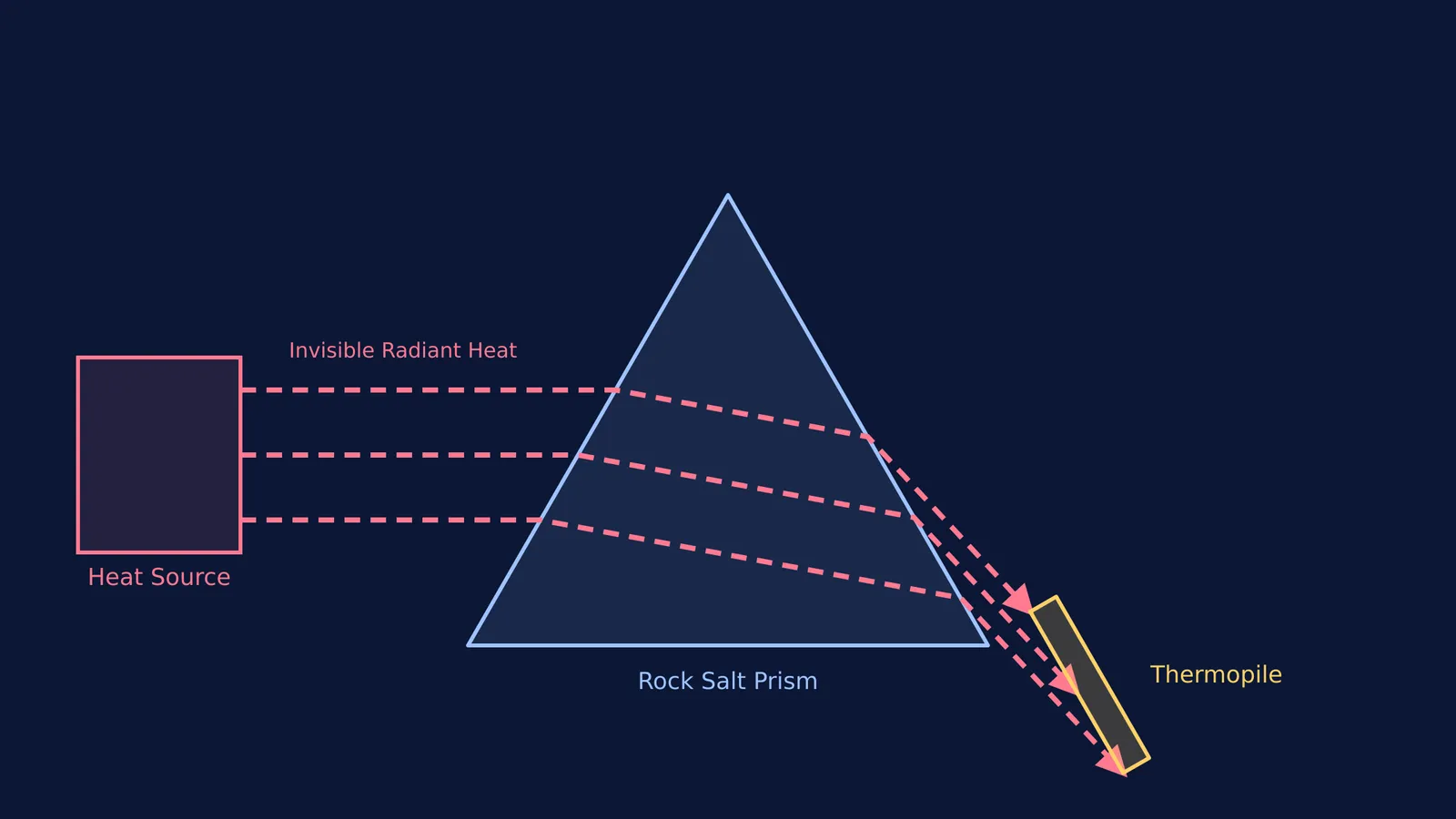
Through systematic testing, he discovered that rock salt (halite) is highly diathermanous, meaning it allows radiant heat to pass right through almost entirely. Melloni painstakingly carved large crystals of rock salt into flawless prisms and lenses, allowing him to perform the defining optical experiments of his career.
By passing heat from a uniform source (such as a boiling Leslie's cube) through his rock salt prisms, he showed that the invisible rays bent exactly as light does. He then used polished metallic mirrors to prove that heat reflects according to the same geometric angles, and thin plates of tourmaline crystals to demonstrate that the heat waves can be polarised. These experiments definitively proved that heat and light are the same fundamental phenomenon, differing only in their wavelength along a broader spectrum.
For this groundbreaking empirical work, he was awarded the prestigious Rumford Medal by the Royal Society in 1834, with the citation praising his "discoveries relevant to radiant heat".
How can Melloni's method help your exam prep?
Melloni's experimental approach is a perfect masterclass in reasoning by analogy. He did not start from scratch to understand radiant heat, nor did he invent new mathematical models. Instead, he took the established laws of optics (such as the refraction rules you might plot in a prism i-d graph practical) and rigorously tested them on a new phenomenon.
You can use this exact framework to accelerate your own studies. When you move from studying electrostatics to gravitation, or transition from the properties of visible light to calculating the energy density of an EM wave, do not treat the new chapter as a completely blank slate. Take the formulas, rules and visual models you already know, and deliberately test them on the new domain to see where the analogy holds up.
If you struggle to picture how invisible fields or waves behave, the Fermi Simulation Lab has interactive simulations for the ideas that are easier to see than to read. And if you are not sure how to connect an old concept to a new one, Fermi's AI tutor works out what you already know, builds a plan for the session, and teaches through it — writing on a board, drawing the figure, running the simulation, and checking understanding as it goes.


