On this page
Every school potentiometer is a long wire, a jockey and a galvanometer that you nudge towards zero. That routine comes from Johann Christian Poggendorff, a Berlin physicist, and one idea: measure a voltage by cancelling it, not by letting it push current through a meter.
Who invented the potentiometer null method?
Poggendorff was born in Hamburg in 1796 and died in Berlin in 1877, according to his Wikipedia biography. He edited the journal Annalen der Physik und Chemie from 1824 to 1876, and in 1826 he built an early mirror galvanometer, a current detector read by a reflected beam of light (Wikipedia; Encyclopedia.com).
In 1841 he published "Methode zur quantitativen Bestimmung der elektromotorischen Kraft inconstanter galvanischer Ketten", a method for measuring the emf of inconstant galvanic cells, in Annalen der Physik, volume 130, pages 161 to 191 (Crossref record, DOI 10.1002/andp.18411301002). The Dictionary of Scientific Biography lists "the compensating circuit for determining the electromotive force of constant and inconstant circuits" among his achievements in experimental physics (Encyclopedia.com).
Wikipedia's article on the instrument says the method was described by Poggendorff around 1841 and became a standard laboratory measuring technique (Wikipedia: Potentiometer, measuring instrument)).
Why does drawing current spoil an emf reading?
A real cell has internal resistance r. When a current I flows, the voltage at its terminals is E minus Ir, so any meter that takes current reads less than the emf. A university lab sheet puts it plainly: to find the emf, you must measure the potential difference across the source when no current flows through it (Tallinn University of Technology lab sheet).
Poggendorff's answer was to oppose the cell with a voltage you can adjust, changing it until the galvanometer between them reads zero. At that point the two voltages are equal and opposite, so the emf is "compensated", which is where the method gets its name (TalTech). At balance the reading is independent of the cell's internal resistance (Wikipedia: Potentiometer)).
How does a school potentiometer use the same idea?
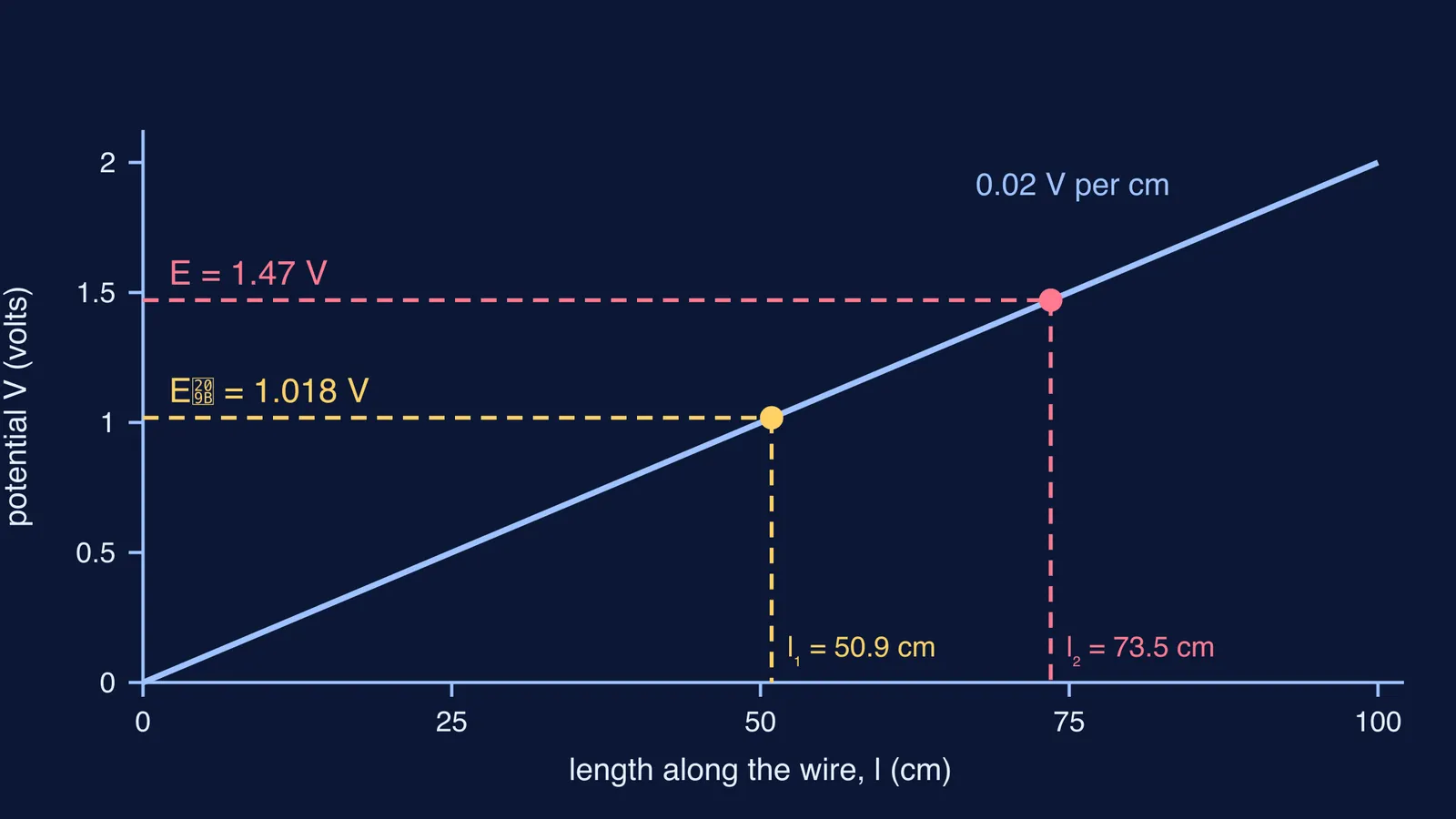
The school version turns "adjustable voltage" into "length of wire". A driver cell sends a steady current through a uniform wire, so the potential falls by the same amount for every centimetre. The voltage between end A and the jockey is k times l, where k is the potential gradient. Slide to where the galvanometer reads zero, and the cell's emf equals k times that balancing length.
You rarely know k directly, so you calibrate with a standard cell. For a Weston standard cell the reference value is 1.0183 volts (Wikipedia: Potentiometer)). The working formula is E = Es × l2 / l1, where l1 balances the standard cell and l2 balances the unknown one (TalTech). For the classic exam comparison, see how to compare the emf of two cells with a potentiometer.
Worked example: what emf does a 73.5 cm balance give?
A 100 cm wire carries a steady current from a driver cell. A Weston standard cell (1.0183 V, the value given by Wikipedia)) balances at l1 = 50.9 cm. Without touching the rheostat, you switch in a test cell, and it balances at l2 = 73.5 cm.
Potential gradient: k = 1.0183 / 50.9 = 0.0200 V per cm.
Emf of the test cell: E = k × l2 = 0.0200 × 73.5 = 1.47 V, the same as the ratio form 1.0183 × 73.5 / 50.9.
Range check: the whole wire drops 0.0200 × 100 = 2.00 V, so any cell above 2.00 V would find no balance point.
Precision: misreading the jockey by 1 mm (0.1 cm) shifts the answer by only 0.002 V.
Now put a voltmeter on the same cell. Suppose the cell has r = 2 Ω and the meter has 98 Ω. The current is 1.47 / 100 = 0.0147 A, and the meter shows 1.47 minus 0.0147 × 2, which is about 1.44 V. That 0.03 V gap is the error the null method avoids. There is a longer comparison in why a potentiometer measures emf better than a voltmeter.
If you want more balancing-length numericals with each step explained, the Fermi Problem Library has worked problems with a step-by-step solver that explains the reasoning rather than printing an answer.
What mistakes cost marks in potentiometer questions?
The driver cell's emf is smaller than the cell under test, so there is no null anywhere on the wire.
The positive terminals of the driver and the test cell are not joined to the same end, so the galvanometer never reaches zero.
The rheostat is moved between the two readings, which changes k and breaks the ratio.
Balancing lengths are measured from the wrong end of the wire.
The same balance also finds a cell's internal resistance: see how to find internal resistance with a potentiometer. If potential gradient itself still feels shaky, the Fermi Concept Library gives each physics concept its own lesson and its place in the map.