On this page
In 1774 a Swedish metallurgist heated a black mineral with charcoal and got manganese metal. That mineral, pyrolusite, is the manganese dioxide that potassium permanganate is still made from.
Who isolated manganese metal first?
Johan Gottlieb Gahn isolated manganese metal in 1774 by reducing manganese dioxide (the mineral pyrolusite) with charcoal, according to WebElements' history of manganese. The Royal Society of Chemistry's periodic table also names Gahn as the first to isolate the metal, while noting that Ignatius Kaim, a student in Vienna, had already described producing manganese metal in a 1771 dissertation.
Gahn (1745 to 1818) met Torbern Bergman and Carl Wilhelm Scheele while studying at Uppsala, then settled in Falun in 1770 and improved copper smelting there (Wikipedia's biography of Gahn). Scheele and others already knew that pyrolusite contained a new element (Wikipedia, Manganese: history). Scheele also used manganese dioxide to make chlorine, a story we tell in our profile of Carl Wilhelm Scheele and his pharmacy lab.
Two caveats: Gahn's sample was impure, and whether Kaim really reduced the dioxide to the metal is uncertain (same Wikipedia article). The fair answer: Scheele and his circle recognised the element; Gahn is usually credited with first isolating the metal.
What reaction did Gahn use to get manganese?
Gahn's charcoal was essentially carbon, heated with the dioxide (WebElements). One balanced way to write the reduction is:
MnO₂ + 2C → Mn + 2CO
You can balance it from oxidation numbers instead of by trial and error:
Assign oxidation numbers. In MnO₂ each oxygen is −2, so manganese is +4. Charcoal carbon is 0.
Manganese goes from +4 to 0: each Mn atom gains 4 electrons (reduced).
Carbon leaving as CO goes from 0 to +2: each C atom loses 2 electrons (oxidised).
Match electrons: 4 gained needs 2 × 2 lost, so two carbons per MnO₂.
Check atoms: each side has 1 Mn, 2 O and 2 C.
With carbon dioxide as the product, carbon goes from 0 to +4 and one carbon is enough: MnO₂ + C → Mn + CO₂. Whether carbon can reduce an oxide at all depends on temperature, which is what our guide on how to read an Ellingham diagram explains.
How does pyrolusite become KMnO4?
Gahn took manganese down from +4 to 0; industry takes it up to +7. Manganese dioxide is fused with potassium hydroxide and heated in air or with another source of oxygen, and the potassium manganate formed is then oxidised electrolytically (Wikipedia, Potassium permanganate):
2MnO₂ + 4KOH + O₂ → 2K₂MnO₄ + 2H₂O (manganese +4 to +6)
2K₂MnO₄ + 2H₂O → 2KMnO₄ + 2KOH + H₂ (manganese +6 to +7)
In acid, manganate can also disproportionate, with some manganese rising to +7 and some falling to +4: 3MnO₄²⁻ + 4H⁺ → 2MnO₄⁻ + MnO₂ + 2H₂O. Two manganese atoms each lose 1 electron, one gains 2, and the charge is −2 on both sides.
The colour change is old news: in 1659 Johann Rudolf Glauber fused pyrolusite with potassium carbonate and got a solution that turned green, then violet, then red (same source).
Why does manganese have so many oxidation states?
Manganese has the electron configuration [Ar]3d⁵4s², so it has seven electrons beyond the argon core (LibreTexts, Chemistry of Manganese). Using all seven in bonds to oxygen gives +7, the state in permanganate.
The RSC lists common oxidation states of 7, 6, 4, 3, 2, 0 and −1 for manganese (RSC periodic table). The most common are +2, +4 and +7, though states from −3 to +7 have been observed; Mn²⁺ is pale pink in water and the +7 permanganate ion intensely purple (Wikipedia, Manganese). Our post on colours of permanganate, manganate and MnO₂ goes through each one.
The ladder also explains KMnO4 titrations. In acid, MnO₄⁻ + 8H⁺ + 5e⁻ → Mn²⁺ + 4H₂O has a standard potential of +1.51 V (LibreTexts table of standard reduction potentials). In alkaline solution, MnO₄⁻ + 2H₂O + 3e⁻ → MnO₂ + 4OH⁻ has a standard potential of +0.60 V (same table). So permanganate takes 5 electrons in acid but 3 in neutral or alkaline solution: that is its n-factor.
How can you revise manganese in five minutes?
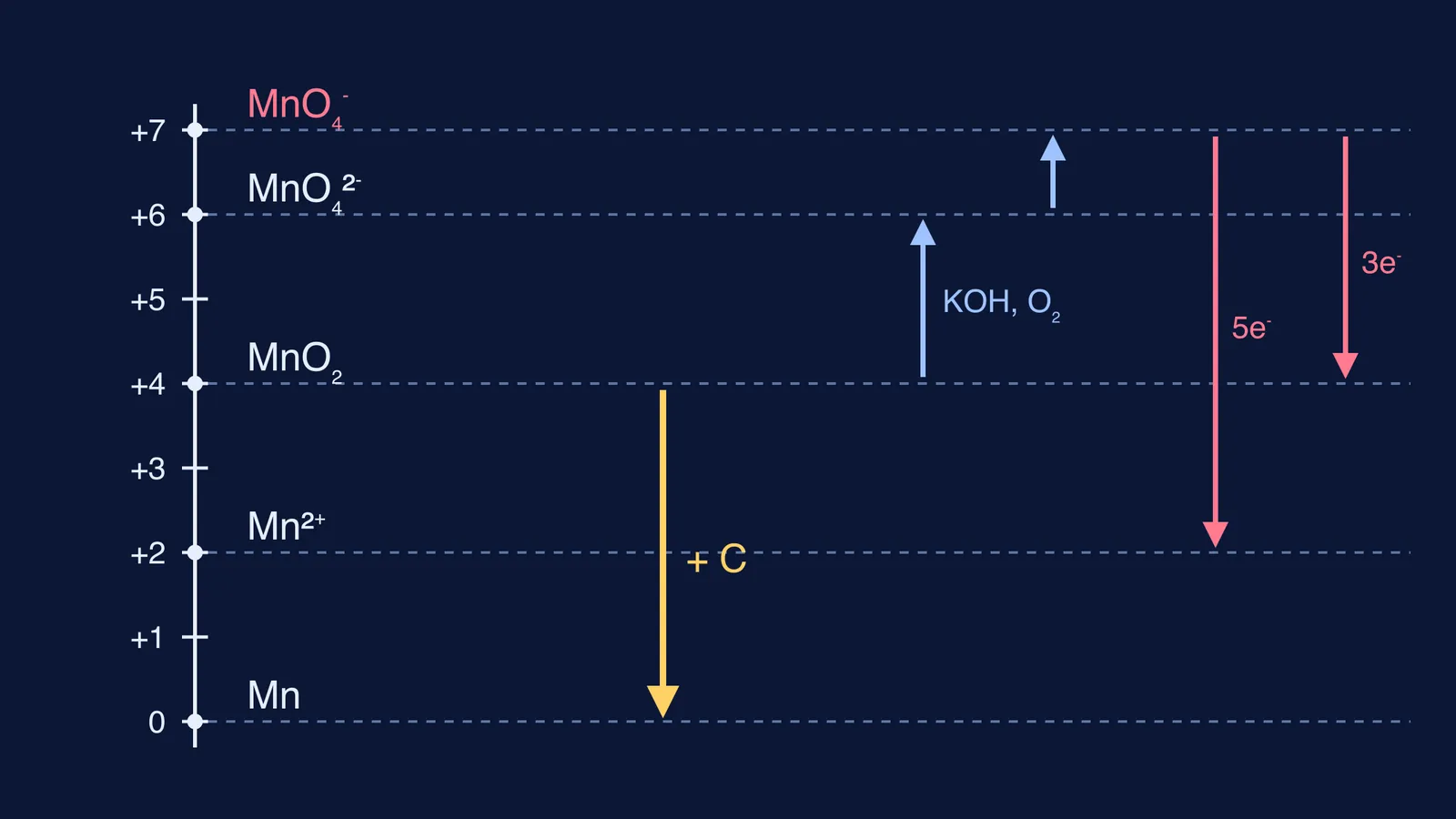
Redraw the ladder at the top of this post from memory:
Draw a line from 0 to +7; place Mn, Mn²⁺, MnO₂, MnO₄²⁻ and MnO₄⁻ on it.
Add Gahn's arrow from +4 down to 0, labelled + C.
Add the KMnO4 route: +4 to +6 with KOH and O₂, then +7 by electrolysis.
Add the titration arrows: +7 to +2 in acid, +7 to +4 in neutral or alkaline solution.
If a step will not balance, the Fermi Problem Library has worked problems with a step-by-step solver that explains the reasoning rather than printing an answer. For oxidation numbers, d-block configurations and electrode potentials, the Fermi Concept Library gives each concept its own lesson and its place in the map.
Next time you see a purple titration flask, remember it began as the black mineral Gahn heated with charcoal.