On this page
Joel Asaph Allen (1838–1921) was an American zoologist and, from 1885, curator of birds and mammals at the American Museum of Natural History in New York (biographical sketch by Charles H. Smith, Western Kentucky University). Here is the pattern he named, why the physics works, and how to use it in an answer.
What is Allen's rule?
Allen's rule says that warm-blooded animals living in colder climates tend to have shorter ears, limbs and tails than related animals living in warmer climates. Allen set it out in 1877 in a paper called The influence of physical conditions in the genesis of species, in the Radical Review, volume 1, pages 108–140, as cited in a 2008 PNAS study of the rule.
Two words matter. Related means you compare populations of one species, or close relatives, not an elephant with a mouse. Tend means it is a pattern, not a law every animal obeys. Allen's rule sits beside Bergmann's rule on body size and Gloger's rule on colour as one of the classic rules linking climate to how animals look.
Why do shorter ears and limbs save heat?
An animal makes heat throughout its body but loses it through its skin. Ears, legs and tails are thin, so each extra centimetre adds much skin and little body. A 2021 review in Trends in Ecology & Evolution notes that appendages such as mammal ears and bird beaks can be used to dissipate excess body heat (Ryding and colleagues, 2021). In hot places that extra skin works like a radiator. In cold places it is a leak, so shorter extremities keep more heat in.
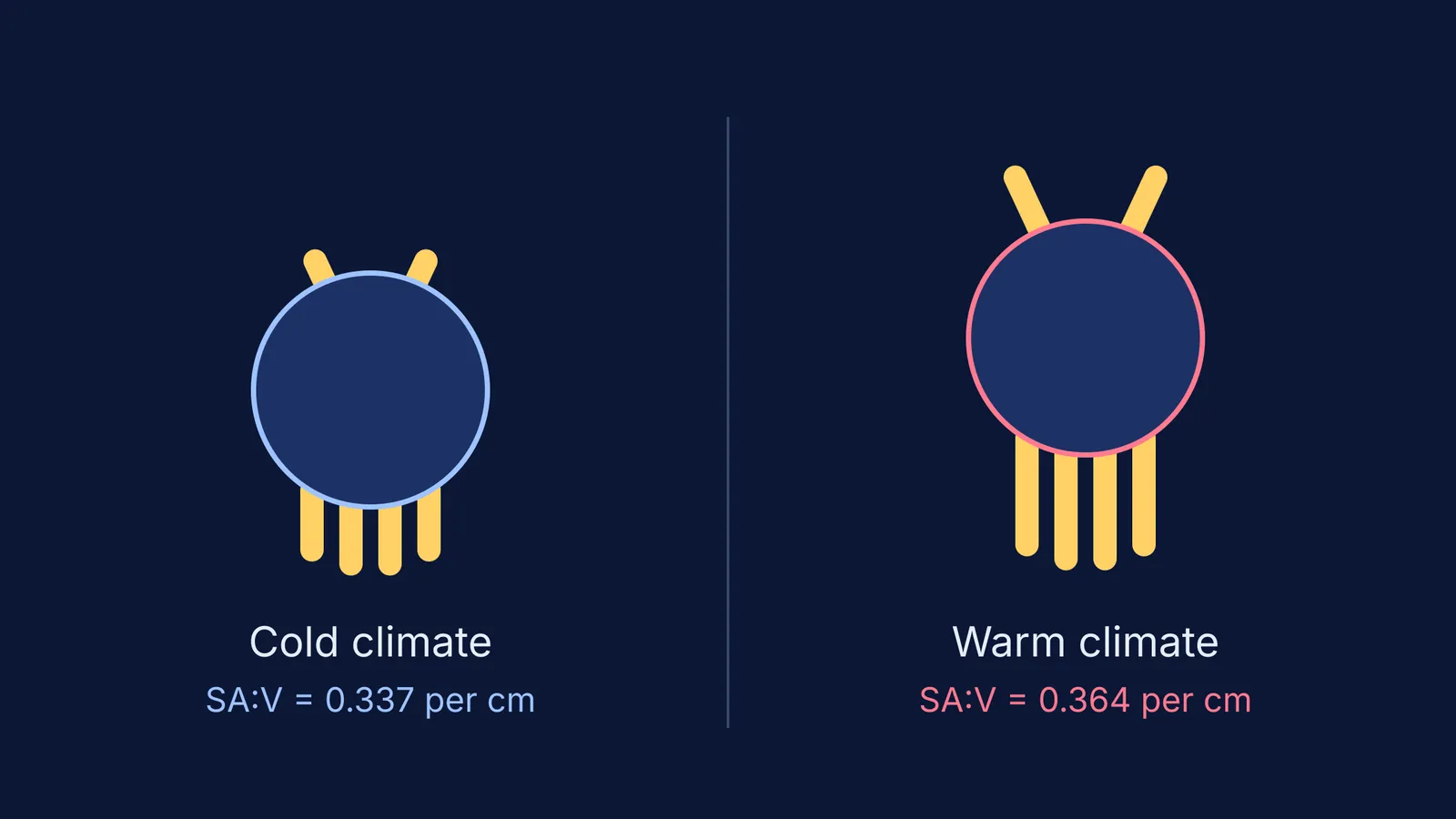
You can check this with a calculator. Picture a toy mammal: a spherical body of radius 10 cm, with four legs and two ears, each a cylinder of radius 1 cm. Count only the curved surface of each cylinder (2πrL) and its volume (πr²L). The sizes are made up to show the geometry.
Body alone: area 4πr² = 1,256.6 cm², volume (4/3)πr³ = 4,188.8 cm³.
Cold-climate version, legs 6 cm and ears 3 cm: 30 cm of appendage adds 188.5 cm² of skin and 94.2 cm³ of volume, so surface area to volume is 1,445.1 ÷ 4,283.0 = 0.337 per cm.
Warm-climate version, legs 10 cm and ears 6 cm: 52 cm of appendage adds 326.7 cm² of skin and 163.4 cm³ of volume, so the ratio is 1,583.4 ÷ 4,352.2 = 0.364 per cm.
Compare: the long-limbed version has under 2% more volume but almost 10% more skin.
If every square centimetre of skin loses heat at the same rate in the same cold air, the long-limbed animal loses nearly 10% more heat while having almost the same body to keep warm.
Has anyone tested Allen's rule?
Yes. In a 2008 experiment, Maria Serrat, Donna King and C. Owen Lovejoy raised 95 male mice from weaning to maturity at 7°C, 21°C or 27°C (PNAS, 2008). The ears, limbs and tails of the warm-reared mice were significantly longer than those of siblings raised in the cold, while body mass stayed similar across the groups. Bones grown in dishes with no blood supply still grew longer when warmer, suggesting temperature acts directly on growing cartilage.
The 2021 review by Sara Ryding and colleagues found widespread evidence of shape-shifting, changes in appendage size, in warm-blooded animals as the climate warms (abstract, Trends in Ecology & Evolution). Reporting on the study, KPBS noted that certain Australian parrots have shown about a 4% to 10% increase in bill size since 1871. Ryding, a researcher at Deakin University in Australia, added a warning: “Shapeshifting does not mean that animals are coping with climate change and that all is ‘fine.’”
Is Allen's rule still in NCERT Class 12 Biology?
Not in the current book. The 2026–27 reprint of NCERT Class 12 Biology, Chapter 11, Organisms and Populations opens straight with populations and does not mention Allen's rule or have a section on adaptations. Some older guides and question banks may still include it, so check with your teacher whether your board or school exam covers it before you spend revision time on it.
How do you write Allen's rule in an exam answer?
Use this four-line frame for a short answer:
Statement: warm-blooded animals in colder climates tend to have shorter ears, limbs and tails than related animals in warmer climates.
Reason: shorter extremities mean less surface area per unit volume, so less body heat is lost.
Evidence: mice raised at 7°C grew shorter ears, limbs and tails than siblings raised at 27°C (Serrat and colleagues, PNAS 2008).
Contrast: in hot climates, longer ears and limbs help shed heat.
Bergmann's rule is about overall body size and Allen's rule about the extremities; both rest on the same surface-to-volume idea. For animals built for cold and for heat, see how polar bears and camels adapt to their extreme habitats.
If surface area to volume itself feels shaky, the Fermi Concept Library gives each concept its own lesson, so you can fix the geometry first. Fermi's AI tutor can work through the toy-mammal calculation with you, checking understanding as it goes.