

On this page
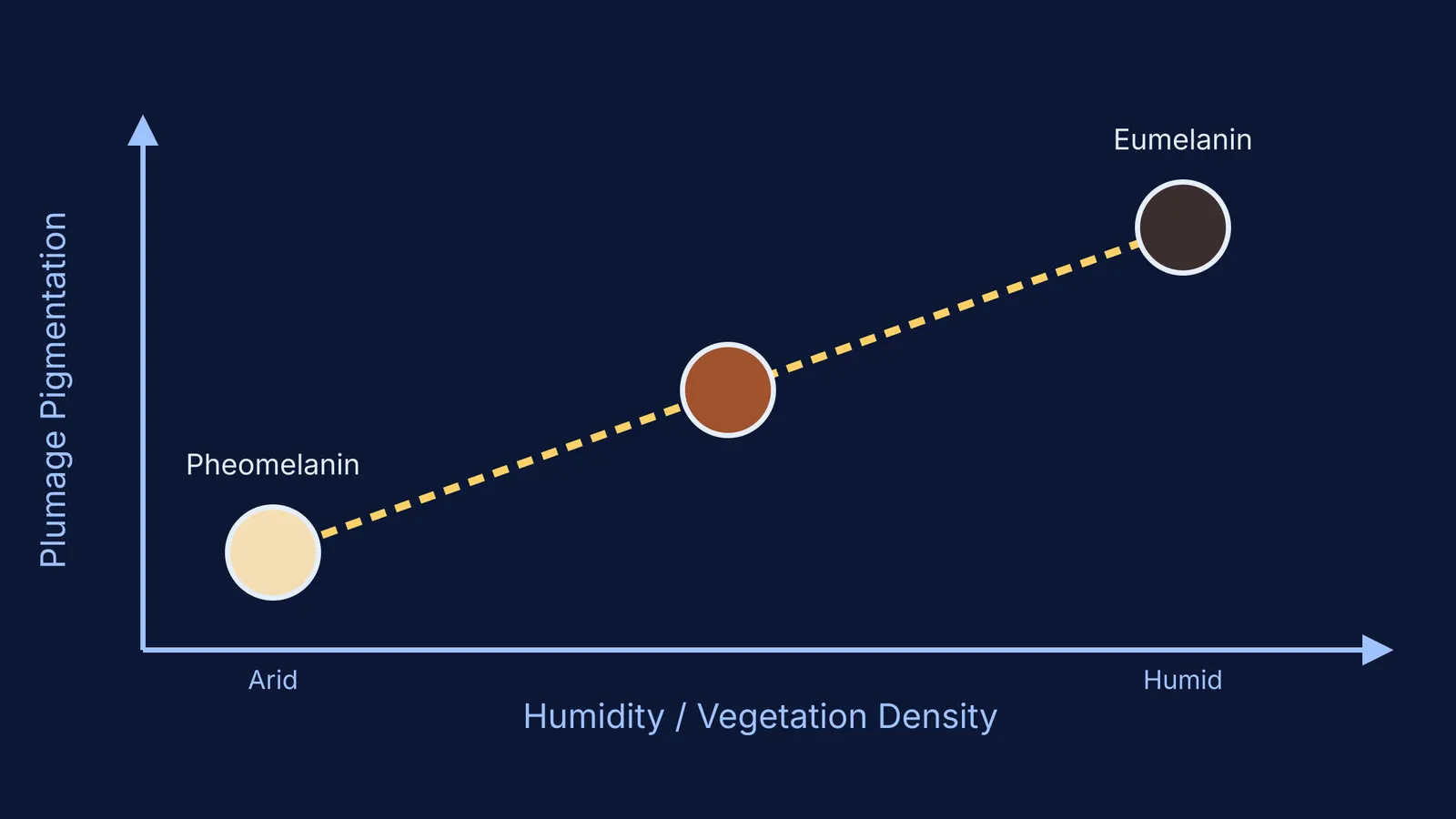
If you look closely at animal populations across a large continent, you will notice a gradient in their colours. Animals in the desert are often pale, sandy or reddish, while their relatives living in dense, wet forests are typically dark brown or black.
This is not a coincidence. It is an ecogeographical rule — a broad pattern linking the physical traits of a species to its environment.
What did Constantin Gloger observe?
The German zoologist Constantin Wilhelm Lambert Gloger was among the first to formally document this pattern. In 1833, he published a review of how climate affects the plumage of birds, noting that bird populations in humid habitats are consistently darker than those in dry ones.
He found that birds in hot, wet regions deposit more eumelanin, the pigment responsible for black and dark brown colours. Conversely, birds in arid, dry environments produce more pheomelanin, which creates reddish, sandy and yellow tones, or they lack pigment entirely.
This observation became known as Gloger's rule. Alongside Bergmann's rule (which states that animals are larger in cold climates to conserve heat) and Allen's rule (which states that animals have shorter limbs and ears in cold climates to prevent heat loss), it remains one of the classic principles of biogeography. These rules help explain how environments shape the evolution of species over thousands of years.
Why does climate affect animal colour?
For decades, biologists assumed the rule was entirely about camouflage. Wet, humid environments support dense vegetation, creating a dark landscape of shadows, dense canopy cover, and rich, damp soils. In these deep forests, dark animals blend into the background, making them harder for predators to spot. Arid environments, by contrast, are open, sandy and bright. In the desert, a dark animal stands out clearly against the pale sand, whereas a sandy-coloured animal can easily hide. You can see similar survival adaptations in Henry Walter Bates and the butterflies that copy others.
However, modern research points to a second, entirely different advantage: resisting disease and physical wear. Humid environments are highly active breeding grounds for bacteria and fungi. This includes specific microbial strains, such as *Bacillus licheniformis*, that break down the keratin found in hair and feathers. Dark pigments do more than change colour; they physically bind to the keratin structure, making feathers significantly tougher. This structural strength makes eumelanin-rich feathers far more resistant to feather-degrading bacteria. A dark bird in a wet jungle is not just hiding in the shadows; it is wearing chemical armour against infections that thrive in the damp.
Does Gloger's rule apply to other animals?
While originally formulated for birds and mammals (think of the dark fur of jungle-dwelling primates compared to the pale fur of desert foxes), the rule is continually tested across the animal kingdom. These tests often reveal new layers of complexity depending on the local climate.
When ecologists tested the rule against 551 species of Australian landbirds, they found that darker birds indeed live in wetter and more densely vegetated habitats. Interestingly, they also found darker birds in *colder* regions — the exact opposite of the temperature pattern Gloger expected. This suggests that in some climates, dark feathers might also help Australian birds absorb and retain the sun's heat.
The rule has also been robustly tested in insects. A massive 2026 study analysed images of 10,400 ant species worldwide to see if macroecological rules held true for invertebrates. The researchers found that ant assemblages were darker in regions with high UV-B radiation and low dry-season precipitation. For ants, high levels of melanin likely serve a dual purpose: protecting their bodies against intense sun damage and strengthening their exoskeletons to prevent them from drying out during droughts.
How to study evolutionary rules
In biology exams, questions rarely ask you to recite isolated facts. Instead, they often test your ability to link an environmental pressure to a specific physical adaptation. This is exactly the logic behind stabilising, directional and disruptive selection: understanding how the environment pushes a physical trait in a specific evolutionary direction over time.
If you struggle to connect these ecological concepts, the Concept Library maps out exactly how topics like natural selection, environmental drivers and genetics fit together. When you want to check if you have really understood the mechanism behind an adaptation, Fermi's AI tutor can work through examples with you. The tutor teaches rather than answers: it holds a line of reasoning, notices where you might be stuck, and decides whether to explain, ask, or show, checking your understanding as it goes.
Understanding Gloger's rule reminds us that every detail of an animal, right down to the specific shade of its feathers or fur, is a living record of the climate it evolved to survive in.


