

On this page
When you see "1 hp" on a water pump, you are reading an 18th-century sales pitch. James Watt (1736 to 1819), the Scottish engineer who improved the steam engine, needed a way to tell mine and mill owners how many horses one of his engines could replace. So he measured horses. A century later, the unit of power was named after him.
Why is horsepower called horsepower?
Because the engines Watt sold were competing with horses, not with each other. According to the history summarised on Wikipedia's horsepower page, Thomas Savery had already compared engines with horses in his 1702 book The Miner's Friend, and Watt later used the idea to market his improved engines. Watt had agreed to take royalties of one-third of the coal his engines saved compared with older Newcomen engines, but that scheme did not work for customers who used horses instead.
The older engines he was improving are described in our post on how Thomas Newcomen's 1712 atmospheric engine worked. Watt improved on them, but many buyers still thought in horses.
That definition is how the 1911 Encyclopaedia Britannica entry on horse-power states it. The same entry notes that, as Watt was aware, it is more than an average horse can keep up over a full day's work, and gives one horsepower as 746 watts.
How did James Watt calculate one horsepower?
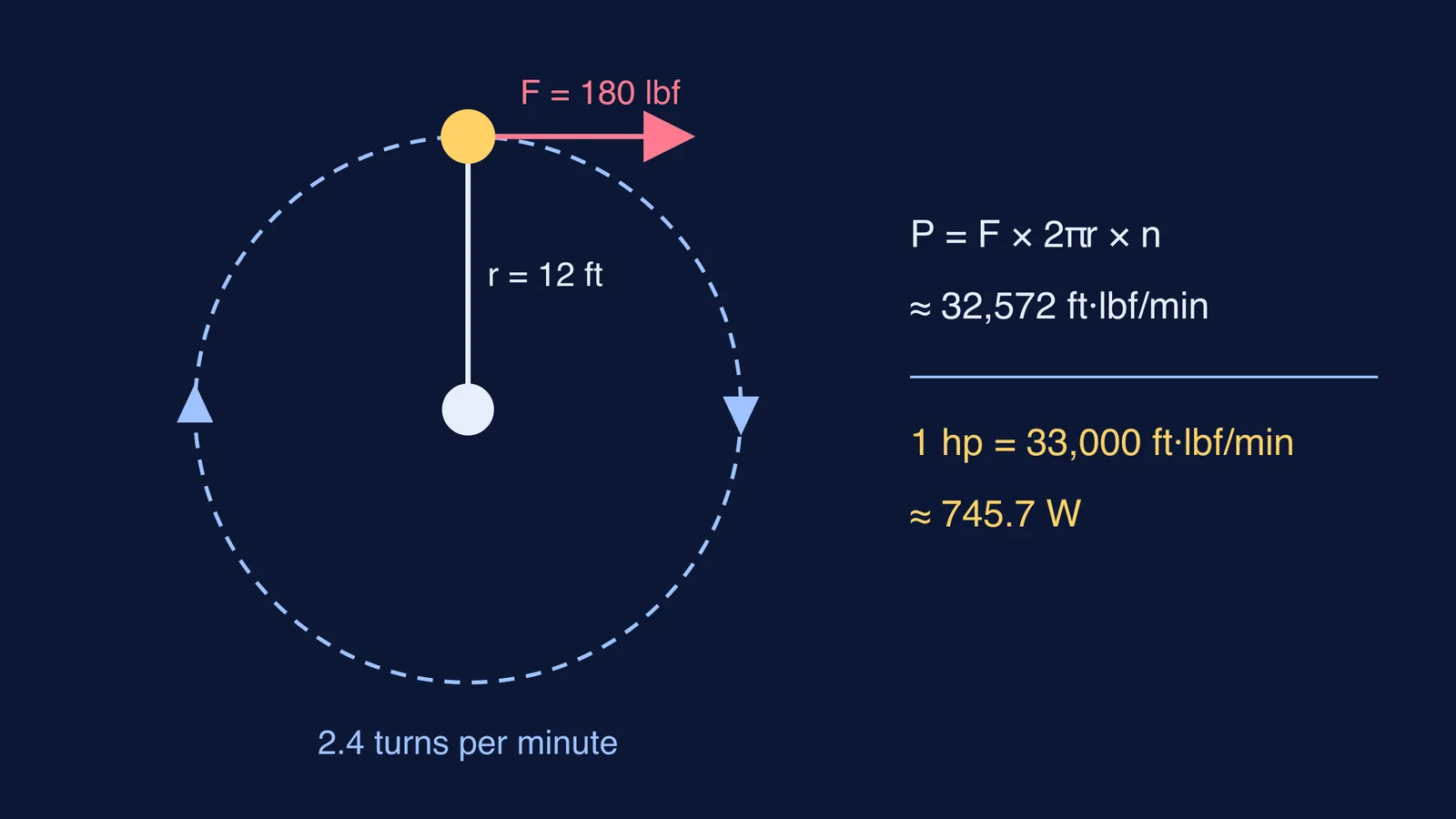
The calculation most often told, set out on Wikipedia's horsepower page, uses a horse turning a mill. The horse is harnessed to a beam and walks in a circle around the central shaft.
Radius of the circle: 12 feet (a 24-foot diameter)
Turns: 144 an hour, which is 2.4 turns a minute
Pull: Watt judged the horse pulled with 180 pounds-force
Power is work divided by time, and work is force times distance. In one minute the horse walks 2.4 × 2π × 12 feet, about 181 feet. Multiply by 180 pounds-force and you get about 32,572 foot-pounds per minute. The figure that became the standard was a little higher: 33,000 foot-pounds per minute.
Accounts differ in the details: the same page also cites a 1782 experiment with a "brewery horse" that gave 32,400 foot-pounds per minute, which Watt and his partner Matthew Boulton standardised at 33,000 the following year.
Why is the unit of power called the watt?
The name came from an engineer, not from Watt himself. In his 1882 presidential address to the British Association for the Advancement of Science, printed in Popular Science Monthly, C. William Siemens proposed a new unit for "the power conveyed by a current of an Ampère through the difference of potential of a Volt".
He wrote that it "might be appropriately called a Watt, in honor of that master-mind in mechanical science, James Watt", and added that "a horse-power is 746 Watts".
The history on Wikipedia's watt page records the later steps: an international conference in London accepted Siemens' definition in 1908, the watt was redefined in 1948 in absolute terms as one joule per second, and the 11th General Conference on Weights and Measures adopted it into the SI in 1960. Today the watt is the SI unit of power, equal to one joule per second.
How do you convert horsepower to watts yourself?
You do not need to memorise 745.7. You can rebuild it from Watt's definition in four lines.
Start with 33,000 foot-pounds per minute.
Divide by 60 to get 550 foot-pounds per second.
Convert units: 1 foot is 0.3048 m and 1 pound-force is about 4.448 N, so 550 × 0.3048 × 4.448 is about 745.7 N m per second.
A newton metre per second is a joule per second, which is a watt.
The NIST conversion table gives 1 horsepower (550 ft lbf/s) as 745.6999 W and the metric horsepower as 735.4988 W. So metric and imperial horsepower are not quite the same.
Now try it on yourself. Suppose you weigh 50 kg and run up a 3 m flight of stairs in 4 seconds. Your power is mgh/t = 50 × 9.8 × 3 ÷ 4, about 368 W, or roughly half a horsepower. Our post on how much power you use climbing stairs goes further with this one.
What should you remember for exams?
Power = work ÷ time = force × velocity.
1 hp is about 746 W (NIST); read the question for the value it wants you to use.
A kilowatt measures power; a kilowatt-hour measures energy.
Units first: convert hp, minutes and grams before you substitute.
For more practice, work through our step-by-step guide to horsepower to watts power numericals. If you get the right formula but the wrong answer, the Fermi Problem Library has worked problems with a step-by-step solver that explains the reasoning rather than printing an answer, so you can see exactly where a unit slipped.


