

On this page
In October 1988, the Belgian mathematician Ingrid Daubechies published an 88-page paper in *Communications on Pure and Applied Mathematics* called Orthonormal bases of compactly supported wavelets. It gave engineers short, smooth building blocks that take a sound or an image apart and put it back together exactly.
What is a wavelet, in plain words?
The older idea, from Fourier, is that any signal is a sum of sine waves, and the 1965 Fast Fourier Transform made that fast to compute. The catch is that a sine wave runs on forever, so one sharp jump in one place has to be described by every sine wave in the sum.
A wavelet is a short wave that rises, wiggles and dies away. You slide it along the signal, stretch or squeeze it, and measure how well it matches at each place and size. Big matches mark where something is happening.
Daubechies's paper, according to its abstract, constructs "orthonormal bases of compactly supported wavelets, with arbitrarily high regularity". In plain words:
Compactly supported: each wavelet is exactly zero outside a short interval, so it only ever looks at a small piece of the signal.
Regularity: how smooth the wavelet is. The paper shows smoothness grows in step with the width of that interval.
Orthonormal basis: the pieces do not repeat each other's information, so the signal can be rebuilt exactly.
How did wavelets change image compression?
A photo is mostly smooth regions broken by sharp edges. Wavelet coefficients are close to zero over smooth regions and large near edges, so compression becomes: keep the large coefficients, round or drop the small ones.
The original JPEG standard of 1992 uses a DCT, a cosine-based transform. JPEG 2000, first published in 2001, supports lossy and lossless coding and "resolution and quality scalability": the image is stored as a coarse version plus layers of detail, so a viewer can stop at a preview or go to full size.
In 1992, Daubechies, A. Cohen and J.-C. Feauveau published symmetric biorthogonal wavelets, which take a signal apart with one set of filters and rebuild it with a matched second set. The Wolf Foundation states: "Her biorthogonal wavelets became the basis for the JPEG 2000 image compression and coding system." A student project hosted by Grand Valley State University names JPEG 2000's default lossy transform the "biorthogonal Daubechies 9-tap/7-tap filter", with a Le Gall 5/3 filter for lossless coding.
How does a wavelet compress a row of pixels?
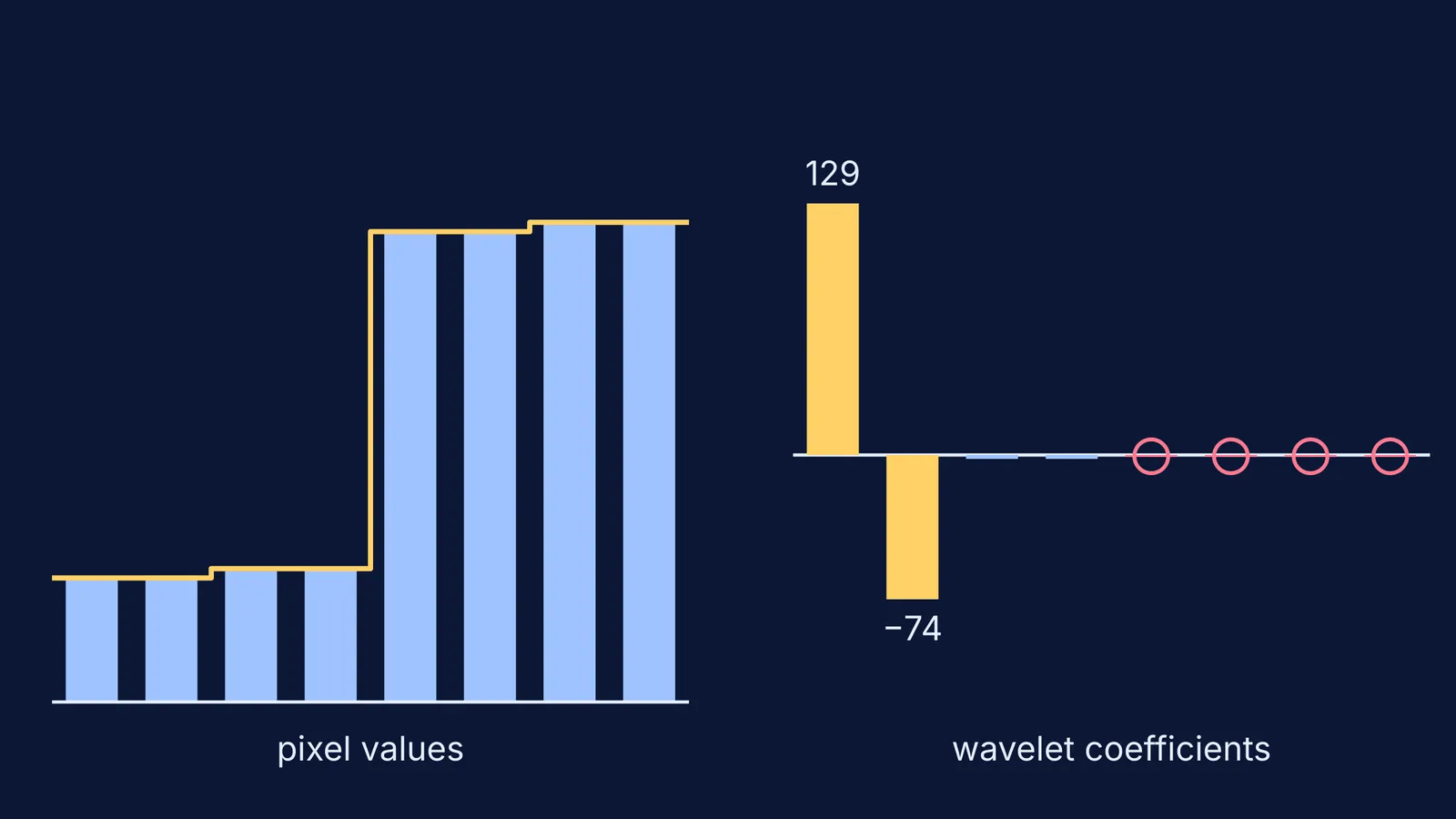
You can see the idea with the simplest wavelet, which just averages and differences pairs. Take one row of eight brightness values with a dark-to-bright edge in the middle: 52, 54, 56, 58, 200, 202, 204, 206.
Pair them up. For each pair, write the average and the half-difference (first minus second, divided by 2). Averages: 53, 57, 201, 205. Details: -1, -1, -1, -1.
Repeat on the averages. Averages: 55, 203. Details: -2, -2.
Repeat once more. Average: 129. Detail: -74.
You now hold eight numbers: 129, -74, -2, -2, -1, -1, -1, -1. Nothing is lost yet; reversing the steps (average plus detail, average minus detail) gives the original row.
Compress: set the four smallest details to zero and rebuild. You get 53, 53, 57, 57, 201, 201, 205, 205. Every pixel is within 1 of the original, and you stored four meaningful numbers instead of eight.
Notice where the big number sits: the -74 records the edge, while the smooth stretches cost almost nothing. Daubechies's smoother wavelets apply the same idea to real photos, using longer, smoother pieces in place of these flat steps.
Where else are Daubechies wavelets used?
The Wolf Foundation awarded her the 2023 Wolf Prize in Mathematics "for work in wavelet theory and applied harmonic analysis", and lists uses in image compression, medical imaging, remote sensing and digital photography, as well as work in art and evolutionary biology. According to ICIAM, she took her first degree in physics in Brussels in 1975 and is at Duke University. The International Mathematical Union notes she served as its President.
For the steps before hers, read how Harry Nyquist found the sampling rate for digital audio and how Steven Sasson built the first digital camera.
What can a student take from this?
Wavelets rest on Class 11 and 12 ideas: functions, waves and vectors. A route that works:
Get comfortable with sine waves and superposition from your waves chapter.
Learn what a basis is: any vector is a sum of a few fixed directions. A wavelet basis is the same idea for signals.
Do the example above on paper until it feels obvious, then read about smoother wavelets, asking "what does each coefficient measure?"
If superposition or vectors feel shaky, the Fermi Concept Library has every concept in physics and mathematics with its own lesson and its place in the map, so you can fill the gap before moving on. For waves, the Fermi Simulation Lab has interactive simulations for the ideas that are easier to see than to read.


