On this page
Every day, countless digital photographs are taken and shared instantly. We are so accustomed to the immediate capture of light that it is hard to imagine a time when digital memory was profoundly slow. But the very first digital image required immense patience.
When was the first digital camera invented?
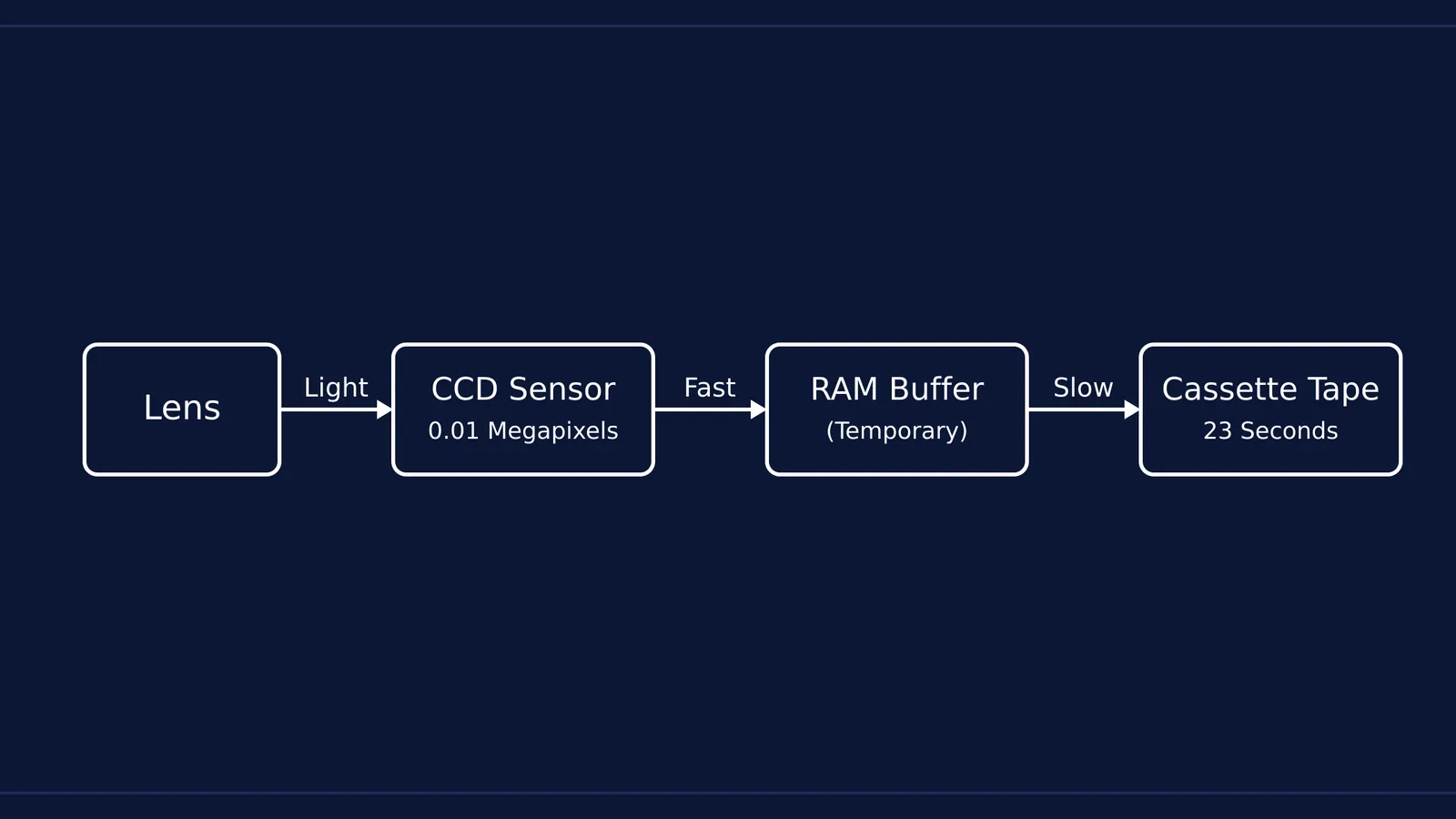
In 1975, an electrical engineer named Steven Sasson developed the first portable, battery-operated digital camera at Eastman Kodak Wikipedia. His prototype weighed exactly 8 pounds Wikipedia. It used a Fairchild charge-coupled device (CCD) image sensor. This early sensor had a resolution of just 100 by 100 pixels, which translates to a mere 0.01 megapixels Wikipedia.
As a true self-contained unit, the device captured black-and-white images and recorded them directly onto a standard digital cassette tape. While Sasson had originally envisioned a camera without any mechanical moving parts, the necessity of the tape drive meant his final prototype did have some mechanical components.
How did Steven Sasson's 1975 camera work?
The most defining feature of Sasson's camera was its speed—or lack thereof. It took exactly 23 seconds to record a single image onto the cassette tape Wikipedia.
To make this possible, the camera relied on a clever data-management system. Sasson and his co-inventor Gareth Lloyd filed U.S. patent 4,131,919 for an "electronic still camera" that solved a crucial bottleneck Wikipedia. The cassette tape was too slow to capture the image data directly from the CCD sensor in real time. Instead, the analog signal was digitized and read rapidly into a temporary buffer of random-access memory (RAM). From this fast RAM buffer, the data could then be written out at the much slower speed dictated by the cassette tape.
This architectural principle of a fast temporary buffer pairing with slower, permanent storage remains fundamental in computer science, echoing the earlier logic seen in machines like Konrad Zuse and the Z3: a programmable computer built from relays and later interface milestones like Douglas Engelbart and the computer mouse: how a pointer finds x and y.
What can students learn from the 23-second buffer?
When studying complex subjects like physics or mathematics, students often become frustrated if they do not understand a new concept instantly. However, human memory works much like Sasson’s camera architecture: your brain acts as a fast buffer (working memory) that needs focused time to encode information into slow storage (long-term memory).
You can apply a practical "23-Second Framework" for active learning when you encounter a difficult problem:
Read and buffer: Read the question carefully and hold the parameters in your working memory.
Pause for 23 seconds: Do not rush immediately to a formula or calculator. Take 23 seconds to sketch a diagram, identify the core principle, and let your brain process the setup.
Write to memory: Write down the clear steps of your reasoning.
If you find yourself stuck during this encoding phase, Fermi's AI tutor can help. It works out what you already know, builds a plan for the session, and teaches through it—drawing the figure and checking understanding as it goes. Rather than simply giving you the final answer, it holds a line of reasoning across a whole session and decides whether to explain, ask, or show.
Furthermore, if the ideas you are trying to encode are abstract, the Fermi Simulation Lab offers interactive simulations for the ideas that are easier to see than to read. Taking the time to observe and process, much like waiting for that first digital image to write to tape, is what ultimately solidifies your knowledge.